Quick Answer
Blackout curtains can support a better sleep environment by reducing outdoor light that reaches a guest room. For a B2B project, fabric opacity is only part of the specification. Buyers should combine a fully opaque panel with correct finished width, center overlap, side returns, floor-to-ceiling coverage, and a compatible track, then approve a daylight room mock-up before bulk production. This is how hotels and apartments avoid visible light gaps, guest complaints, and repeat installation work.
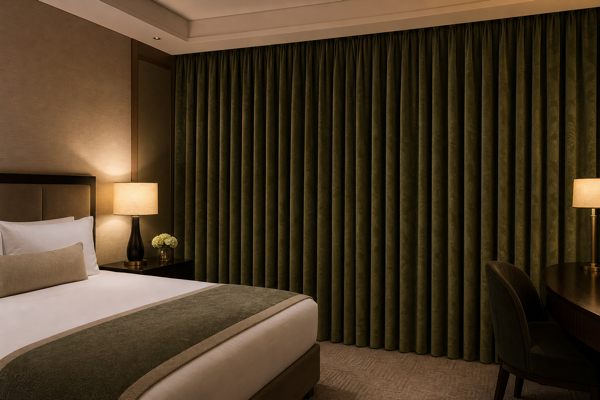
A hotel can approve a perfectly opaque fabric and still end up with a bright line at 6 a.m. The fabric passes. The room fails.
This usually happens because the purchase order describes a textile, not a finished window. It may say "blackout fabric, dark grey, custom size" but say nothing about the track position, center overlap, side return, top coverage, or the relationship between the curtain and the sill.
One failed room is an adjustment. The same detail repeated across 200 rooms becomes a project cost. The buyer faces guest complaints, installer call-backs, replacement components, delayed handover, and an uncomfortable question: who owns the problem?
The pain point is not always the fabric
"Blackout" is often treated as a single material property. In a real room, darkness is the result of a system.
Light can enter through a center opening, the sides of the curtain, the top of the track, or an incorrect bottom clearance. A panel can also be too narrow to hold its intended fullness after installation. None of these problems will appear in a small fabric swatch.
This distinction matters during procurement:
- Fabric performance asks whether visible light passes through the curtain panel.
- Room performance asks whether visible light reaches the occupied room after the curtain, track, dimensions, and installation are complete.
ShadeCort true blackout fabric is designed so visible light does not pass through the panel. To deliver the same result at the window, the panel dimensions, overlap, returns, track, and installation details need to be coordinated as one system.
Why room darkness belongs in the sleep conversation
Blackout curtains are not a medical treatment. They are an environmental control that can reduce unwanted light during the sleep period.
Verywell Health explains that bright light at night can suppress melatonin and recommends a pitch-dark bedroom, noting that blackout curtains or blinds may help create a darker sleep environment. The article also makes an important distinction: reported health links are associations, and more research is needed.
TIME reported on a large observational study involving nearly 90,000 people. Greater nighttime light exposure was associated with higher cardiovascular risk. The study does not prove that light caused those outcomes, but it adds weight to a practical point for hospitality projects: controlling bedroom light is part of creating a sleep-supportive room.
Product testing also shows why the label alone is not enough. Better Homes & Gardens tested 11 blackout curtains over six months and found meaningful differences in the amount of light blocked. Size, material, panel count, and hanging method all affected the result. Some products blocked only 70 to 90 percent of light, while the strongest performer blocked the bedroom light and prevented slivers between panels.
For a hotel guest, the problem is simpler than the research language: a bright room can wake them earlier than planned. For the buyer, the solution is to turn "blackout" into an inspectable room requirement.
What to put in a B2B blackout curtain specification
The table below is a procurement checklist, not a universal set of dimensions. Window construction, room design, local regulations, and the selected track determine the final values. Approve them in a representative room before releasing the bulk order.
| Item | What to specify | Why it matters | Approval evidence |
|---|---|---|---|
| Fabric performance | True blackout construction, color, face and back appearance, weight, and required test method | Confirms that visible light does not pass through the panel | Approved swatch, test report, and sealed sample |
| Finished curtain width | Finished width per opening and required fullness | A narrow panel can pull open at the center or sides | Window schedule and measured sample |
| Center closure | Panel overlap or overlap carrier where two panels meet | Prevents a vertical line of light between panels | Closed-curtain daylight inspection |
| Side coverage | Return depth or another project-specific side detail | Reduces light entering between the curtain edge and wall | Section drawing and room mock-up |
| Top coverage | Track position, ceiling condition, pelmet or pocket detail | Controls light above the heading and prevents clashes | Reflected ceiling plan and site photo |
| Bottom condition | Floor, sill, or recess relationship and final clearance | Avoids an exposed strip while allowing clean operation | Site measurement and installed sample |
| Track and carriers | Track type, mounting method, carrier spacing, draw direction, and manual or motorized operation | Keeps the curtain aligned and closing consistently | Hardware sample and functional test |
| Compliance | Target market, fire performance, labeling, and project documentation | Prevents approval delays and unsuitable substitutions | Current reports for the selected material |
| Mock-up | One representative room tested in daylight and in the operating mode guests will use | Reveals gaps that a swatch and drawing cannot show | Signed room approval with photos |
| Bulk quality control | Agreed checks for dimensions, shade, sewing, labels, packing, and hardware | Keeps the approved result consistent across the room count | Inspection standard and batch records |
A better approval process for hotels and apartments
The costliest decisions are often made before the factory sees a complete window schedule. A more reliable process is straightforward.
1. Define the room outcome
State that the finished window must show no visible light through the curtain fabric and no visible gaps when the system is correctly closed. Identify the inspection conditions. A daytime mock-up is usually more revealing than a sample viewed under office lighting.
2. Share the window information early
Provide opening dimensions, ceiling height, wall and sill details, track recesses, room drawings, operating direction, and any motorization requirement. Photos of a typical opening help expose conditions that are missing from drawings.
3. Match the curtain and track
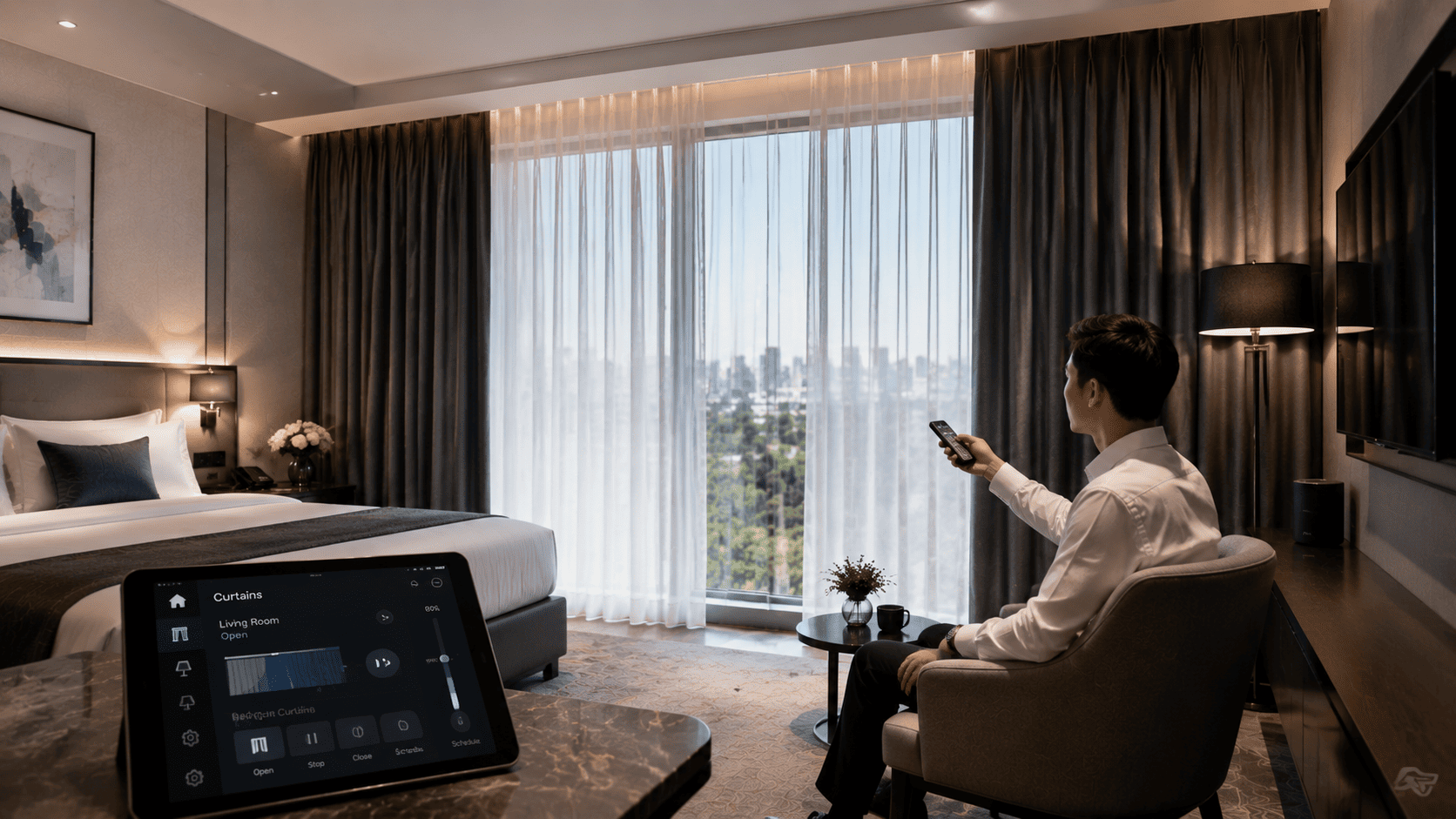
Treat the panels and track as connected components. The heading must suit the carriers. The stack space must suit the window. Center closure and side coverage must still work after the curtain is dressed and operated repeatedly. Projects that require scheduled or group operation should also coordinate the curtain specification with the selected motorized curtain system.
4. Approve one real room
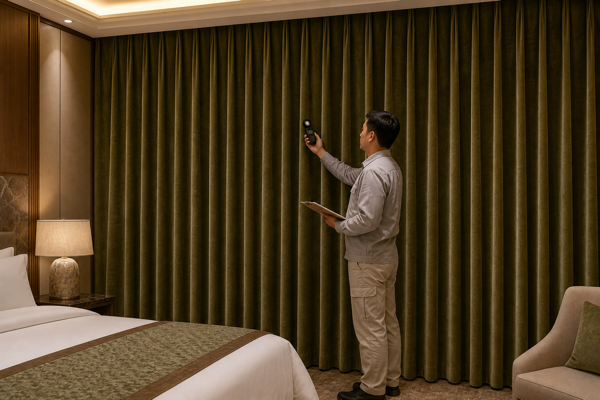
Install a production-representative curtain and track in a typical room. Close it as a guest would, then inspect the center, sides, top, and bottom in daylight. Record any adjustment in the approved specification rather than relying on verbal instructions.
5. Lock the bulk standard
The sealed fabric, final dimensions, sewing details, hardware, labels, packing method, and room mock-up should point to the same approved version. This gives the factory, buyer, and installer one reference when questions arise.
Common buying mistakes that create rework
Buying a blackout percentage without defining the test
A number is not useful unless the buyer knows what was tested, how it was tested, and whether the result applies to the selected color and construction. Ask for the relevant report and keep an approved sample.
Buyers who are still comparing product categories can first review the practical differences between room darkening blinds and blackout shades.
Approving only a fabric swatch
A swatch can confirm hand feel, color, and panel opacity. It cannot confirm the center closure, side coverage, track position, or bottom clearance. Add a finished sample and room mock-up to the approval path.
Leaving measurements to separate parties
When the buyer, factory, and installer work from different assumptions, gaps appear at the window. Use one window schedule with a clear revision number and named approval owner.
Treating installation as a final detail
Track position can determine whether a blackout curtain succeeds. Confirm fixing conditions and any pelmet, pocket, or motor before production, especially where the ceiling design is already complete.
How ShadeCort can support a project
ShadeCort custom fabric drapery is available for B2B blackout curtain, track, and motorized window treatment projects. The useful starting point is not a request for the lowest unit price. It is a short project pack that allows the factory to check whether the proposed system can produce the required room result.
Send the following information with your inquiry:
- Window schedule and typical opening dimensions
- Room drawings or clear site photos
- Curtain style, color direction, and operating method
- Target country and required compliance documents
- Estimated room count, quantity, and delivery program
- Mock-up and inspection requirements
With that information, ShadeCort can prepare a project-specific fabric and track proposal, sample plan, and mock-up checklist before bulk production. Contact the ShadeCort project team, request curtain samples, or email info@shadecortresources.com to discuss the window schedule.
Before you release the bulk order
Ask one final question: has the team approved a dark fabric, or a dark room?
For a hotel, serviced apartment, student residence, or other sleep-focused project, the room is what the guest experiences. Put the room outcome in the specification, prove it in daylight, and carry that approved detail into production and installation.
Sources and further reading
- Verywell Health: Getting Too Much Bright Light at Night May Increase Your Cancer Risks. Here's Why
- TIME: Your Bedroom Probably Isn't Dark Enough
- Better Homes & Gardens: The 9 Best Blackout Curtains, According to Testing
FAQ
Do blackout curtains really help with sleep?
Blackout curtains can support sleep by reducing outdoor light that reaches the bedroom. A darker room may help protect the nighttime environment from streetlights, early sunrise, signage, and corridor light. Curtains are an environmental control, not a treatment for insomnia or another medical condition.
Why do some blackout curtains still let light in?
The fabric may block light while the finished window has gaps at the center, sides, top, or bottom. Incorrect width, limited overlap, shallow side coverage, and track placement are common causes. Buyers should approve the complete curtain and track system in a daylight room mock-up.
What should a hotel buyer include in a blackout curtain specification?
Include fabric performance, finished dimensions, fullness, center closure, side returns, top and bottom conditions, track type, mounting details, operating method, compliance documents, mock-up criteria, and bulk inspection requirements. The final values should match the actual window and room design.
Does blackout fabric have to be black?
No. Blackout describes light-blocking performance, not the face color. The selected construction can be produced in different decorative colors, although buyers should approve the exact color and construction together because appearance and performance can vary by product.
How should buyers verify blackout performance before bulk production?
Review the relevant material report, seal an approved fabric sample, and install a production-representative curtain and track in a typical room. Inspect it in daylight while fully closed. Record the approved dimensions, overlap, returns, track position, sewing details, and hardware for bulk quality control.
Can ShadeCort supply OEM or ODM blackout curtain systems?
Yes. ShadeCort supports B2B custom curtain projects, including blackout curtains, compatible tracks, and motorized options. Share the window schedule, drawings, target market, compliance needs, quantity, and delivery program so the factory can propose a project-specific sampling and approval process.