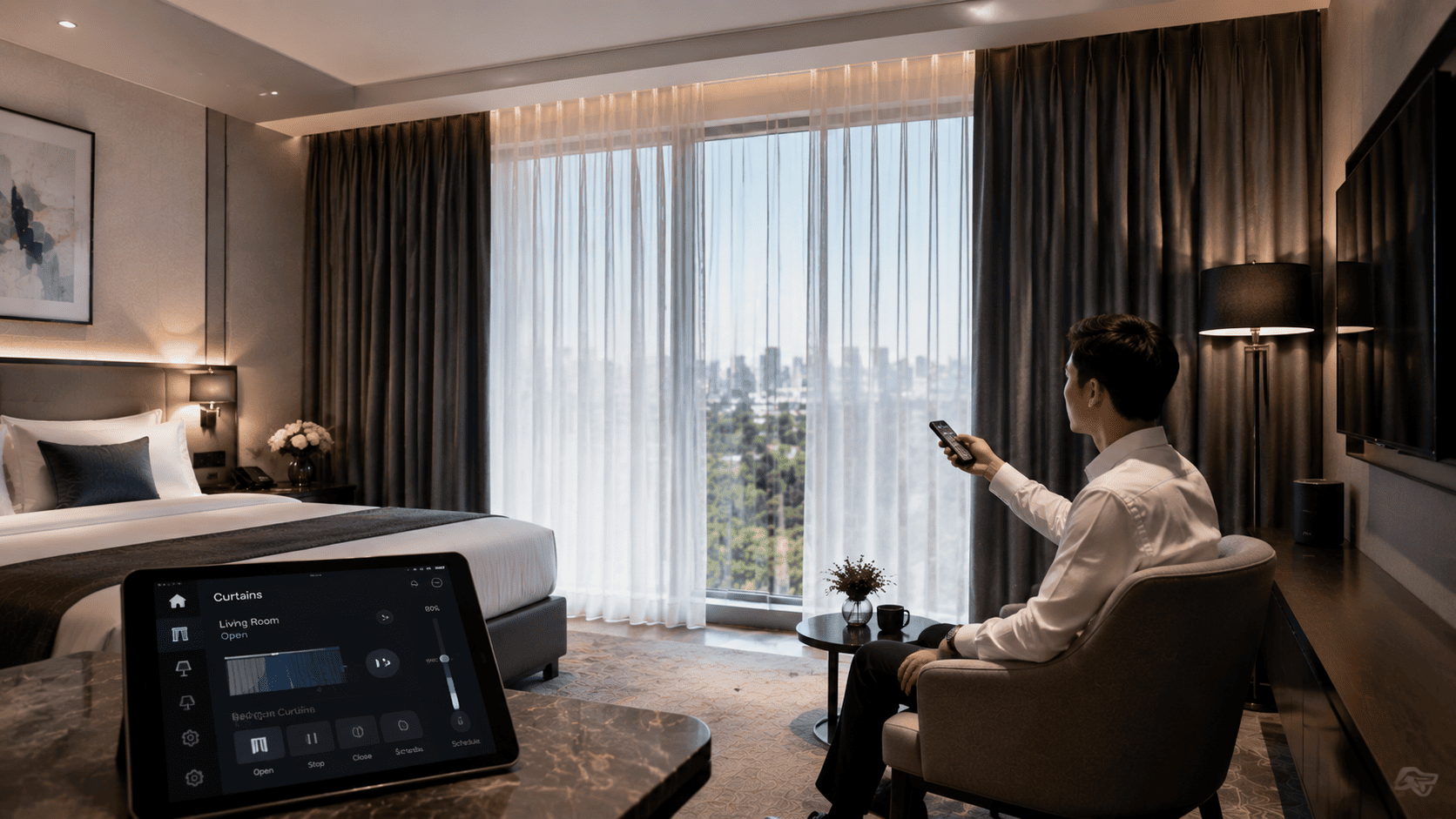
Quick Answer
For hotel curtain stackback, approve where the opened panels will sit before releasing the order. Record side stacking width separately from front-to-back pocket clearance. Give the workroom the finished curtain specification and proposed hardware, then compare its estimate with the space shown on the room drawing. Review one-way and split-draw options against each room type. Finally, agree what the open-position mock-up must demonstrate and which rooms that approval covers. A generic allowance is not a substitute for a documented review of your proposed arrangement.

Plan the Open Curtain Before Approving the Room
Approve the open position as a separate room-design decision. A closed elevation can show the intended curtain coverage without recording where the panels should sit during the day.
For hotel procurement managers, hospitality designers and drapery contractors, the useful question is specific: does the proposal leave the agreed view and room-use space available when the curtain is open? Put that objective on the drawing before comparing quotations.
Imagine a room with generous wall space on one side and a furniture return on the other. Instead of asking suppliers to use a standard allowance, ask them to mark the proposed resting position of each panel. Keep any unresolved conflict visible in the quotation.
Set fabric-quantity decisions with the hotel curtain fullness guide. This guide handles the next decision: recording and accepting the space assigned to the opened curtain. It is not a track-installation design or a building-code assessment.
Record Curtain Stackback Width and Depth Separately
Stackback is the space occupied by a curtain when it is drawn open. Silent Gliss includes heading choice, fitting space and the opened stack location in its planning guidance. See its curtain planning guidance.
Keep side width and pocket depth in different fields. Lutron’s guestroom application note says opened drapery occupies more front-to-back space than closed drapery, and closely spaced dual tracks can let one panel interfere with the other. Its guestroom window-treatment application note describes a manufacturer-specific planning issue, not a universal pocket dimension.
Use this proposed two-axis record for the supplier and site review:
- Drawing identity: room template, opening reference, drawing revision and units.
- Available side space: mark the left and right limits separately, with the reference points used to measure them.
- Available depth: show the pocket or fitting space in section, including the proposed track positions and nearby obstructions.
- Supplier estimate: ask for the opened curtain’s proposed width and depth on the same drawing references.
- Layer arrangement: identify each curtain layer and ask the supplier to review the proposed arrangement together.
- Review status: name the person confirming the site dimensions and record each unresolved clearance item.
Do not mix a supplier’s estimated curtain envelope with an unconfirmed site measurement. Label both. If the available space is still pending, keep that part of the order pending too.
Give the Workroom One Finished Construction
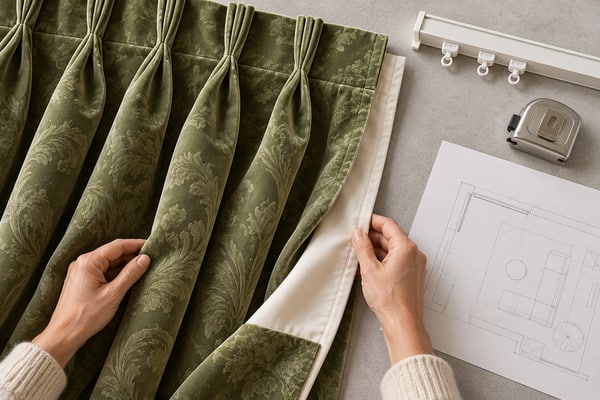
Ask the workroom to estimate the stack using the construction you intend to order. Send the fabric reference, lining choice, heading, panel arrangement and proposed track or rod together, rather than requesting a result for an unspecified curtain.
Hardware detail belongs in that brief. For example, Silent Gliss describes a glider-cord inside its Wave track that controls fabric extension and the opened stack. Read the Silent Gliss Wave explanation. This is a named system example, not a claim that every wave heading works the same way or fits a ShadeCort proposal.
Ask the supplier to identify the basis of its estimate: a proposed drawing, a comparable construction or the project sample. Record any assumption still awaiting confirmation. Where a hardware model has not been selected, request a provisional response with that limitation stated.
Keep a revision field beside the estimate. If the buyer later changes the lining, heading or hardware, send the changed brief back for review. The purchasing record should show which construction was accepted, not simply that a stack-space discussion took place.
Compare Draw Arrangements by Room Type
Compare opening arrangements against the actual room constraints, not a preferred label. Use the matrix below as a proposed buyer review tool. It does not assign a standard stackback percentage or establish that one arrangement always saves space.
| Room condition or proposal | Ask the supplier to mark | Keep pending until agreed |
|---|---|---|
| Split-draw curtains with space on both sides | The resting position and estimated envelope of each panel | Left and right allowances, plus the agreed open view |
| One-way draw curtains proposed for one side | The complete opened stack on the nominated side | That side’s width, depth and intended room-use clearance |
| Unequal side space or a furniture return | The arrangement against the actual asymmetric layout | Any exception to the standard room template |
| A sheer and an opaque curtain in one pocket | Each proposed layer and its opened position in section | The reviewed shared-space arrangement |
| A corner room or a changed opening layout | A separate drawing and construction reference | Whether the existing approval applies or a new review is needed |
Keep different room conditions separate until the responsible teams agree they share the same reviewed arrangement. A standard king room and a corner suite need not inherit the same approval merely because the fabric code matches.
Give each exception an owner and a next action. For example: the designer confirms the desired open view, the site team confirms the available pocket, and the supplier responds to the revised arrangement. These are proposed handoff fields; assign responsibilities to match your contract.
Approve the Open Position in a Room Mock-up
Make the sample-room decision traceable to the arrangement reviewed. Before the review, agree what the buyer wants to see and which details remain outside that check.
Use this proposed acceptance record:
- Identify the sample. Record the room template, drawing revision, curtain construction and proposed hardware.
- State the objective. Mark the agreed open-view area and room-use space on the drawing. Avoid an undefined instruction such as “stack neatly.”
- Record the reviewed position. Ask the responsible team to compare the opened panels with the proposed width and depth envelope. Keep photographs tied to the same room reference.
- List exceptions. Note any unreviewed layers, changed furniture, missing hardware or different room conditions.
- Release a defined scope. Name the approving person, the accepted revision and the room templates covered. Keep other conditions pending.
A photograph alone should not stand in for the missing approval fields. Record what the reviewer accepted and what still needs an answer. If a change follows the review, ask which part of the earlier acceptance remains applicable.
Carry that released reference into the wider custom curtain quality-control checklist. This keeps the space decision connected to the order without replacing the broader production inspection plan.

Send ShadeCort a Stack-Space Brief
For a useful curtain stackback inquiry, send ShadeCort the room drawing and the proposed finished construction together. Include left and right space, the pocket section, opening direction, room-template differences, destination and the decisions still awaiting confirmation.
ShadeCort’s custom fabric drapery page describes double-turned hems, sewn-in liners and bottom weights. Review the custom fabric drapery options when defining the construction for your inquiry. ShadeCort’s motorization page lists motorized track systems for heavy drapes. Its motorization options provide a starting point for discussing operation; confirm the exact system and its applicability in the project quotation.
This gives a factory discussion a concrete basis: a named curtain construction, a room-space record and a list of open decisions. Ask the response to distinguish the proposal from assumptions that need site or designer confirmation.
Send your hotel curtain brief to ShadeCort on WhatsApp: +86 18926693786, or submit the same brief through the ShadeCort contact form. Include the current drawing revision so the response relates to the arrangement you intend to order.
Sources and Further Reading
- Silent Gliss: Planning Your Curtains. Heading choice, fitting space and stack location.
- Lutron: Guestroom Window-Treatment Application Note #736. Opened drapery depth and dual-track planning considerations.
- Silent Gliss: Wave Curtains. A specific track-and-heading example.
The records in this guide are proposed procurement tools, not universal engineering rules. Manufacturer examples do not establish ShadeCort dimensions, system compatibility or a partnership. ShadeCort product information is linked in the inquiry section.
FAQ
Can the left and right stacks have different allowances?
Ask the supplier to review each side against the actual drawing and proposed arrangement. Record separate allowances where the room is asymmetric, and have the designer confirm the intended open view. Do not treat an equal split on a sketch as an accepted solution unless the responsible teams have reviewed that condition.
Does a later lining change reopen the space review?
Send the revised construction to the supplier and ask it to confirm whether the previous estimate remains applicable. Identify the changed lining and the earlier approval reference. Keep any affected space decision pending until the response is recorded; do not silently carry an approval from one finished construction to another.
Is a supplier estimate enough to release every room?
Ask the project team to define the estimate’s status and approval scope. A planning estimate can identify an arrangement for review, but the order record should say which room templates and revisions have been accepted. Keep unreviewed variants on an exception list rather than extending an approval by assumption.
Should motor controls be approved in this same record?
Reference the proposed operating system in the stack-space record, but keep the control and integration decisions identifiable in their own specification. Ask the supplier and responsible project team to confirm each scope. An accepted open position should not be described as approval of an unspecified motor, control interface or electrical installation.