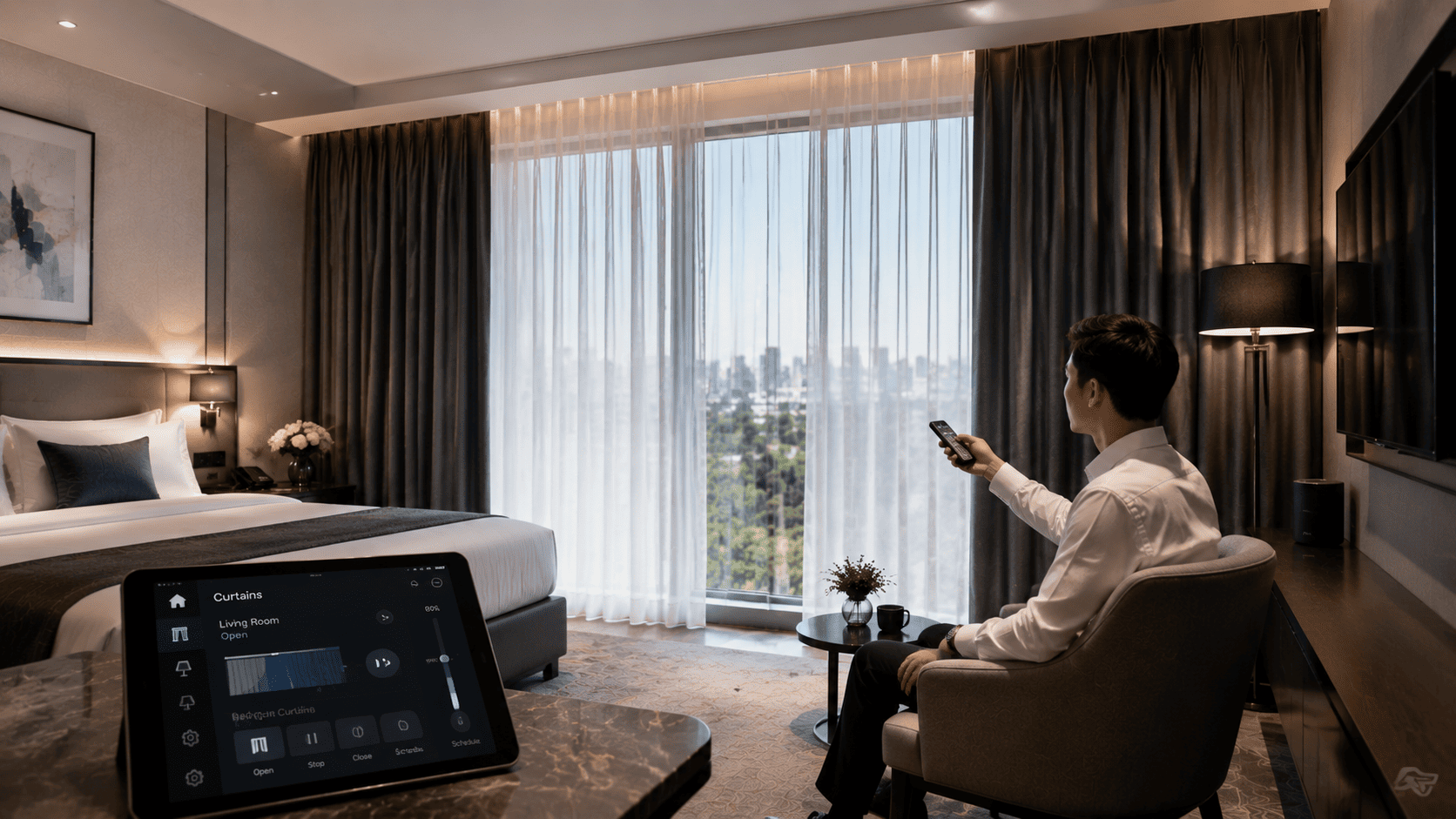
Quick Answer
This curtain fabric selection guide starts with the room, not the fiber name. Decide how much daylight, privacy, softness, and maintenance you need. Then compare the face fabric, lining, weave, color, drape, and finished construction as one system. Always review a physical swatch in your own room before approving a custom order. A beautiful online photo cannot show how the fabric changes beside your wall color, how it hangs at full scale, or whether the finished curtain or shade will provide the light control you expect.
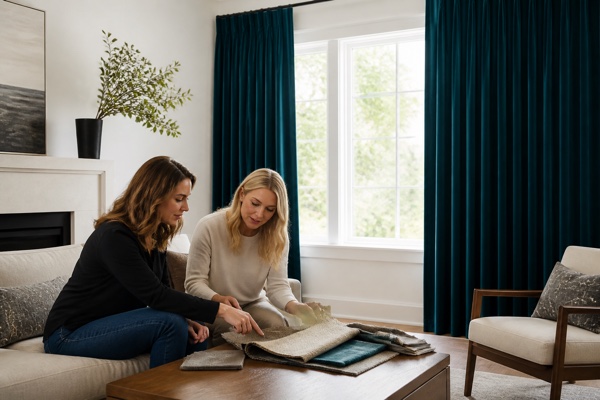
The Buyer Problem: A Good-Looking Swatch Can Still Make the Wrong Curtain
People often begin with color. They find a warm neutral, deep blue, or soft linen look that suits the room and assume the difficult part is over. Trouble starts when the finished window treatment behaves differently from the small sample.
A loosely woven fabric may glow in daylight even when it looks solid on a desk. A substantial velvet may make graceful drapery but be unsuitable for a slim roller system. An unlined decorative fabric may not provide bedroom darkness. A pale color can shift beside cool northern daylight or warm artificial light. Even the same material can look different when pleated across a wide window.
The cost of a poor choice is not only visual disappointment. Custom window treatments are made to specific dimensions and options, so correcting the fabric after cutting or assembly can mean a remake. The simpler approach is to approve material and construction together before the order is released.
Start With the Room Problem, Not a Fabric Name
Describe what must change in the room. This gives the seller more useful information than asking for the “best” fabric.
- Bedroom: State whether you need privacy, room darkening, or a true blackout result. The face fabric, lining, track coverage, returns, overlap, and installation all affect the result.
- Living or dining room: Decide whether you want soft daylight, full privacy at night, decorative drape, or a layered treatment.
- Media room: Control reflected light as well as direct daylight. Dark fabric alone does not solve gaps around the installed product.
- Street-facing room: Check privacy in daylight and after interior lights are switched on.
- Kitchen or busy family room: Ask about the care method and whether the selected texture suits regular contact, dust, or cooking residue.
- Large or tall opening: Consider fabric weight, seam position, fullness, track capacity, and ease of operation.
ShadeCort’s window treatment range includes drapery and several shade constructions. That breadth is useful at the selection stage because the right answer may be a lined curtain, a roller shade, or a layered combination. The product should follow the room problem.
Face Fabric, Lining, and Sheer Are Different Jobs
The face fabric carries most of the visible color, pattern, and texture. Lining sits behind it and can change light control, body, appearance from outside, and how the panel hangs. A sheer is usually a separate layer that softens daylight and provides limited daytime privacy. A roller shade uses a different material and operating structure, so do not choose it from a drapery swatch alone.
Do not assume that a heavy face fabric is automatically blackout. Weight and opacity are related in some materials, but they are not the same specification. For complete light blocking, confirm the selected blackout construction and how the finished product manages the edges. ShadeCort’s full-blackout products should be evaluated as complete systems, without treating visible light leakage as normal.
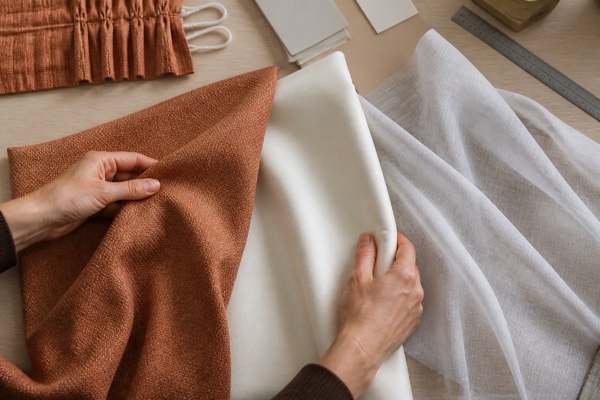
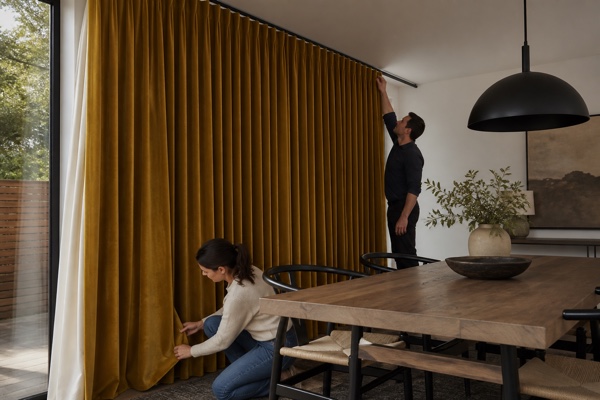
For full-length panels, review the available heading, lining, hem, return, overlap, and fullness with the chosen material. ShadeCort’s custom fabric drapery page shows how these finished details belong to the product decision, not just the fabric swatch.
Curtain Fabric Selection Guide: Compare the Whole System
| Room priority | Material or construction to consider | What to verify on a sample | What can still go wrong |
|---|---|---|---|
| Soft daylight | Sheer, light-filtering weave, or an unlined decorative layer | Daytime privacy, color cast, texture, and view-through | Night privacy may disappear when indoor lights are on |
| Bedroom darkness | Blackout face fabric or decorative face fabric with blackout lining | Opacity, lining color, side coverage, returns, overlap, and track position | Small installation gaps can defeat an otherwise opaque material |
| Full, soft drape | Fabric with suitable body and flexibility for the selected heading | Hang a larger piece vertically and form several folds | A tiny flat swatch can hide stiffness or excessive bulk |
| Easy care | Material and finish with a care method that suits the room | Written care instructions, spot-test advice, and lining compatibility | Cleaning one layer incorrectly can cause distortion or shade change |
| Wide matching windows | One approved color lot and a planned seam or panel layout | Color under the same light and usable fabric width | Different lots or unplanned seams may look inconsistent side by side |
| Motorized operation | Fabric weight and construction suited to the selected track or shade system | Finished sample movement, motor compatibility, stacking, and controls | A fabric-only approval does not prove the complete system will operate well |
Five Fabric Details Worth Confirming
1. Fiber content
Fiber content can influence texture, maintenance, appearance, and how the material responds to use. It does not tell you everything about performance. Weave, finish, lining, and finished construction matter too.
In the United States, the Federal Trade Commission explains that curtains and draperies are generally covered textile products and that labels identify fiber content, country of origin, and the responsible manufacturer or marketer. In Canada, the Competition Bureau says custom-made draperies may show fiber content and dealer identity on the invoice or other document when properly labeled samples or swatches are available for the consumer to inspect.
2. Weave and construction
Look at how tightly the yarns are arranged and hold the sample toward a window. A loose weave can create an airy appearance. A dense weave may provide more visual body. Coated shade fabrics and woven drapery fabrics also behave differently when rolled, folded, or sewn.
3. Weight, thickness, and usable width
Fabric weight can affect fullness, stacking, hardware load, and how easy the product is to operate. Thickness is not a guarantee of darkness. Usable width matters because it influences seams, pattern placement, and whether several panels can be cut consistently.
4. Drape and hand
Drape is how the fabric falls. Hand is how it feels and responds when handled. Fold a sample rather than judging it flat. For curtains, ask for a larger cutting or a made-up heading sample when the choice is close. For a shade, review the material on the actual product construction when possible.
5. Finish and backing
A finish or backing may be used for light control, appearance, dimensional stability, or another defined purpose. Ask what layer provides each claimed result and how it should be cleaned. Avoid treating a broad label such as “performance fabric” as a complete specification.
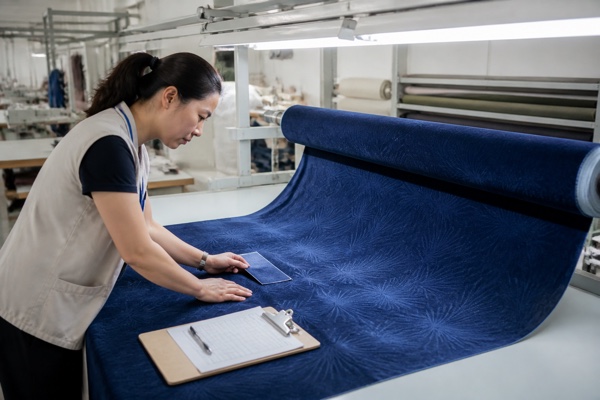
How ShadeCort Reviews Fabric Before a Custom Order
A useful factory review begins with the finished product. ShadeCort can discuss the room use, window dimensions, product type, face fabric, lining, heading or shade construction, manual or motorized operation, hardware, and destination as one brief. Exact options, samples, minimums, testing, and timing depend on the selected configuration and quotation.
- Define the result. Share the room, privacy need, light-control target, style reference, and care priorities.
- Choose the product family. Compare drapery, roller shades, Roman shades, or layered options before narrowing the textile.
- Shortlist materials. Review color, weave, opacity, lining, and operating compatibility.
- Approve a physical reference. Record the fabric code, color, face and back, and any lining or trim.
- Confirm the finished construction. Lock dimensions, fullness or deductions, heading, rails, controls, and accessories.
- Check production against the approved record. Keep material identity, color reference, construction, and change approval connected to the order.
This process is a practical factory advantage. It reduces the handoff between a fabric seller and a separate finished-product maker. It does not remove the homeowner’s responsibility to review the physical sample and confirm measurements.
Approve the Swatch in the Room Where It Will Be Used
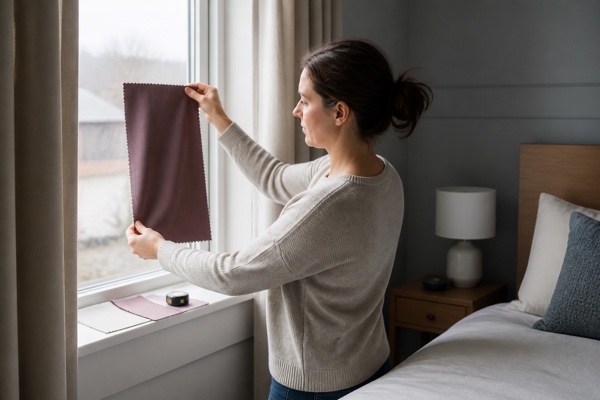
Check the sample beside the window, wall, floor, and major furniture. Look at it in morning light, afternoon light, and after dark with the room lights on. Place it vertically and make folds. If privacy is important, view it from both sides.
Phone and monitor screens can shift color. A small swatch also hides pattern scale and the way repeated folds create darker and lighter bands. When several windows must match, write down the approved fabric code and ask whether the order will be cut from one production lot.
Keep the approved swatch until the order arrives. It gives you a clear reference for color, texture, face direction, and lining instead of relying on memory.
Do Not Separate Fabric Choice From Safety and Operation
Fabric is only one part of a window covering. The operating system, inner cords, hardware, and installation also need attention. The U.S. Consumer Product Safety Commission provides requirements and business guidance for stock and custom window coverings. Health Canada advises replacing window coverings with long accessible cords and notes that Canadian requirements apply to custom-made and off-the-shelf products.
For homes with young children, ask about cordless or inaccessible-cord options that apply to the exact product and destination. If you choose automation, review the fabric and product alongside ShadeCort’s motorization options. A motorized track or shade needs the right fabric weight, dimensions, controls, and installation plan.
Watch: Measure After You Choose the Product
The same window can require different order dimensions for drapery, an inside-mount roller shade, or an outside-mount system. Watch ShadeCort’s measuring guide, then follow the instructions for the exact product you plan to order.
Watch the ShadeCort Measuring Guide on YouTube
Open the ShadeCort Measuring Guide on YouTube if the player is unavailable.
Buyer Checklist Before Approving Curtain Fabric
- The room, window orientation, privacy need, and light-control target are written down.
- The product type is confirmed before fabric approval.
- Face fabric, lining, sheer layer, and backing are identified separately.
- The physical swatch has been checked vertically in the intended room.
- Fiber content, fabric code, color, care method, and face direction are recorded.
- Drape or rolling behavior has been reviewed on a suitable sample.
- Seam position, pattern repeat, usable width, and one-lot matching are addressed where relevant.
- Heading, fullness, track, returns, overlap, hem, or shade deductions are confirmed.
- Manual, cordless, or motorized operation suits the household and destination.
- No material or component substitution is allowed without your approval.
Request a ShadeCort Fabric and Product Review
Send ShadeCort photos of the room and window, approximate dimensions, your preferred product type, color references, privacy and light-control needs, manual or motorized preference, and U.S. or Canadian delivery location. The team can then discuss suitable fabric and construction options for the selected project.
Use the ShadeCort contact page to request a fabric and product review. Ask for the exact sample scope, included components, measurement method, quotation, and approval steps before ordering.
Sources and Further Reading
- JingSourcing: How to Source the Best Fabrics for Your Business?, used as a structural reference for fabric decision topics
- U.S. Federal Trade Commission: Textile and Wool Acts labeling guidance
- Competition Bureau Canada: Guidance on the Labelling of Textiles
- U.S. Consumer Product Safety Commission: Window Coverings 15(j) Rule guidance
- Health Canada: Window covering safety
- U.S. Department of Energy: Window selection and interior shade considerations
- ShadeCort Measuring Guide on YouTube
FAQ
What is the best fabric for custom curtains?
There is no single best fabric. The right choice depends on the room, desired light control, privacy, drape, care method, heading, lining, hardware, and budget. Start with the result you need, then compare physical samples.
Does heavier curtain fabric always block more light?
No. Weight does not prove opacity. A heavy decorative fabric can still transmit light, while a purpose-built blackout layer may be thinner. Confirm the complete face fabric, lining, edge coverage, and installed construction.
Should I order a curtain fabric swatch first?
Yes, especially for custom work. Review the swatch in the intended room at different times of day. Check color, texture, opacity, privacy, drape, face direction, and how it looks beside the room’s fixed finishes.
What is the difference between curtain fabric and lining?
The face fabric provides the visible color, texture, and pattern. Lining sits behind it and may add body, change light control, create a more uniform exterior appearance, or support another defined function. Approve both layers together.
Can the same fabric be used for curtains and roller shades?
Not automatically. Drapery fabric must sew and hang well. Roller-shade material must also roll, track, and remain stable in the selected system. Ask the supplier to confirm compatibility with the finished construction.
How can I request fabric options from ShadeCort?
Share room photos, approximate window dimensions, product type, color references, privacy and light-control targets, operation preference, and destination through the ShadeCort contact page. Ask which physical samples and finished-product options are available for that brief.