

Quick Answer
Custom curtain quality control should not wait until the cartons are ready to ship. A useful plan checks the approved specification, incoming fabric and lining, the first cut panel, sewing in progress, finished dimensions, hardware or motor operation, labels, and packing. Each checkpoint needs an acceptance rule and a record. For U.S. and Canadian orders, the buyer should also confirm which cord-safety and textile-label requirements apply to the exact product. ShadeCort can review these checkpoints with the buyer before production, but the final plan must match the curtain construction, installation, destination, and order scope.
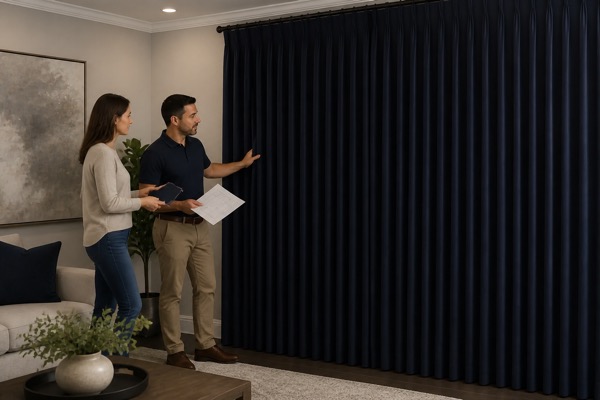
Why Can a Good Sample Still Become a Bad Curtain Order?
A fabric swatch proves very little on its own. It does not confirm finished width, panel length, pattern position, seam quality, lining, heading construction, center overlap, hardware compatibility, or packing. Even a well-made pre-production sample can lose value if the factory later cuts from a different lot or changes an unrecorded detail.
For a homeowner, the result may be two panels that hang at different heights or a color that looks uneven across one wall. For a designer, retailer, or small contractor, the same defect can delay installation and turn one complaint into several remakes. The practical problem is timing: a defect that costs minutes to correct at the cutting table may be expensive once every panel has been sewn and packed.
What Does Curtain Quality Control Actually Cover?
Quality control is the set of inspections and tests used to decide whether materials, work in progress, and finished products meet an approved requirement. It is different from a broad promise that a product is “high quality.” A workable QC plan names the requirement, the inspection method, the responsible person, the sample size when sampling is used, and the action to take when a result fails.
For custom window treatments, the plan should connect four records: the final order specification, the approved material or sample, the production inspection record, and the packing list. That chain matters because made-to-measure products often differ by window. An order number without a room or window reference is not enough when ten panels have similar widths.
If you are still deciding the basic construction, review ShadeCort’s custom drapery options and window shade range before locking the checklist.
What Should Be Approved Before Production Starts?
The buyer and factory need one current specification. Email comments, chat screenshots, and old quotations should not compete with it. The approved document should identify the product type, finished measurements, quantity by room or window, face fabric, lining, color or lot reference, heading, fullness, hem, side returns, opening direction, hardware, operation, labels, accessories, and packing method.
For fabric curtains, approve both the face and the back of the sample. Record the fabric direction and pattern position if either matters. If blackout is required, define the complete construction, not only the face fabric. Lining, overlap, side return, track position, and installation all affect the finished condition. ShadeCort blackout curtain orders should be reviewed as a complete opaque system, with no planned light path through the closed curtain.
Custom Curtain Quality Control Checkpoints
The most efficient plan places each check where the factory can still correct the problem without remaking the whole order. The exact tolerances belong in the approved specification. The examples below show the evidence a buyer should request rather than universal pass limits.
| Production stage | What to inspect | Evidence to keep | Release decision |
|---|---|---|---|
| Specification release | Measurements, fabric, lining, color, heading, fullness, hardware, operation, labels, and packing | Approved specification, signed sample, revision number, and room or window schedule | Do not purchase or cut material until open questions are closed |
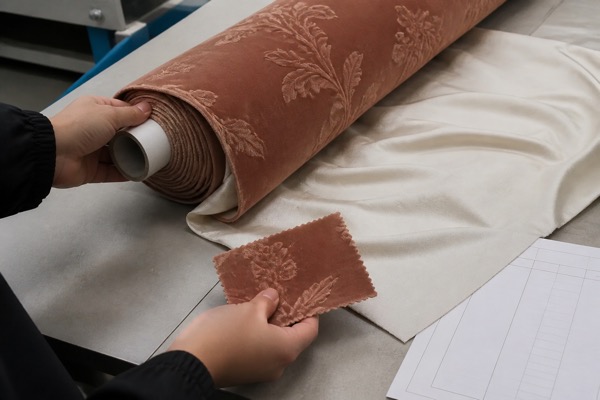
| Incoming material inspection | Fabric identity, lot consistency, color, visible flaws, usable width, lining, trims, tracks, motors, and accessories | Roll or batch references, swatch comparison photos, defect notes, and material count | Quarantine or replace material that does not match the approved reference |
| First cut and first panel | Cut direction, pattern position, allowance, finished-size calculation, heading build, seam, hem, and label position | First-panel measurements and close photographs against the approved construction | Correct the method before repeating it across the order |
| In-process sewing | Panel matching, stitch consistency, seam placement, puckering, thread trimming, pleat spacing, and lining attachment | Inspection sheet tied to operator, batch, room, or window reference | Stop and rework the affected units before final finishing |
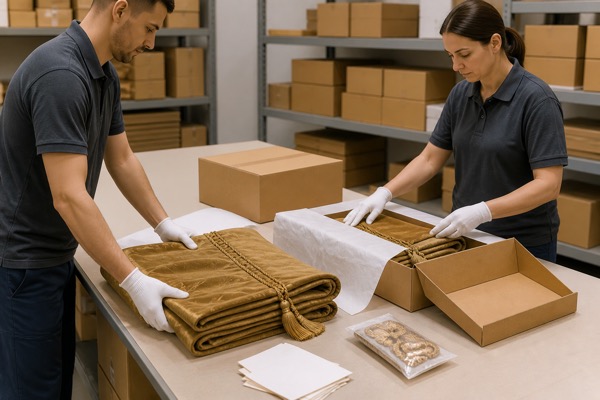
| Finished product and packing | Finished dimensions, pair matching, appearance, opening and closing, hardware, motor direction, labels, accessories, protection, and carton marks | Final inspection report, selected measurement photos, function record, packing list, and carton count | Release only the units that meet the agreed acceptance plan |
How Should Each Production Stage Be Checked?
1. Inspect Fabric, Lining, and Components on Arrival
Compare the received material with the approved physical reference under consistent lighting. Check roll identity, lot information, color variation, marks, weaving faults, usable width, and obvious finish problems. Confirm that the lining, hooks, carriers, tracks, remotes, and other components match the order. Material that is uncertain should be separated before cutting.
A visual check cannot replace a specified laboratory test when the order depends on a performance claim. If the buyer needs a test report, define the method, construction, sample source, issuing laboratory, and destination requirement before production. ShadeCort can review the requested documentation scope, subject to the exact product and order.
2. Approve the First Cut Panel Before Repetition
The first cut panel is where the written specification meets real material. Measure the cut length and width, check fabric direction, confirm pattern placement, and verify the allowance used for hems, seams, heading, and returns. If several windows use similar sizes, the identification method should already be attached to the work order.
3. Check Sewing While Correction Is Still Practical
In-process inspection should look at the actual construction, not only a clean front view. Check seam position, stitch balance, puckering, lining attachment, heading reinforcement, pleat spacing, hems, side edges, and trimmed threads. Compare paired panels together when the order requires a matched drop or pattern.
4. Measure Finished Curtains in a Defined Condition
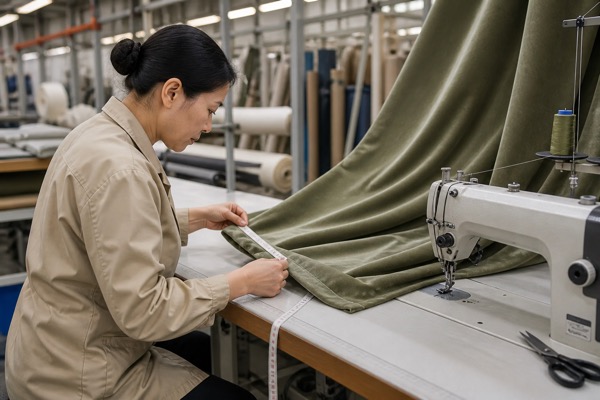
Finished dimensions can change with heading construction, fabric behavior, pressing, and how the panel is laid or hung. The specification should state the measuring method and condition. Record width, drop, pair matching, hem line, and any permitted tolerance. Photographs are useful, but the measuring points and tape position must be visible if the photo is meant to support acceptance.
Measure the mounting area correctly before production. A precise factory measurement cannot repair an incorrect site dimension.
Watch: Measure Before the Quality Plan Is Released
The production checklist starts with the dimensions approved by the buyer. Watch ShadeCort’s measuring guide, then compare your notes with the instructions for the exact product, mount type, track, and opening direction.
Open the ShadeCort Measuring Guide on YouTube if the player is unavailable.
5. Test Hardware, Movement, and the Finished Closure
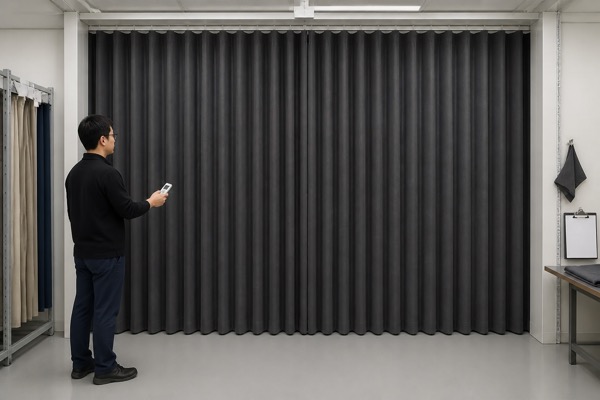
For manual curtains, check that carriers move, stops hold, hooks are secure, and panels open and stack as specified. For motorized window treatments, the inspection should match the agreed scope. Typical checks may include motor direction, travel limits, center closure, remote pairing, noise or obstruction observations, power components, and included instructions. Site wiring, controls integration, and installation remain separate responsibilities unless they are expressly included.
Which Defects Belong on the Final Inspection Checklist?
A final checklist should be specific enough that two inspectors would reach a similar decision. Start with the approved sample and specification, then group checks by the way the product can fail.
- Fabric and appearance: wrong material, visible color difference, stains, holes, weaving faults, pressure marks, incorrect direction, pattern mismatch, or inconsistent sheen.
- Dimensions and pair matching: incorrect finished width or drop, uneven hems, different panel lengths, incorrect overlap or return, or the wrong room and window identification.
- Sewing and construction: open seams, skipped stitches, puckering, loose threads, uneven pleats, damaged lining, weak heading reinforcement, or incorrect hook position.
- Operation and accessories: rough travel, wrong opening direction, missing carriers or brackets, incomplete accessory bags, incorrect remote, poor center closure, or a motor setting that does not match the approved arrangement.
- Labels and packing: inaccurate fiber or dealer information where required, wrong order marks, missing instructions, unprotected decorative surfaces, excessive compression, moisture exposure, or a carton count that does not match the packing list.
If an order uses sampling rather than 100 percent inspection, the buyer should approve the sampling plan and defect categories before inspection. A statistically acceptable lot can still contain defects, so safety-critical or unit-specific checks may need a different rule.
What Must U.S. and Canadian Buyers Verify?
Quality approval and legal compliance are related, but they are not the same decision. The product type, operating system, selling model, responsible business, and destination determine which requirements apply. Buyers should obtain current advice for the exact product rather than relying on a generic factory checklist.
In the United States, the U.S. Consumer Product Safety Commission’s window-covering business guidance addresses operating cords, inner cords, and permanent markings for relevant stock and custom products. The guidance states that finished products need specified identifying information and that custom products should connect to customer order information.
The U.S. Federal Trade Commission’s textile-labeling guide lists curtains and draperies among covered household textile products. Most covered products need fiber content, country of origin, and identification of the manufacturer or another responsible business, subject to the detailed rules and exceptions.
For Canada, Health Canada’s window-covering safety guidance explains the hazard of long accessible cords and says Canadian requirements apply to custom-made and off-the-shelf products. The Competition Bureau’s textile-labeling requirements explain prescribed fiber and dealer information and note that claims must be accurate and not misleading.
Who Should Inspect the Order?
The factory knows the construction and can catch problems while production is active. The buyer controls the commercial acceptance rules and should approve the specification, sample, tolerances, and defect priorities. A third-party inspector can add independent observation, especially for a larger order or a new supplier, but the inspector still needs a product-specific checklist.
These roles work best together. A third-party visit at the end cannot replace first-panel approval or repair material that was cut incorrectly weeks earlier. On the other hand, a factory’s internal report should not quietly redefine the buyer’s acceptance criteria. Decide who witnesses each hold point and who can authorize a deviation.
How ShadeCort Can Support a Curtain QC Plan
ShadeCort can review the buyer’s curtain specification, sample references, room or window schedule, inspection checkpoints, label requirements, packing method, and requested evidence before production. Depending on the confirmed order scope, the team can discuss material checks, first-panel review, in-process records, finished measurements, operation checks, packing photos, and access for an agreed third-party inspection.
This support does not replace the buyer’s responsibility to define destination requirements or approve the final acceptance plan. It does make the conversation concrete. Instead of asking whether quality is “good,” the buyer can ask which evidence will exist before the order moves to the next stage.
Buyer Checklist Before You Approve Production
- Is there one current specification with a revision date?
- Are finished dimensions tied to a room or window schedule?
- Have face fabric, lining, color, and construction samples been approved?
- Are measuring methods and tolerances written down?
- Is there a hold point for incoming materials and the first completed panel?
- Does the checklist cover sewing, appearance, operation, accessories, labels, and packing?
- Are U.S. or Canadian safety and textile-label questions assigned to a responsible party?
- Does the acceptance plan define sampling, defect categories, evidence, and authority to release?
To prepare a useful review, send ShadeCort the window schedule, product type, dimensions, fabric or performance brief, operation, destination, quantity, packaging needs, and required documents. Review ShadeCort’s compliance information, then request a specification and QC discussion before the production release.
Sources and further reading
- U.S. CPSC: Window Coverings 15(j) Rule Business Guidance
- U.S. FTC: Textile and Wool Acts Labeling Guide
- Health Canada: Window Covering Safety
- Competition Bureau Canada: Textile Labelling Requirements
FAQ
What is the most important custom curtain quality-control checkpoint?
The first-panel review is often the most economical checkpoint because it tests the real fabric, cutting calculation, heading, sewing, hem, lining, and identification method before the factory repeats them. It does not replace incoming-material or final inspection, but it can prevent one method error from affecting the whole order.
Should every custom curtain be inspected?
That depends on the risk and the inspection item. Unit-specific measurements, window labels, special patterns, safety-related components, or unique motor settings may justify broader checking. Repeated appearance checks may use an agreed sampling plan. The buyer should approve that distinction before inspection starts.
Can photos replace a third-party inspection?
Photos can document color comparison, construction, measurements, operation, and packing when the subject and method are clear. They do not provide the same independence or coverage as an on-site inspection. For a new supplier, large order, or high-risk installation, combine factory records with buyer review or an agreed independent inspection.
What should happen when one curtain fails inspection?
Separate the affected unit, record the defect, and determine whether the cause could affect other units from the same material, operator, machine setting, or specification. Rework or replace as agreed, then verify the correction. Do not treat one repaired panel as proof that the rest of the lot is unaffected.
Does passing factory QC prove U.S. or Canadian compliance?
No. Factory QC proves only that the inspected product met the agreed checklist and acceptance rule. Compliance depends on the exact product, destination, applicable requirement, label or marking, test method, responsible business, and current law. Buyers should verify those items separately and include the relevant evidence in the order file.