
Quick Answer
Custom window treatment packaging should be designed around the finished product, sales channel, shipment route, and installation process before artwork begins. Buyers need to define the carton format, internal protection, accessory pack, instructions, barcode and label data, room or opening identification, and acceptance tests. Approve a complete pack-out sample with the actual blind, shade, track, motor, controls, and hardware inside. Then freeze the dieline, materials, print files, packing method, and inspection criteria before bulk printing. This prevents attractive packaging from becoming a source of transit damage, missing parts, returns, or project delays.

Who this guide is for
This guide is for window treatment brands, importers, wholesalers, ecommerce sellers, project suppliers, contractors, and procurement teams sourcing packaging in China.
It covers packaging for:
- Ready-made and made-to-measure blinds and shades
- Manual and motorized window treatments
- Shutters, drapery, tracks, and long hardware
- Retail, ecommerce, wholesale, and project orders
- Installation kits, remotes, controls, and spare parts
The article follows the useful question order of the reference guide, but applies it to products that are long, surface-sensitive, size-variable, and supplied with installation parts. A carton for a compact consumer item and a carton for a 2.4-meter motorized shade do not solve the same problem.
The buyer’s problem: the carton looks right, but the delivery fails
Packaging discussions often begin with a logo, a box color, or a request for the lowest printed-carton MOQ. That is too late in the decision chain.
A window treatment can arrive with:
- A bent headrail or bottom rail
- Fabric rubbed, creased, stained, or compressed
- A motor or remote moving freely inside the carton
- Brackets that scratch the visible finish
- Missing fasteners, safety devices, or instructions
- The right product in the wrong room or opening
- A barcode linked to another size or color
- A long carton that collapses under stacking
None of these failures is fixed by better artwork.
The packaging has three jobs. It protects the product, identifies the product, and helps the next person receive, store, sell, or install it correctly. Brand presentation matters, but it sits on top of those operational jobs.
Where should buyers coordinate custom packaging?
Buyers usually have three routes: ask the window treatment manufacturer to coordinate packaging, contract a packaging supplier directly, or use a hybrid model.
Coordinate through the window treatment manufacturer
This route is practical when the manufacturer already holds the final product, hardware, controls, and instructions. The team can build and inspect a complete packed sample before production. It also avoids moving empty cartons from one factory to another only to discover that the finished product does not fit.
The buyer should still ask which work is performed in-house and which printing, carton, foam, molded-pulp, or label suppliers are subcontracted. The window treatment manufacturer should remain responsible for the approved pack-out, not merely for forwarding artwork.
Contract a packaging supplier directly
Direct sourcing may suit a large brand with its own packaging engineer, consolidated packaging volumes, established print standards, and several product factories. The brand can negotiate common materials and artwork controls across the assortment.
The challenge is physical coordination. The packaging supplier needs accurate product dimensions, weight, fragile areas, pack orientation, and accessory contents. It also needs a representative production sample. If the carton is tested without the actual product, the result says little about the complete delivery.
Use a hybrid model
In a hybrid model, the brand owns the packaging specification and artwork while the window treatment manufacturer coordinates samples, local suppliers, final packing, and inspection. This often works well for private-label and project programs because brand control and factory pack-out responsibility stay separate.
ShadeCort Resources publicly presents OEM/ODM services, packaging customization, and a broad manual and motorized product scope. That makes a complete-pack review possible across more than one window treatment category, subject to the exact product and requested packaging.
What should be decided before packaging design starts?
Start with the packed product and the distribution route, not a blank dieline.
Product configuration
Record the product type, finished dimensions, weight, visible surfaces, moving parts, projection points, and fragile components. Note whether the product includes a cassette, fascia, side channel, track, valance, motor, battery, power supply, remote, hub, or fabric roll.
The ShadeCort shade range shows why one packaging rule cannot cover every product. A cellular shade, zebra shade, roller shade, Roman shade, and sliding panel have different compression, surface, and component risks.
Sales and delivery channel
Retail packaging may need shelf information and consistent presentation. Ecommerce packaging may travel as the shipping container and face parcel handling. Wholesale cartons may prioritize efficient palletization and SKU visibility. Project packaging may need room, floor, elevation, or opening codes more than retail graphics.
Define whether the product moves:
- As an individual parcel
- In a master carton
- On a pallet
- In a mixed-size project shipment
- Through a distribution center
- Directly to an installer or end customer
The International Safe Transit Association advises users to understand how packages are shipped, handled, and stored before selecting a test method. Its design and testing guidance treats the product and package as one system.
Installation and handover
List everything the installer expects to find. This may include brackets, fasteners, safety devices, templates, instructions, cables, power supplies, remotes, channel assignments, labels, and spare parts.
Motorized products need particular care. A remote can look identical across configurations while using a different channel plan or control protocol. ShadeCort’s motorization overview can help a buyer identify the controls and accessories that belong in each pack.
Which packaging format fits the order?
The correct format depends on the product and channel. Packaging names alone are not specifications.
| Packaging route | Best fit | Main protection need | Identification need | Buyer should verify |
|---|---|---|---|---|
| Plain individual carton | Samples, project orders, wholesale programs | Rail, fabric, corners, and accessory separation | SKU, size, purchase order, room or opening | Board grade, closure, internal supports, label layout |
| Printed retail carton | Standardized private-label ranges | Product plus shelf handling | Brand, model, variant, barcode, consumer information | Dieline, print proof, artwork version, language, retail test |
| Ecommerce ship-in-own-container | Direct parcel delivery | Drops, vibration, compression, abrasion, weather exposure | Carrier label area, product data, tamper evidence | Distribution-specific test plan and damage criteria |
| Master carton with inner packs | Small products, accessories, remotes, brackets | Unit separation and master-carton compression | Inner SKU, quantity, master-carton data | Pack quantity, mixed-SKU rules, scan access |
| Project-coded long carton | Hotels, offices, apartments, multi-opening orders | Long-product bending, stacking, surface protection | Building, floor, room, elevation, opening, size | Room schedule match, label position, sorting sequence |
| Crate or reinforced pallet load | Large tracks, shutters, oversized assemblies | Racking, impact, forklift, load restraint | Shipment and handling marks | Wood treatment, load plan, lift points, restraint method |
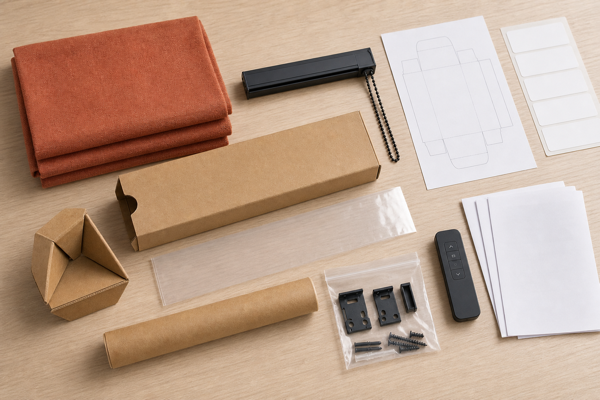
A seven-step custom packaging process
The sequence below is close to the reference article’s packaging workflow, with added controls for window treatments.
Step 1: define the packaging brief
The brief should identify:
- Product and configuration
- Packed quantity per unit and master carton
- Sales channel and destination
- Shipment method and handling points
- First order and expected repeat volume
- Branding level
- Required labels, barcodes, languages, and instructions
- Protection and appearance acceptance criteria
- Sustainability or material restrictions
- Target production and delivery dates
Add photos or drawings that show the finished product, but do not ask the packaging supplier to estimate dimensions from an image. Use measured production samples or controlled drawings.
Step 2: build the pack-content list
Create one list of everything inside each pack and one list for items shipped separately. Give every component a name, part number, quantity, and location.
A motorized shade pack might include the finished shade, brackets, fixing screws, remote, remote holder, charging cable or power supply, instructions, safety information, and a product label. A project shipment may place common controls in a separate commissioning carton. If so, the room schedule and packing list must show that separation.
Use sealed, labelled hardware bags where loose metal parts could mark fabric or rails. Keep remotes and power components from moving against finished surfaces. Do not place a sharp bracket against an unprotected textile roll.
Step 3: engineer the structure and protection
The factory or packaging supplier can now develop the carton dimensions and internal protection. Review the complete structure, including:
- External carton dimensions
- Board construction and direction
- End protection and intermediate supports
- Wrap, sleeve, bag, film, or fabric protection
- Separation between product and metal parts
- Void control
- Closure tape, staples, glue, straps, or bands
- Carry points and lifting method
- Pallet pattern and stacking orientation
Long cartons need support at the product’s weak points. More padding is not always the answer. Poorly placed supports can concentrate load on a rail, cassette, fabric edge, or motor end.
Confirm whether the package can be opened without a blade contacting the fabric. Also check whether installers can repack the product if a room is not ready.
Step 4: create the dieline, artwork, and data map
The dieline should be based on the approved structural sample, not an early estimate. Mark cut lines, folds, glue areas, print limits, label zones, closure zones, and areas that may be covered by shipping labels or straps.
Create a data map for:
- Brand and model name
- Product type
- Color or fabric reference
- Finished width and drop
- Operation and control side
- Motor or control configuration
- Quantity
- Country of origin where applicable
- Importer, manufacturer, or responsible-party details where required
- Safety, disposal, environmental, or handling information
- SKU, purchase order, barcode, room, or opening code
GS1 states that the brand owner is normally responsible for assigning the Global Trade Item Number, including when an importer or wholesaler has a product made under its own brand. See GS1’s responsibility guidance. The factory should print and verify the supplied number, but it should not invent a permanent GTIN for the buyer.
Separate fixed artwork from variable data. The printed carton may carry the brand and standard product information, while a controlled label carries the size, room, order, and configuration. That can reduce obsolete packaging when made-to-measure dimensions vary.
Step 5: make a complete pack-out sample
Approve the package with the actual product and every intended component inside. A flat print proof confirms artwork but cannot confirm fit or protection.
Check:
- External and internal dimensions
- Product movement after closing
- Contact between hardware and finished surfaces
- Compression of fabric or cellular material
- End protection
- Carton closure
- Label readability and scan result
- Correct instructions and accessory count
- Opening sequence
- Appearance after unpacking
- Ability to identify the product without opening it
Photograph the approved pack layer by layer. Keep a packing instruction with numbered steps and component positions. The approved sample should link to the dieline, material specification, artwork revision, label template, and pack-content list.
Step 6: select a transport check that matches the route
Do not describe a single informal drop as “ISTA tested.” ISTA publishes several test series for different purposes. Its test-procedure overview distinguishes screening tests from general simulations of distribution hazards and channel-specific member tests.
Before testing, define product-damage and package-degradation criteria. A carton may be scuffed but acceptable while the product must remain straight, clean, functional, and complete. For motorized products, repeat operation and control checks after the test.
A reasonable development sequence may include:
- Internal fit and handling review
- Trial stacking and compression review
- Controlled drop, impact, or vibration screening
- Distribution-specific testing selected by a qualified packaging professional or laboratory
- A monitored pilot shipment when appropriate
The test choice depends on package weight, dimensions, route, carrier, palletization, handling equipment, and customer requirements. Retest when the product, package, material, closure, internal protection, or distribution route changes in a way that may affect performance.
Step 7: control printing, packing, and inspection
Before bulk printing, approve:
- Dieline revision
- Structural material specification
- Color and print standard
- Fixed artwork
- Variable-data template
- Barcode data and scan quality criteria
- Labels, instructions, and accessory-bag artwork
- Quantity and allowed production overrun
- Pack-out instruction
- Inspection plan
During bulk packing, inspectors should compare the product, accessory count, labels, carton, and packing method with the approved standard. Sample cartons from different sizes and production periods, not only one easy-to-pack size.
For project orders, reconcile the room or opening schedule against the packing list before closing the shipment. A complete quantity with the wrong room coding is still a failed handover.
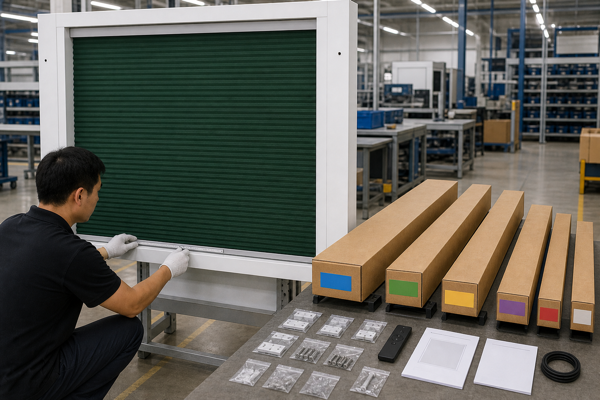
What drives custom packaging cost and MOQ?
There is no useful universal price or MOQ for window treatment packaging. Cost depends on the structure, material, dimensions, print process, quantity, number of artwork versions, variable labels, protection, assembly labor, and testing.
Ask the quotation to separate:
- Structural sample and print proof
- Dieline or design work
- Printing plates, cutting dies, or setup
- Carton or tube
- End caps, inserts, sleeves, bags, and wrap
- Labels, barcodes, instructions, and hardware bags
- Packing labor
- Test or laboratory work
- Pallets, crates, corner boards, straps, and load protection
- Freight from the packaging supplier to the window treatment factory
- Excess printed stock and storage
One product order can create several packaging minimums. A standard carton may have one minimum, a printed carton another, molded inserts another, and instruction sheets or labels another. Multiple sizes, languages, or retail variants divide the volume into smaller artwork runs.
The cheapest unit price can create the highest total cost if the carton is oversized, the buyer must purchase years of printed stock, or a brand change makes unused cartons obsolete.
How can a smaller buyer reduce packaging risk?
Small orders do not need to look unfinished, but the packaging plan should match the evidence available.
Use standard structures with controlled labels
A plain carton, standard internal protection, branded label, and good instruction pack may be better than a complex printed box for a market test. The buyer can change the product range without discarding large quantities of artwork-specific cartons.
Limit artwork versions
Use one structural carton across compatible products when it does not compromise protection. Place variable size, color, room, or SKU data on controlled labels. Do not force one generic label onto configurations that the warehouse or installer must distinguish.
Separate retail presentation from transport protection
A printed retail carton may need an outer shipping carton for parcel delivery. Decide whether the product is intended to ship in its own container. Do not assume shelf packaging can survive direct ecommerce handling.
Approve the largest, smallest, heaviest, and most fragile variants
A middle size may pack easily while the longest rail bends, the smallest product moves inside the carton, or a motorized version concentrates weight at one end. Use representative worst-case variants in the sample plan.
Packaging compliance and environmental claims
Packaging rules depend on the destination, material, channel, and claims.
The EU’s Regulation (EU) 2025/40 on packaging and packaging waste establishes sustainability and labelling requirements across the packaging life cycle. Buyers selling into the EU should review the application dates and obligations for their role, packaging format, and market rather than relying on a generic “eco packaging” statement.
For U.S. environmental marketing, the FTC’s Green Guides summary explains that recyclable, recycled-content, renewable-material, degradable, and source-reduction claims need appropriate evidence and qualifications. A supplier’s description of a paper or plastic material does not automatically support the buyer’s final marketing claim.
If wood pallets, crates, or dunnage are used in international trade, review the IPPC’s ISPM 15 implementation guide. The standard addresses approved treatment and marking of regulated wood packaging material. Processed wood products may be treated differently, so confirm the exact material and destination requirements.
Buyers can also review ShadeCort’s compliance information when preparing the complete product and document list. Match every statement to the exact finished product, package, destination, and supporting evidence.
How ShadeCort can support custom packaging
ShadeCort’s practical role is to connect packaging decisions to the finished window treatment.
The public product scope includes manual and motorized shades, blinds, shutters, drapery, tracks, controls, accessories, OEM/ODM services, and packaging customization. This allows a buyer to discuss:
- Product dimensions, weight, and fragile areas
- Manual and motorized accessory differences
- Standard and custom packaging options
- Brand artwork and variable labels
- Retail, ecommerce, wholesale, and project pack formats
- Room or opening identification
- Complete pack-out samples
- Packaging and accessory inspection
- Pallet, crate, or shipment handover requirements
The advantage is coordination, not a promise that every packaging style has the same MOQ, price, or schedule. The exact option depends on the product, quantities, printing method, material, number of variants, destination, and test plan.
Buyer checklist before requesting a packaging quote
- What exact product and configuration goes inside?
- What are the finished dimensions and weight?
- Which surfaces or parts are vulnerable to bending, rubbing, compression, or impact?
- Which accessories, controls, instructions, and safety parts belong in each pack?
- Which items ship separately?
- Is the package for retail, ecommerce, wholesale, or a project site?
- What route, carrier, handling points, storage, and pallet plan apply?
- Does the product ship in its own container?
- What fixed artwork and variable data are needed?
- Who assigns and verifies the barcode?
- Which countries and languages apply?
- Which room, opening, order, or SKU identifiers are required?
- What materials and environmental claims are requested?
- Is regulated wood packaging involved?
- Which sizes or configurations represent the worst case?
- What physical samples, print proofs, and tests will be approved?
- Who owns the dieline and editable artwork?
- How will revisions be numbered?
- What inspection criteria apply to printing, accessories, labels, and pack-out?
- What happens to unused printed stock after a design change?
Request a packaging review
Use the ShadeCort contact form to send the product type, dimensions, weight, destination, channel, shipment route, quantity range, artwork status, label data, accessories, motor and control scope, current packaging problems, and required date.
Include photos, drawings, an existing package, retailer requirements, or a room schedule when available. Ask the response to separate standard packaging, custom structural work, printed items, variable labels, samples, MOQ drivers, testing, and pack-out inspection. This produces a quote that procurement can compare and a package that operations can actually use.
Sources and further reading
- International Safe Transit Association: Test Procedures
- International Safe Transit Association: Getting Started with Design and Testing
- GS1: Who Is Responsible for Numbering Trade Items?
- European Union: Regulation (EU) 2025/40 on Packaging and Packaging Waste
- Federal Trade Commission: Environmental Claims Summary of the Green Guides
- International Plant Protection Convention: ISPM 15 Implementation Guide
FAQ
What packaging can ShadeCort customize for blinds and shades?
ShadeCort can review packaging needs for its window-treatment scope, including product cartons, protective wrap, internal supports, hardware bags, labels, instructions, retail presentation, project coding, master cartons, and shipment protection. Available materials, printing, construction, MOQ, cost, and timing depend on the exact product, dimensions, quantity, destination, and required tests.
Should I use a printed carton for a small private-label order?
Not always. A plain structural carton with a branded label, controlled product data, and a professional instruction pack may be more flexible for an early order. Printed cartons make more sense when the artwork, assortment, quantity, sales channel, and repeat demand are stable enough to support the setup and leftover-stock risk.
What is a pack-out sample?
A pack-out sample is the complete finished product packed exactly as intended for shipment. It includes internal protection, brackets, fasteners, remotes, power parts, instructions, labels, and the final carton. Buyers use it to approve fit, protection, presentation, component count, opening sequence, and identification before bulk packaging and packing begin.
How should made-to-measure shades be labelled?
The label should let the warehouse, installer, or customer identify the pack without opening it. Depending on the project, useful data may include purchase order, SKU, product type, width, drop, color, operation, control side, building, floor, room, elevation, and opening number. Link the label template to the controlled order or room schedule.
Who should provide the barcode?
The brand owner is normally responsible for the permanent GTIN, according to GS1 guidance. The buyer should supply the approved barcode data and assignment rules. The factory or printer can place it in the artwork and verify print quality, size, contrast, and scan performance against the agreed specification.
Does every package need an ISTA test?
No single test rule applies to every package. The buyer should first understand the distribution route, package dimensions, weight, handling, carrier or retailer requirements, and damage criteria. A packaging professional or qualified laboratory can then select an appropriate screening or simulation method. Avoid claiming certification when only an informal factory check was performed.
How can I reduce missing accessories?
Create a controlled pack-content list with part names, numbers, quantities, and packing positions. Use labelled bags or compartments, photograph the approved arrangement, and inspect accessory count during pack-out. For motorized products, distinguish remotes, power supplies, cables, hubs, and control assignments that may look similar across configurations.
When should packaging development begin?
Begin once the product dimensions, main construction, and sales channel are stable enough to define the package. Work on protection, structure, labels, and artwork while the final product sample is being approved. Do not wait until bulk production is complete, because packaging changes may affect component placement, labels, instructions, carton size, and shipment planning.