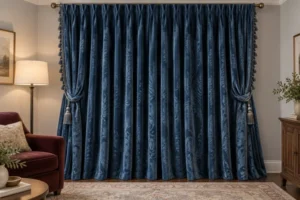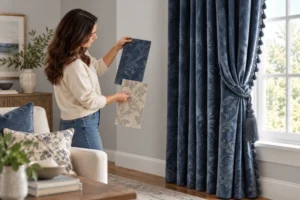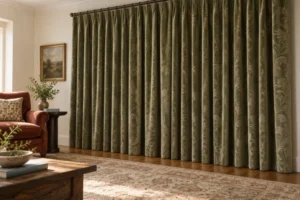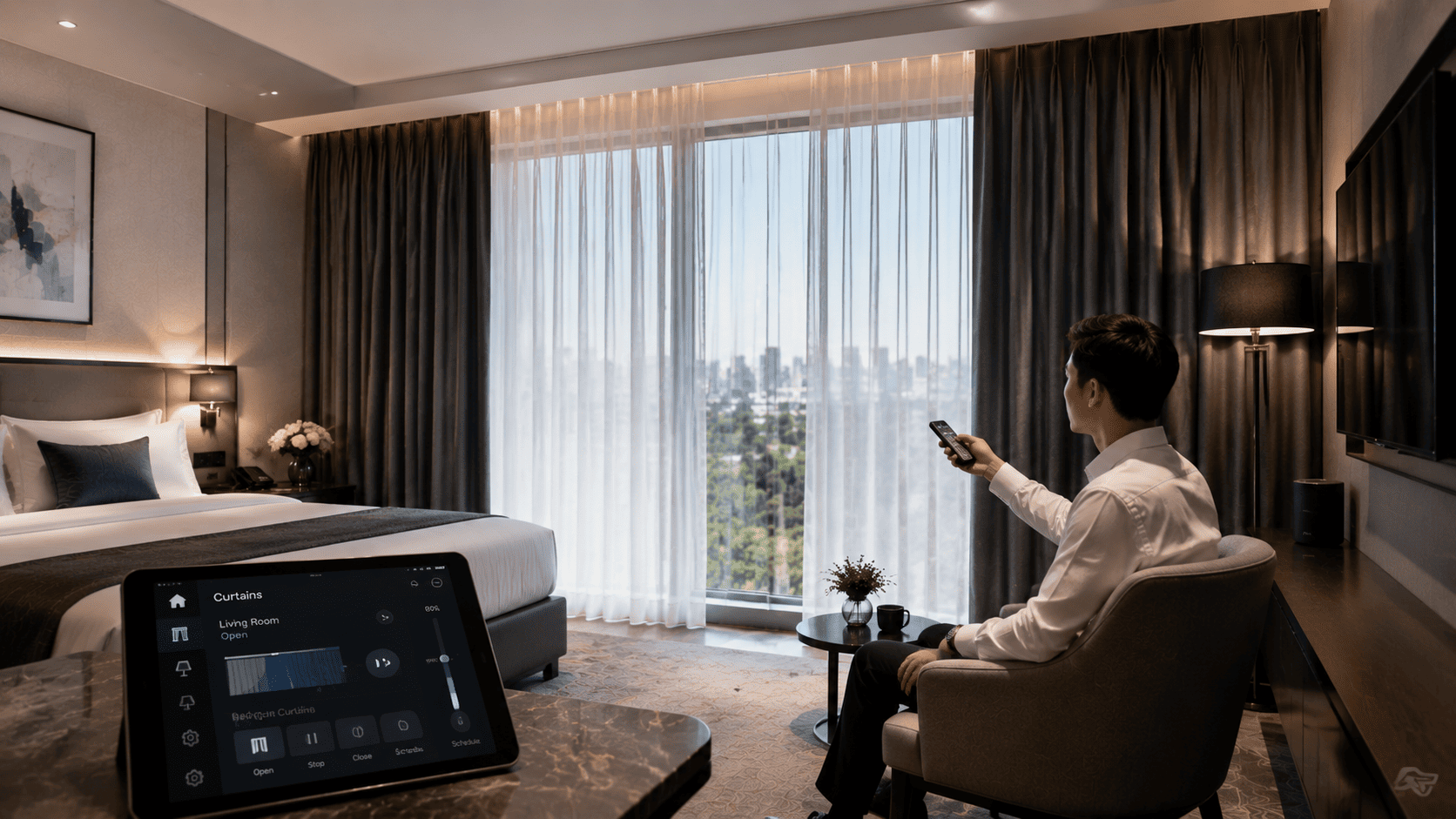
Quick Answer
For a hotel or serviced-apartment project, do not approve a curtain simply because a supplier sends a document marked "FR." First confirm which test method and performance level the project authority requires. Then make sure the report covers the exact face fabric, lining, color or finish, construction, treatment condition, and cleansing procedure that will be supplied. Approve a production-representative curtain, retain a sealed sample, and link every bulk roll and finished panel to a batch record. Flame-retardant does not mean fireproof, and a report for one material or market does not automatically approve every finished curtain or jurisdiction.
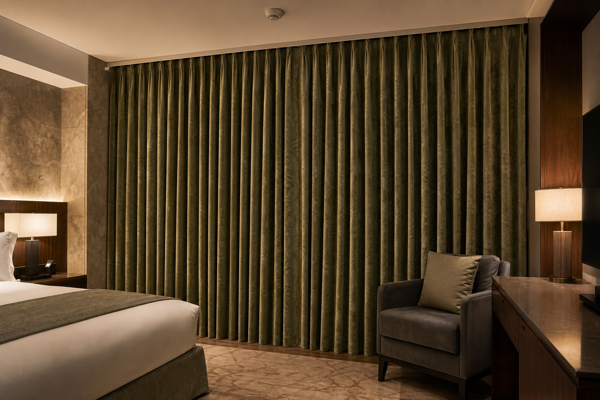
The curtain sample looks right. The color is approved, the heading hangs cleanly, and the blackout lining closes without visible light leakage. Two weeks before shipment, the project team asks for the flame test file.
The report that arrives names a fabric code, but the purchase order uses a different code. The report covers an unlined fabric, while the finished curtain has a separate blackout lining. Nobody can say whether the tested material was inherently flame resistant or treated after weaving. The hotel's laundry schedule was never discussed.
At that point, the problem is larger than missing paperwork. The factory, importer, contractor, designer, and hotel owner may all be working from different definitions of the product.
This is why fire-performance documentation belongs near the beginning of a B2B curtain order. It should shape material selection, sampling, care instructions, labeling, and production control. It should not be assembled from whatever files happen to be available at the end.
The buyer's real problem is product identity
A test report is a record of what a laboratory tested under a named method and set of conditions. It is not a blanket approval for every curtain made by the supplier.
The report may apply to a single fabric, a family of colors, a treated batch, or a particular fabric-and-lining assembly. It may record testing before cleansing, after a specified cleansing procedure, or both. It may also refer to a standard that the destination market does not use.
The purchasing question is therefore not "Do you have an FR certificate?" A better question is:
Can you show that the material, construction, treatment condition, and care cycle in this report are the same as the curtains quoted for this project?
That wording exposes gaps early. It also gives a responsible supplier enough information to select the correct material and testing route.
Flame-retardant is not the same as fireproof
No textile curtain should be described as fireproof. Fire tests evaluate defined aspects of burning behavior under stated conditions. They do not prove that a curtain cannot ignite, contribute fuel, produce smoke, melt, drip, or behave differently in a full room fire.
Even the name of NFPA 701 is precise: it provides methods for testing flame propagation of textiles and films. The 2024 International Fire Code refers to NFPA 701 performance criteria for certain curtains, draperies, and similar decorative materials where improved fire performance is required. That is a test-and-code framework, not permission to advertise a textile as immune to fire.
Use plain language in the specification:
- Name the required test method and edition.
- State the required classification, type, or acceptance result.
- Identify who must accept the report.
- Avoid broad claims such as "international fireproof certificate."
The authority having jurisdiction, fire consultant, architect, hotel brand, or project insurer may impose requirements beyond a buyer's standard purchase order. Their written direction should control the test route.
One standard does not fit every destination
Projects commonly reference different standards by market. The list below is an orientation tool, not a substitute for local code review.
United States projects
NFPA lists the 2023 edition of NFPA 701, Standard Methods of Fire Tests for Flame Propagation of Textiles and Films. The 2024 International Fire Code states that curtains, draperies, fabric hangings, and similar decorative materials must meet the applicable NFPA 701 Test Method 1 or Test Method 2 criteria, or an allowed alternative, when improved fire performance is required under that code section.
That does not mean every hotel window curtain in every U.S. city has the same approval path. Local adoption, amendments, occupancy classification, product use, and the fire official's decision matter. California also operates a separate State Fire Marshal registration system for approved flame-retardant chemicals, applicators, nonflammable materials, and treated fabrics in specified occupancies.
Ask the project consultant to state the adopted code, edition, test method, and any local certificate or label requirement before the factory orders bulk fabric.
United Kingdom projects
BSI describes BS 5867-2:2008 as the flammability specification for fabrics and fabric assemblies used in non-domestic curtains, drapes, and window blinds. Its scope includes finished articles and combinations of curtains and linings. BSI also states that a multi-layer curtain or drape should be tested in the combination in which it will be used.
The UK government's fire-safety guide for sleeping accommodation lists BS 5867-2 for curtain and drape fabrics, including nets and linings. The same guide warns that treated soft furnishings may have a limited wash life and advises following the supplier's care instructions. Where treatment is uncertain, it recommends confirmation from a suitably accredited testing organization.
Do not choose a BS 5867 performance type from a generic online checklist. The fire-risk assessor, specifier, or enforcing authority should define the level required for the hotel's rooms, public areas, or escape routes.
European and other projects
EN 13773 is a classification scheme for the burning behavior of curtains and drapes. It is not simply another name for NFPA 701 or BS 5867-2. A buyer should not convert one result into another unless the project authority accepts that route in writing.
Other countries and hotel brands may specify national standards, local registration, independent inspection, or additional labeling. The safest commercial approach is to create a compliance matrix by destination rather than promise that one report covers every market.
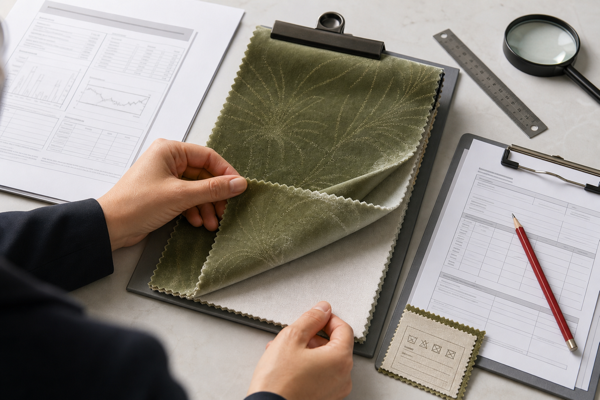
What to put in a B2B flame-retardant curtain specification
The table below is designed for the inquiry, purchase order, submittal register, and pre-production meeting. Complete it with the project's fire consultant or other responsible authority.
| Control point | What the buyer should specify | What the supplier should return | Why it matters |
|---|---|---|---|
| Destination and use | Country, city, occupancy, guest room or public area, and window covering or decorative hanging use | Written scope confirmation | Code and approval routes change by location and application |
| Required standard | Exact standard, edition, test method, and required result or classification | Report matching the named route | "FR" alone does not identify a test |
| Acceptance authority | Fire consultant, architect, hotel brand, insurer, contractor, or local official | Submittal addressed to the named reviewer | A laboratory result may still need project acceptance |
| Face fabric identity | Supplier code, fiber content, construction, weight, color range, and finish | Data sheet and labeled sample | Similar-looking fabrics are not automatically covered by one report |
| Lining and interlining | Exact blackout lining, dimout lining, interlining, coating, and layer order | Assembly description and sample | A multi-layer finished curtain can differ from the tested face fabric |
| FR route | Inherently flame-resistant fiber or applied treatment, with limitations stated | Manufacturer declaration and supporting report | Care and durability controls may differ |
| Cleansing condition | Uncleaned, washed, dry-cleaned, water-soaked, number of cycles, and named procedure where required | Care instructions and relevant test condition | Treatment performance may change after cleaning |
| Laboratory | Required accreditation or approval status and accepted report format | Laboratory details, accreditation reference, and report number | The lab must be competent for the cited test scope |
| Report traceability | Report number, date, specimen description, result, and page count | Complete report, not a cropped pass page | Missing pages can hide the method, limitations, or specimen identity |
| Production batch | Roll and dye-lot controls, treatment batch, quantity, and replacement procedure | Batch register linked to curtain labels or cartons | Bulk production must remain tied to the approved material |
| Finished sample | Full curtain or representative panel with final seams, heading, lining, and labels | Sealed pre-production sample | Swatches do not show the complete delivered construction |
| Labeling | Required sewn label, carton mark, care label, project code, and local certificate details | Label artwork and placement sample | Inspectors and hotel teams need traceable records after installation |
| Change control | Written approval before fabric, color, lining, finish, treatment, factory, or lab changes | Deviation request with impact review | A quiet substitution can invalidate the original evidence |
| Handover file | Report, declarations, care instructions, labels, batch list, and approved samples | Indexed digital and physical handover package | The operator needs usable records after the contractor leaves |
Check the whole curtain, not a convenient swatch
Hotel drapery often combines a decorative face, blackout lining, header tape, thread, weights, labels, and sometimes interlining. The fire-performance file should identify which parts were tested and whether the project requires the final combination to be assessed.
BSI's published scope for BS 5867-2 specifically includes fabric assemblies and finished articles. It also says that multi-layer constructions should be tested in the combination in which they are used. That matters for a full-blackout ShadeCort curtain because the opaque lining is part of the delivered product, not a temporary accessory.
Do not assume that a face-fabric report covers a different blackout lining. Do not assume that two individually tested layers automatically produce an approved assembly. Ask the responsible project reviewer what evidence is required for the finished construction, then make the submitted sample match it.
For projects that also need strict light control, define it separately. A curtain can be specified for flame performance and for true blackout rather than room darkening, but the acceptance methods are different.
Treated FR and inherently flame-resistant textiles need different records
An inherently flame-resistant textile relies on its fiber or polymer chemistry for the claimed performance. A treated textile relies on a finish applied to the material. Those are useful procurement descriptions, but neither phrase is enough by itself. The project still needs the applicable report and an exact match to the supplied goods.
For treated fabrics, ask:
- Who applied the treatment, and at which production stage?
- Is the report tied to the treated material or batch being supplied?
- What cleaning process and number of cycles were used before testing?
- What care method must the hotel follow?
- Is retreatment permitted or required, and who may perform it?
- What happens to the documentation if the hotel uses a different laundry process?
The UK sleeping-accommodation guide gives a practical warning: some flame-retardant treatments have a limited wash life. This is a maintenance issue as much as a sourcing issue. The hotel operator needs the care instructions before selecting a laundering contract, not after the first cleaning cycle.
For inherently flame-resistant fabrics, still confirm fiber identity, report scope, color coverage, finishing chemistry, and cleansing condition. "Inherent" should not be used as a shortcut around testing or project approval.
How to read a test report without becoming a laboratory specialist
A procurement team does not need to reproduce the test. It does need to confirm that the report can be traced to the product.
Start with these fields:
- Laboratory name and report number. Check the laboratory's identity and whether the report is complete.
- Client and manufacturer. Note who submitted the specimen. This may differ from the factory making the finished curtains.
- Specimen description. Match the material code, fiber, weight, color, coating, treatment, lining, and construction against the approved bill of materials.
- Test method and edition. Confirm the exact standard and method requested by the project.
- Conditioning and cleansing. Record whether the specimen was tested as received or after a stated procedure and number of cycles.
- Results and limitations. Read the result table, notes, deviations, and any statement restricting use of the report.
- Dates. Review the test date, issue date, and any project or authority rule on current documentation.
- Authorization. Check the signature, digital verification method, or laboratory contact route.
ISO explains that ISO/IEC 17025 is the international standard used to assess the competence, impartiality, and consistent operation of testing and calibration laboratories. Accreditation is still scope-specific. A laboratory accredited for one field is not automatically accredited for every curtain test. When the project requires accredited testing, confirm that the requested method sits within the laboratory's accepted scope.
If a report looks edited, incomplete, or inconsistent, send it to the issuing laboratory through an official contact channel. Do not rely on a screenshot forwarded through several suppliers.
A pre-production approval process that survives handover
1. Freeze the compliance brief
Record the destination, use area, required standard, edition, method, result, cleansing condition, labeling, and reviewer. Resolve conflicting hotel-brand and local-code requirements before choosing the fabric.
2. Build one controlled bill of materials
List the face fabric, lining, interlining, thread, header tape, weights, labels, and hardware. Identify which components affect the fire-performance submission and which test evidence covers them.
3. Review documents before the visual sample is approved
A beautiful sample can create pressure to accept weak paperwork. Review the report and care conditions while alternative fabrics are still available.
4. Make a production-representative curtain
Use the intended materials, seams, heading, fullness, lining, label, and track. The curtain should also meet the project's appearance, operation, and full-blackout requirements. Where a motorized track is planned, include the actual curtain weight and heading in the motorization review.
5. Seal the approved reference
Have the buyer and supplier sign or otherwise control the retained sample. Give it a sample number that appears on the purchase order, inspection plan, and test-document register.
6. Link bulk materials to the reference
Record incoming roll codes, dye lots, treatment batches, lining batches, inspection results, and the finished curtain or carton range made from them. Hold a replacement lot until its identity and documents have been reviewed.
7. Assemble the handover file before shipment
The final package should include the approved report, declarations, batch list, care instructions, label sample, shop drawings where relevant, inspection record, and approved-deviation log. Send a draft index early enough for the contractor and fire consultant to comment.
Production and installation can still break the chain
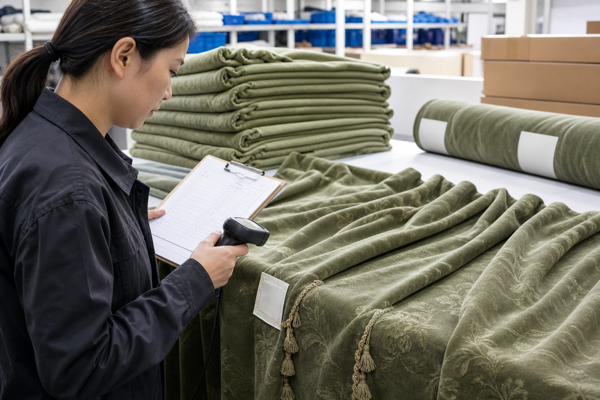
Passing documentation does not control an undocumented substitution. The quality plan should stop production when a face fabric, lining, coating, finish, treatment source, or factory process changes from the approved reference.
Useful factory checks include:
- Incoming material codes against the approved bill of materials
- Roll, dye-lot, and treatment-batch records
- Face and lining shade against the sealed sample
- Finished dimensions, heading, seams, weights, and label position
- Blackout closure and visible-light leakage at the approved mock-up
- Carton marks linked to room or opening schedules
- A retained production sample from the shipped batch
Installation teams also need clear instructions. Curtains must not obstruct exits, exit signs, fire-protection equipment, or maintenance access. Clearances around heaters, luminaires, sprinklers, and other equipment should follow the approved project drawings and local requirements. A flame-retardant test result does not make poor placement acceptable.
After handover, the operator needs a simple rule: clean the curtains only by the approved method and review the fire-performance file before repair, replacement, retreatment, or reinstallation. A replacement panel should not be selected only by color.
Six purchasing mistakes that create late-stage risk
1. Requesting an "international FR certificate"
There is no single certificate that approves every hotel curtain worldwide. Name the destination, standard, method, result, and acceptance authority.
2. Accepting a report with a similar fabric name
Commercial names can change between mills, converters, and curtain factories. Match technical codes and material descriptions, not appearance alone.
3. Testing the face fabric but buying a layered blackout curtain
Ask whether the final combination must be tested or otherwise accepted. Keep the report scope and production bill of materials together.
4. Ignoring cleaning until hotel operations takes over
Treated finishes may have specific wash-life and care limits. Put those limits into the operator's maintenance file and laundry instructions.
5. Allowing substitutions without a compliance review
A different lining, coating, color, or treatment source may change the evidence required. Use a written deviation process before production continues.
6. Treating a laboratory report as the entire fire-safety strategy
Curtain selection is one part of a building's fire precautions. Egress, alarms, sprinklers, ignition sources, housekeeping, installation position, and fire-risk management remain separate responsibilities.
How ShadeCort can support a controlled hotel-curtain order
ShadeCort custom fabric drapery can be developed for hotels, serviced apartments, student residences, contractors, importers, and commercial interior projects. For a flame-retardant curtain inquiry, send the destination, room and public-area schedule, required test method and edition, target classification or result, curtain construction, blackout requirement, cleaning expectation, quantity, label format, and approval process.
ShadeCort can then review available face fabrics and linings, develop samples, coordinate tracks and finished construction, prepare production records, and plan batch inspection around the agreed bill of materials. Supporting reports and claims must be confirmed for the exact selected construction and destination before they are included in a project submittal.
Contact the ShadeCort project team or email info@shadecortresources.com with the project location and the fire consultant's written requirement. That short brief is more useful than asking for a generic FR curtain price.
Sources and further reading
- NFPA: available editions of NFPA 701
- International Code Council: 2024 IFC Chapter 8, decorative materials and furnishings
- California Office of the State Fire Marshal: Flame Retardant Chemicals and Fabrics
- BSI: BS 5867-2:2008 scope and status
- BSI: BS EN 13773 curtain and drape classification scheme
- UK Government: Fire safety risk assessment for sleeping accommodation
- ISO: ISO/IEC 17025 requirements for testing and calibration laboratories
FAQ
What flame-retardant standard should hotel curtains meet?
The required standard depends on the destination, adopted code, occupancy, curtain use, hotel-brand specification, and the authority reviewing the project. U.S. projects may reference NFPA 701. UK projects may reference BS 5867-2, while European specifications may use EN 13773. Ask the responsible fire consultant or authority to name the standard, edition, method, and acceptance result in writing.
Does an NFPA 701 report make a curtain fireproof?
No. NFPA 701 evaluates flame propagation of textiles and films under defined test conditions. It does not prove that a textile cannot burn or that it is safe in every installation. Use "meets the specified NFPA 701 test criteria" only when the exact supplied material and report support that statement.
Must the blackout lining be included in flame testing?
That depends on the required standard and approval route. BS 5867-2 covers fabric assemblies and BSI states that multi-layer curtains should be tested in the combination in which they will be used. For any market, ask the project reviewer whether the finished face-and-lining construction needs testing or other acceptance. Do not assume that a face-fabric report covers a different lining.
What is the difference between treated FR and inherently flame-resistant fabric?
Treated FR fabric receives a flame-retardant finish during manufacturing or after weaving. Inherently flame-resistant fabric relies on the fiber or polymer composition for its claimed behavior. Both still need project-appropriate test evidence, exact product identification, and care instructions. The description alone is not an approval.
Can washing reduce flame-retardant performance?
It can for some treated textiles. The UK sleeping-accommodation guide warns that flame-retardant treatments may have a limited wash life. Confirm the cleansing procedure and number of cycles used for the report, then give the same care limits to the hotel operator. Do not change the laundry method without reviewing the supplier's instructions and project requirements.
How can a buyer verify a curtain test report?
Match the laboratory, report number, specimen code, fiber, weight, color or finish, treatment, lining, test method, edition, cleansing condition, result, dates, and limitations against the purchase order and approved sample. When accredited testing is required, confirm that the laboratory's accreditation scope covers the cited method. Contact the issuing laboratory if the file appears incomplete or altered.
What should be retained after the curtains are installed?
Keep the complete test report, supplier declarations, care instructions, label sample, approved construction, sealed sample reference, batch list, inspection records, and approved deviations. The operator should be able to trace a replacement or repaired panel to the same controlled specification.
Can ShadeCort supply flame-retardant blackout curtains for B2B projects?
ShadeCort can review project-specific face fabrics, blackout linings, finished constructions, tracks, samples, and documentation requirements for hotel and commercial orders. Availability and fire-performance evidence must be confirmed against the exact selected materials, test route, and destination. Send the written compliance brief before requesting a final quotation.