Quick Answer
The most useful questions to ask a window treatment supplier are the ones that turn a sales promise into evidence. Before ordering, confirm the legal entity and production site, what is made in-house, the exact product construction, dimensional tolerances, sample approval method, MOQ basis, quotation scope, lead-time trigger, inspection plan, packaging, shipping documents, and remedy for nonconforming goods. Ask for drawings, component lists, test reports for the exact construction, sample records, and inspection criteria where relevant. A detailed answer is useful. A quick “yes, we can do it” is only the start of the next question.
The Costly Problem Is a Vague Yes
A new supplier may answer every early question positively. They can make the size. They can match the color. They can add a motor. They can meet the date. None of those answers tells a buyer what will actually be produced.
Window treatments combine textiles, fabricated hardware, dimensions, operating systems, packaging, and installation interfaces. A quotation can look complete while one supplier has priced only the shade, another has included brackets and controls, and a third has assumed a different fabric or rail. The gaps often appear after the deposit, when changes cost more and the installation date is already fixed.
This guide adapts a practical supplier-interview format to blinds, shades, and curtains. The aim is not to interrogate a sales representative. It is to create a comparable record before sampling and ordering.
Who This Guide Is For
Use this checklist if you are:
- an importer or wholesaler adding a new window treatment line;
- a hotel, serviced-apartment, or commercial procurement team;
- a contractor coordinating products with site dimensions and installation dates;
- a designer who needs a visual sample to become a repeatable production standard; or
- a brand sourcing private-label, OEM, ODM, manual, or motorized products from China.
For a simple repeat order, some questions can be answered by the existing specification and purchase history. For a new supplier or new construction, work through the full list.
How to Use the Questions
Send a short project brief first: product type, sizes or size range, quantities, destination, target date, operating method, required accessories, and any known market or project requirements. Then ask the questions in stages.
The first call should establish fit. The next exchange should lock the product and commercial basis. Final inspection, packing, and claims procedures belong in the purchase-order package. Asking all 21 questions in one unstructured message usually produces a long reply that is hard to compare.
Questions About the Company and Factory
1. Which legal entity will quote, invoice, receive payment, and accept the order?
Request the registered company name and confirm that the same entity appears consistently across the quotation, bank details, contract, and commercial documents. A factory, sales company, and export company may be related, but the buyer should understand each party’s role before paying.
The U.S. International Trade Administration recommends due diligence on foreign partners because it can reduce exposure to loss and liability. Its guidance includes company background checks and direct evaluation of a prospective partner. This does not replace local legal advice, but it is a sensible starting point.
2. Where will the order actually be made, and what is subcontracted?
Ask where cutting, sewing, assembly, motor programming, finishing, inspection, and packing take place. Subcontracting is not automatically a problem. Undisclosed subcontracting is.
A credible answer names the production site and explains which processes are controlled there. If fabric coating, track bending, wood finishing, or electronics are sourced elsewhere, ask how incoming materials and changes are checked.
3. Can you show experience with a comparable product and order type?
Do not ask only whether the supplier has exported before. Ask for an anonymized example close to your product: a similar width range, curtain heading, motor platform, packaging format, or room schedule.
The best evidence might be a sample, drawing, bill of materials, inspection form, or packaging mock-up. Customer names are not necessary. You are checking whether the team understands the work, not asking it to disclose another buyer’s confidential information.
Questions About the Window Treatment Specification
4. What exact construction is included in your quotation?
Ask the supplier to state the system, fabric, color, rail or track, brackets, control method, accessories, and packing unit. For drapery, include heading, fullness, lining, hem, joining, weights, hooks, and track. For shades, include tube or headrail, bottom rail, operating mechanism, brackets, and side-channel or cassette details where used.
Use ShadeCort’s shade categories or drapery range to identify the product family before requesting a detailed construction review.
5. Which dimensions are finished dimensions, and what tolerances apply?
Clarify whether width means bracket-to-bracket, fabric width, track width, or finished curtain width. Confirm drop, deductions, stack-back, fullness, overlap, return, and mounting clearances where applicable.
Ask how tolerances are measured and recorded. A drawing with named dimensions is more useful than a general statement that the product will be “made to size.”
6. What does blackout mean for this construction?
An opaque fabric does not by itself control light at the perimeter. Ask separately about fabric opacity and the assembled system: center overlap, side returns or channels, headbox, sill condition, track position, and installation gaps.
For curtains, request a representative full-size mock-up when edge control matters. For shades, ask whether the quoted construction includes the hardware needed for the target room condition. Avoid treating a fabric swatch as proof of installed blackout performance.
7. Which fabric lot, color standard, and finish will control bulk production?
Name the color reference and approval method. Photos are useful for discussion but unreliable for color approval because screens, cameras, and lighting differ.
Ask whether the approved sample is cut from stock or from a production-intent lot, how lot changes are recorded, and what happens if the selected fabric becomes unavailable. Any substitution should require written approval.
8. What hardware and installation accessories are included?
List brackets, screws, anchors, tracks, connectors, stops, carriers, wands, chains, safety devices, remotes, chargers, gateways, and spare parts. Then assign responsibility for the wall or ceiling substrate and site-specific fixings.
This question prevents a familiar site problem: a visually correct window treatment arrives, but the installation team lacks one small component that was never priced.
9. For motorized products, what is the complete control and electrical scope?
Ask for motor model, power method, voltage, torque basis, control protocol, remote channels, gateway requirements, wiring responsibility, limits, grouping, commissioning, and handover documents. Confirm what happens after a power interruption and how replacement motors are matched later.
ShadeCort’s motorization overview can help buyers identify control questions, but compatibility and performance still need confirmation for the exact motor, load, dimensions, and destination.
What a Useful Supplier Answer Looks Like
| Topic | Weak answer | Useful answer | Evidence to request |
|---|---|---|---|
| Production scope | “We are a factory” | Names the production site and in-house versus subcontracted processes | Site address, process flow, relevant production photos or visit |
| Product construction | “Same as your picture” | Lists fabric, system, hardware, controls, accessories, and packing basis | Drawing, component list, coded sample |
| Compliance | “We have certificates” | Identifies the destination requirement and whether the exact quoted construction is covered | Current report, model or material scope, issuer, date |
| Sample approval | “Sample will match bulk” | Defines which signed or coded sample controls color, construction, and workmanship | Approval record and retained reference sample |
| Lead time | “About 30 days” | States when the clock starts and names material, approval, and production dependencies | Milestone schedule |
| Inspection | “Our QC checks everything” | Defines checkpoints, defect classes, sampling plan, and release authority | Inspection checklist and report template |
| Packing | “Export carton” | Specifies unit protection, carton size and weight, labels, long-part protection, and pallet plan | Packaging drawing or packed sample |
Questions About Compliance and Product Ownership
10. Which destination requirements apply to this exact product?
Do not begin with “Do you have CE, FCC, NFPA, or child-safety certification?” Begin with the destination, product type, installation, operating system, and buyer or authority requirement. Then ask which evidence applies to the exact material and construction being quoted.
For example, U.S. requirements for corded window coverings distinguish stock and custom products and include provisions for operating and inner cords plus permanent product markings. The U.S. Consumer Product Safety Commission provides current business guidance. Commercial drapery projects may also have project-specific fire-testing or documentation requirements. Review ShadeCort’s compliance information as a discussion point, then verify scope for the actual order.
11. Who owns the drawings, tooling, packaging artwork, and custom development?
Private-label and OEM work can involve buyer artwork, supplier platforms, custom profiles, firmware settings, or tooling. Record which items are buyer-owned, supplier-owned, exclusive, reusable, or subject to a minimum purchase.
Also ask who may authorize revisions. A clear ownership and change record is more useful than relying on assumptions after development has started.
Questions About Price, MOQ, and Samples
12. What creates the MOQ?
A finished-product MOQ may not be the real constraint. Fabric color, coating, dyed lot, printed packaging, motor model, aluminum finish, or custom component can each have a different minimum.
Ask the supplier to separate these layers. This helps a buyer decide whether to reduce customization, combine sizes under one material, hold components for repeat orders, or accept a surcharge for a trial run.
13. What does the price include, and which Incoterm and named place apply?
Compare quotations only after the product construction and commercial scope are identical. Ask whether prices include samples, tooling, labels, accessories, spare parts, inspection support, pallets, export packing, inland transport, documents, and bank charges.
If an Incoterm is used, include the named place or port and the rules version. The International Chamber of Commerce explains that Incoterms allocate specified costs, risks, and obligations between seller and buyer. They do not replace the product specification, payment terms, or remedies in the sales contract.
14. Which sample stages do you recommend, what do they cost, and what does each approve?
A fabric swatch, appearance sample, functional prototype, packaging mock-up, room mock-up, and pre-production sample do different jobs. Ask which stages are necessary for the risk of your project.
Confirm sample cost, freight, remake conditions, and whether any fee is credited after an order. More important, write down what each sample approves and what remains provisional.

15. Which approved sample or document will control bulk production?
Choose one controlled reference: a signed and dated sample, coded component set, approved drawing, bill of materials, or combined approval pack. The factory and buyer should hold matching references.
If a later email changes one detail, update the approval record. Otherwise two teams may follow two versions and both believe they are correct.
16. When does lead time start, and which milestones can stop it?
“Lead time after deposit” is incomplete if production also depends on artwork, final sizes, fabric approval, electrical details, or packaging confirmation. Ask for the start trigger and a milestone schedule covering material readiness, sample approval, production, final inspection, and shipment handover.
Also ask how a quantity or specification change affects the schedule. A supplier that names dependencies is giving a more useful answer than one that promises the shortest date.
Questions About Production and Quality Control
17. What is checked before and during production?
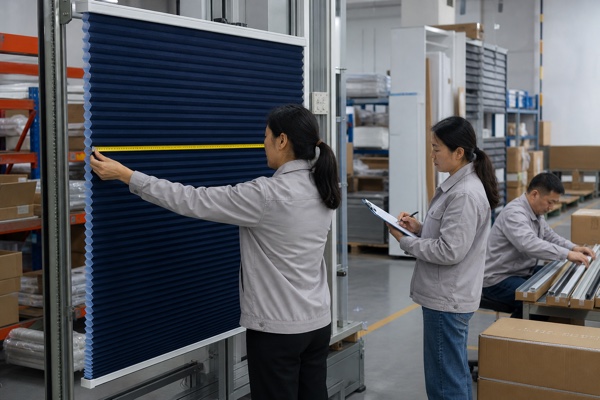
Final inspection cannot correct every upstream problem. Ask how the supplier checks incoming fabric, color and lot, hardware, motors, cut dimensions, sewing, assembly, programming, and first-off production.
The answer should match the product. Curtain workmanship checks differ from cellular shade alignment or motorized roller-shade testing.
18. What are the final inspection criteria, defect classes, and sampling plan?
Define critical, major, and minor defects for your order. State which dimensions, functions, appearance points, labels, accessories, and packing details will be checked and who can release the shipment.
ISO 2859-1:2026 provides AQL-indexed sampling schemes for lot-by-lot inspection by attributes. A buyer should not simply write “AQL inspection” and assume the job is defined. Agree on the lot, inspection level or sampling basis, defect categories, acceptance numbers, and product-specific checklist.
19. How will you control material lots, substitutions, and production changes?
Ask how the factory links finished units to fabric, component, or motor lots where traceability matters. Require written approval before changing an approved material, component, construction, process, or supplier.
This is particularly important for repeat programs. A change that seems invisible in one sample may alter color, fit, sound, compatibility, care, or service parts later.
Questions About Packing, Delivery, and Problems
20. How will each product be packed, labeled, and matched to the installation schedule?
Request the unit pack, carton plan, carton dimensions and weight, labels, room or window references, accessory location, palletization, and protection for long tracks or rails. For projects, the installer should be able to identify the correct unit without opening several cartons.
Ask for a packaging mock-up when damage, mixed room schedules, retail presentation, or long components create unusual risk.
21. What happens if inspection fails, goods arrive damaged, or site quantities change?
Agree on the process before a problem exists. Who receives the report? Can defects be reworked before shipment? What evidence is needed for a claim? Who pays for sorting, replacement, or expedited parts when responsibility is established? How are missing accessories and site spares handled?
Also confirm payment milestones, shipment-release authority, required documents, and the basis of any freight estimate. The answer may vary by order, but it should be written and connected to the purchase contract.
Common Red Flags in Supplier Replies
A single weak reply does not automatically disqualify a supplier. A pattern matters more. Follow up when you see:
- certifications mentioned without model, material, date, issuer, or scope;
- a quotation based only on a reference photo;
- no distinction between fabric width and finished width;
- “blackout” used without discussing perimeter light;
- a sample promise with no bulk-production reference;
- an unusually short lead time with no approval or material assumptions;
- resistance to a reasonable third-party inspection; or
- bank details that do not match the agreed entity and have no documented explanation.
The point is not to search for a supplier that never says no. A useful supplier explains limits early and offers a workable next step.
How ShadeCort Can Support the Qualification Process
ShadeCort is a China-based window treatment supplier for B2B buyers. For a defined brief, the team can review manual or motorized product options, discuss construction and accessories, prepare relevant samples, and align quotation and approval points. The exact scope, MOQ, evidence, timing, and destination requirements still need confirmation for each order.
A practical first exchange is simple:
- Send the product type, sizes, quantities, destination, and target date.
- Identify the fabric, appearance, operating method, and project requirements that cannot change.
- Ask ShadeCort to mark assumptions, exclusions, and open decisions in the quotation.
- Approve the necessary sample and document set before bulk release.
- Agree on inspection, packing, and shipment-release criteria.
This process gives both sides a clearer basis for the order. It also makes a supplier comparison fairer because competing quotations can be reviewed against the same brief.
Buyer’s Checklist Before Paying a Deposit
- The contracting and payment entity is confirmed.
- The production site and subcontracted processes are understood.
- The quotation names the exact construction and included accessories.
- Finished dimensions and tolerances are defined.
- Destination and project requirements have been reviewed for the exact product.
- MOQ drivers and sample stages are clear.
- The approved bulk-production reference is identified.
- Lead-time start and approval dependencies are written.
- Inspection criteria and remedies are agreed.
- Packaging, labels, documents, and shipment handover are recorded.
Request a Supplier Qualification Review
Send ShadeCort one representative product, size schedule, expected quantity, destination market, and target delivery date. The team can review the brief and identify the questions that need answers before quotation, sampling, or production. Contact ShadeCort to request a project-specific discussion.
Sources and further reading
- U.S. International Trade Administration: Perform Due Diligence
- U.S. Consumer Product Safety Commission: Window Coverings 15(j) Rule Business Guidance
- ISO 2859-1:2026: Sampling procedures for inspection by attributes
- International Chamber of Commerce: Incoterms 2020
FAQ
What are the most important questions to ask a window treatment supplier first?
Start with the legal entity, actual production site, comparable product experience, and exact construction included in the quote. These questions establish whether the supplier fits the project and whether quotations can be compared. Move to samples, lead time, inspection, packing, and remedies once the basic product and company fit is credible.
How can I tell whether a supplier’s answer is reliable?
Look for specific, checkable detail. A useful answer names a material, drawing, process, model, tolerance, report scope, milestone, or responsible party. Ask for an appropriate record or physical sample where the risk justifies it. One document cannot prove the whole relationship, so compare the answer with the quotation, sample, factory discussion, and later inspection results.
Should I ask a supplier for every certificate it has?
No. Give the supplier the destination, product type, operating system, installation, and buyer or project requirement. Then ask which current evidence covers the exact quoted construction. A report for a different motor, fabric, model, or test scope may not support your order. Use a qualified compliance adviser or local authority where the requirement is uncertain.
Is a golden sample enough to control bulk quality?
A retained approved sample is useful, but it should sit beside the drawing, bill of materials, workmanship criteria, dimensions, labels, packing instructions, and change record. One sample may not show tolerances or every size. The purchase order should identify which documents and samples form the approved production standard.
What should I ask about AQL inspection?
Ask which sampling standard and edition will be used, how the lot is defined, the sampling or inspection level, defect classifications, acceptance and rejection numbers, and the product-specific checklist. “AQL” alone does not identify what inspectors will check or what happens after a failed result.
How should I compare two window treatment suppliers?
Send both suppliers the same brief and use the same comparison sheet. Compare construction, evidence, sample plan, MOQ drivers, inclusions, lead-time assumptions, quality controls, packing, communication, and problem-handling process. A lower unit price is not comparable if it excludes hardware, uses a different fabric, or leaves inspection and packaging undefined.
Can ShadeCort answer these questions before I request samples?
ShadeCort can review a defined B2B brief and discuss relevant construction, customization, sample, quotation, and approval points before sampling. The amount of detail available depends on the chosen product and how complete the buyer’s requirements are. Send one representative item first so the discussion stays specific and useful.