Quick Answer
Thermal curtains can help a hotel or apartment project manage unwanted solar heat gain and improve comfort near windows. Fabric weight alone does not prove how the installed room will perform. A B2B buyer should specify the face fabric and lining, finished window coverage, track, room orientation, climate, operating schedule, and approval method. Test a production-representative room before bulk production. Curtains can support the window system, but they do not replace efficient glazing, repair air leakage, or guarantee a fixed percentage of energy savings.
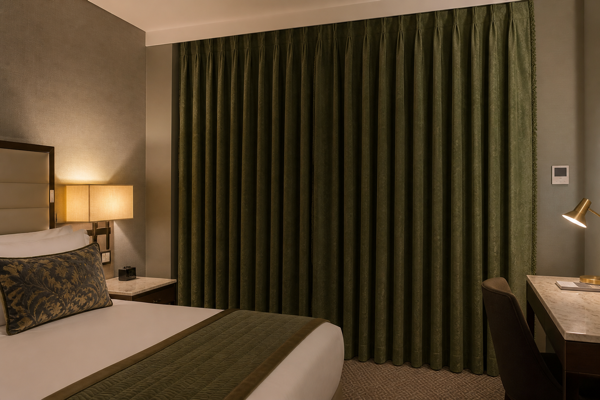
At four o'clock, the west-facing rooms are warm again. Guests lower the thermostat. Housekeeping opens every curtain the next morning. The purchasing file says "thermal curtain," but nobody defined when the curtain should be closed, how it should cover the window, or what result the sample room had to meet.
The supplier may have delivered exactly what the purchase order described. The building can still miss the intended outcome.
This is a common B2B problem because the word "thermal" sounds like a measurable result while the specification often treats it as a fabric label. For a hotel, serviced apartment, student residence, or build-to-rent project, the result depends on the complete window, curtain, installation, and operating routine.
The business problem sits at the perimeter of the room
Rooms beside large glazed areas can feel different from rooms deeper inside the building. Direct sun may raise cooling demand in the afternoon. In cold weather, a guest seated near a window may feel uncomfortable even when the room thermostat shows the expected temperature. Glare, warm glass, cold glass, air leakage, and uneven HVAC distribution can all be part of the complaint.
A curtain can address some of that exposure. It can provide an interior layer between the occupied room and the glazing, and it can reduce direct solar radiation when closed. It cannot fix a poorly sealed frame, undersized HVAC equipment, or the wrong glazing for the climate.
That distinction protects both buyer and supplier. If the contract describes an energy outcome without defining the rest of the window system, the curtain is being asked to carry a claim that it cannot prove on its own.
What thermal curtains can and cannot do
A useful specification separates three questions.
- Textile construction: What are the face fabric, lining or backing, color, weight, and relevant test documents for the exact approved construction?
- Installed coverage: How closely does the finished curtain cover the window, and how does the heading, track, center closure, side condition, and bottom condition affect the opening?
- Operation: When will the curtain be open or closed, who controls it, and does that schedule match the climate and window orientation?
The first question belongs to the sample room and laboratory file. The second belongs to design coordination and installation. The third belongs to hotel operations, the controls contractor, or the occupant.
When those responsibilities are mixed together, "thermal" becomes a marketing term. When they are documented separately, the project has something it can inspect.
Why "heavy fabric" is an incomplete specification
Dense fabric may contribute to an insulating curtain assembly, but weight is not a substitute for system data. Color and backing also affect how a curtain handles solar radiation. Coverage matters because heat can still move around a loosely fitted interior curtain. The base window matters because single glazing, insulated glazing, low-e coatings, frame construction, and air leakage do not behave the same way.
The U.S. Department of Energy explains that window energy performance is strongly affected by U-factor and solar heat gain coefficient. It also notes that interior blinds or shades can reduce unwanted solar heat gain. Those window ratings belong to the window, not automatically to an untested drapery. For a hotel project, they are useful inputs when the curtain supplier and project consultant review the opening.
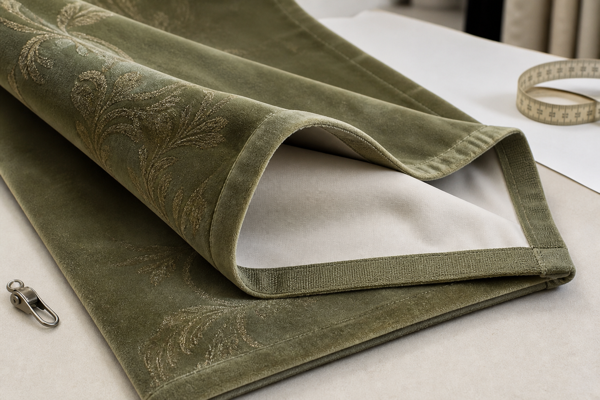
This is also why blackout and thermal performance should not be treated as synonyms. A curtain may be designed to block visible light, manage heat transfer, or do both. Buyers whose main concern is daylight should first define the difference between room darkening and true blackout before adding thermal requirements.
What the published evidence supports
The strongest practical conclusion is modest: window coverings can help manage heat, but the result changes with the window, climate, product, and how the covering is used.
The U.S. Department of Energy advises using window coverings to prevent daytime heat gain. Its Energy Saver guide gives a more specific warm-weather example: medium-colored draperies with a white backing can reduce heat gain, and draperies should be closed on windows receiving direct summer sun.
Research from Lawrence Berkeley National Laboratory goes one step further. Its modeling of operable window attachments found that the open, partly open, or closed position can have a large effect on energy performance. The results also changed by climate and base window. In cooling-dominated locations, the modeled attachments reduced energy use. In heating-dominated locations, balanced solar control and insulation mattered, and some operating choices offered little benefit or could increase total energy use.
There is an important limit to that evidence. The cited LBNL study modeled residential buildings and several attachment categories. It does not provide a universal savings number for hotel drapery or for a ShadeCort product. A hotel energy estimate should come from project-specific testing or building simulation using the actual climate, glazing, orientation, curtain construction, operating schedule, and HVAC controls.
What to put in a B2B thermal curtain specification
Use the table below as a coordination checklist. It does not replace the architect's window schedule, the mechanical engineer's calculations, local code, or a project-specific test plan.
| Project item | What the buyer should specify | Why it matters | Approval evidence |
|---|---|---|---|
| Climate and season | Project location, cooling or heating priorities, and seasonal operating intent | The same solar control strategy does not suit every climate | Design brief or consultant note |
| Window orientation | North, south, east, and west openings identified in the room schedule | Direct solar exposure changes by orientation and time of day | Marked window schedule |
| Base window | Glazing type, frame condition, available U-factor and SHGC data, and known air-leakage issues | The curtain works with the window, not independently of it | Window data sheet and site survey |
| Curtain construction | Approved face fabric, lining or backing, color, weight, sewing details, and requested reports | "Thermal" must refer to a defined sample, not a generic fabric family | Sealed sample and document register |
| Finished coverage | Finished width and height, fullness, center closure, side condition, top condition, and bottom clearance | Gaps and loose coverage change the installed result | Dimensioned elevation and section |
| Track and stack | Track type, mounting location, carriers, draw direction, and clear stack space | Hardware affects closure, repeatable operation, and usable glass area | Hardware sample and shop drawing |
| Control method | Manual, wall switch, remote, room control, or building control interface | A curtain provides little solar control when it stays open at the wrong time | Controls narrative and functional test |
| Operating schedule | Expected open and closed periods by orientation, season, occupancy, or room status | Deployment can change the energy result | Written sequence of operation |
| Compliance | Target market, fire requirements, labeling, test method, and documentation validity | Approval must apply to the exact supplied construction | Current reports and approved labels |
| Room mock-up | Representative orientation, glazing, curtain, track, installation, and agreed inspection conditions | The mock-up exposes conflicts that a swatch cannot show | Signed room report with photos |
| Bulk quality control | Tolerances and checks for dimensions, shade, lining, sewing, hardware, labels, and packing | Production must match the approved room standard | Inspection plan and batch records |
Specify for the climate, not the product name
Cooling-dominated projects
For a hot climate or a facade with strong solar exposure, identify which windows receive direct sun and when. The design team may favor a light or reflective backing, dependable coverage, and an operating schedule that closes the curtain before the room has already overheated. West-facing glass deserves particular attention because low afternoon sun can be difficult to shade.
Do not turn that general approach into a fixed recipe. The selected glazing may already have a low solar heat gain coefficient, and the project may need daylight or view at certain times. The curtain specification should follow the building strategy rather than compete with it.
Heating-dominated projects
Cold-climate operation is more complicated than "keep the curtain closed." Solar gain may be useful during part of a winter day, while an interior layer may be useful after sunset. The correct balance depends on orientation, glazing, outdoor conditions, and occupancy. Air leakage also needs separate attention because a curtain does not seal the window frame.
Ask the project energy consultant to define the intent by season. That instruction is more useful to the factory than a broad request for the thickest available material.
Mixed climates
Mixed climates need a seasonal plan. A schedule that helps in July may not be the best schedule in January. If hotel staff or residents are expected to manage the curtain manually, keep the operating instruction simple enough to be followed. If the intended routine is too complex for daily operation, automation may be a better fit.
Operation is part of the product decision
A manually operated curtain is only deployed when somebody closes it. In a guest room, the guest may prefer the view. Housekeeping may reopen the curtain after servicing the room. An unoccupied room may remain exposed to afternoon sun for hours.
This does not make manual drapery a poor choice. It means the buyer should be honest about the operating assumption used in any energy claim.
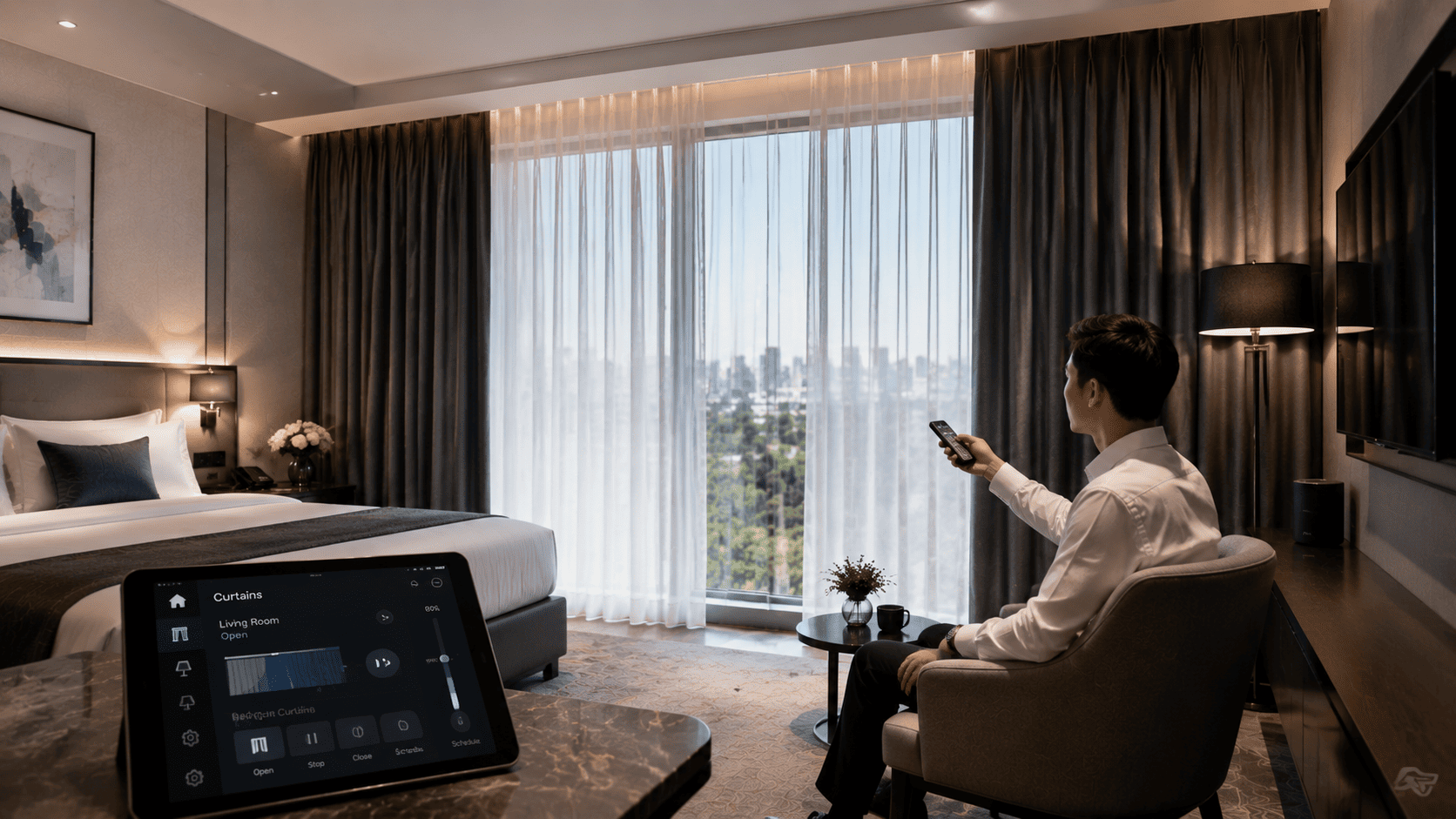
Projects that need scheduled closing, room-status logic, or consistent operation across many windows can coordinate the drapery with a motorized curtain system. The controls sequence should state who has priority, what happens when a guest operates the curtain, how the system responds during room turnover, and what the curtain does if a motor or control signal fails.
Motorization also changes the hardware and sample-room scope. Confirm motor torque, track length, curtain weight, power location, control protocol, access for maintenance, stack space, noise expectations, and manual override before production.
Five purchasing mistakes that weaken the project
1. Asking for a universal energy-saving percentage
A percentage without a defined baseline, climate, window, room model, and operating schedule is not a reliable project promise. Ask what was measured or modeled and whether it matches the proposed installation.
2. Comparing fabric weight as if it were thermal performance
Weight can describe one material property. It does not describe solar reflectance, emissivity, installed coverage, air movement around the curtain, or the base window. Approve the complete construction and request the documents relevant to the project.
3. Ignoring orientation in the room schedule
Two identical rooms can have different afternoon conditions when their windows face different directions. Mark orientation before sampling so the mock-up represents the harder case.
4. Leaving the operating schedule until handover
An energy concept that depends on the curtain being closed must identify who closes it and when. Coordinate guest control, housekeeping routines, and any automation while the track and controls are still being designed.
5. Treating the curtain as a repair for the window
Condensation, frame leakage, failed seals, and unsuitable glazing require building-envelope review. A thermal curtain may support comfort, but it should not hide a separate defect.
A practical sample-room approval process
Start with one representative room, preferably one with the orientation and glazing condition most likely to create discomfort. Install the production-representative curtain, lining, track, motor if required, and final mounting detail.
Before the inspection, agree on the questions the room must answer. These may include:
- Does the curtain close and stack correctly without dragging or twisting?
- Does the installed coverage match the approved drawing?
- Does the face appearance and lining match the sealed sample?
- Can staff and guests operate the system as intended?
- If thermal measurements are required, who records them, with what instrument, under which indoor and outdoor conditions, and against what baseline?
The last question matters. A single surface-temperature photo can be useful during troubleshooting, but it is not a complete building energy test. For a performance claim, use a method agreed by the project's energy consultant and record the weather, glazing, room state, HVAC state, curtain position, time, and measurement locations.
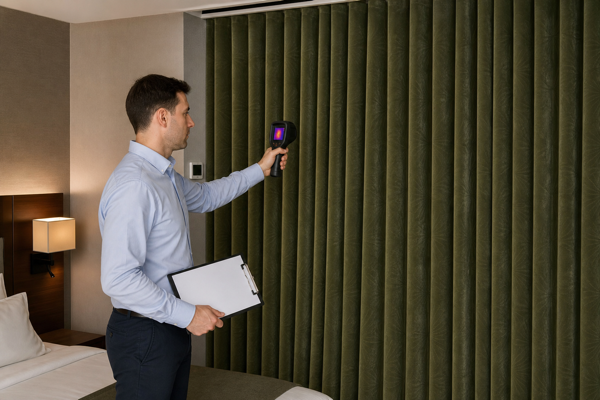
After approval, transfer every accepted detail into the purchase order, shop drawing, inspection plan, and installation instructions. The signed room should be the production reference, not a one-off display that the bulk order quietly changes.
How ShadeCort can support a thermal curtain project
ShadeCort custom fabric drapery can be developed for hotel, apartment, hospitality, and commercial window treatment projects. For thermal curtain inquiries, the most useful first package includes the project location, room count, window schedule, orientation, glazing information, drawings, operating method, target documents, and expected mock-up process.
ShadeCort can then coordinate fabric and lining samples, curtain construction, tracks, motorized options, shop-drawing information, packaging, and bulk inspection around the approved project scope. Product availability and supporting documents should be confirmed for the exact selected material and destination market.
Contact the ShadeCort project team or email info@shadecortresources.com with a typical window drawing and project location. That is enough to start a useful technical conversation before pricing and sampling.
Sources and further reading
- U.S. Department of Energy: Spring and Summer Energy-Saving Tips
- U.S. Department of Energy: Energy Saver Guide
- Lawrence Berkeley National Laboratory: Residential Windows and Attachments
- U.S. Department of Energy and Lawrence Berkeley National Laboratory: Energy Savings from Window Attachments
- U.S. Department of Energy: Window Types and Technologies
FAQ
Do thermal curtains reduce hotel energy use?
They can help manage solar heat gain and heat transfer at windows, but the result depends on climate, glazing, orientation, curtain construction, installed coverage, operating schedule, and HVAC controls. A supplier should not promise one savings percentage for every hotel. Project-specific simulation or testing is needed for a quantified energy claim.
What makes a curtain "thermal"?
The term usually refers to a curtain construction intended to improve heat control, often through a dense face fabric, an opaque lining or backing, and suitable window coverage. Because the term is used broadly, B2B buyers should specify the exact layers, color, weight, documents, dimensions, and approval method instead of relying on the label alone.
Are thermal curtains and blackout curtains the same?
No. Blackout describes visible-light control. Thermal performance concerns heat flow and solar heat gain. One curtain construction may address both requirements, but each outcome should be specified and approved separately.
Can thermal curtains replace low-e or insulated glazing?
No. Curtains are interior window attachments. They can support the performance of the window area, but they do not replace suitable glazing, repair failed seals, or stop air leakage through the frame. Glazing and curtain decisions should be coordinated.
Should hotels motorize thermal curtains?
Motorization is useful when the project needs scheduled operation, room-status logic, group control, or a repeatable response to sun exposure. It is not required for every room. The decision should consider guest control, housekeeping routines, power, control integration, maintenance access, curtain weight, and project budget.
How should a buyer verify a thermal curtain before bulk production?
Approve the exact face fabric, lining, sewing, dimensions, track, and controls in a representative room. Record the window orientation, glazing, installation detail, curtain position, and inspection conditions. If the contract includes a measured thermal result, use a method and baseline approved by the project's energy consultant.
Can ShadeCort supply OEM or ODM thermal curtain systems?
Yes. ShadeCort supports B2B custom curtain projects with fabric and lining options, tracks, motorization, sampling, and project-specific production. Send the project location, window schedule, drawings, quantity, operating method, compliance needs, and mock-up requirements so the team can review the correct construction and documents.