Quick Answer
To shortlist curtain manufacturers in China, verify what each supplier actually controls before comparing prices. Confirm whether it makes fabric, converts fabric, or produces finished curtains; then check the exact construction, sample-to-bulk controls, destination-market evidence, labeling, packaging, production capacity, inspection plan, system responsibility, and pilot-order process. A supplier list can help you find leads, but it cannot qualify them. The safer shortlist is built from project-specific evidence: an approved specification, traceable samples, valid documents, agreed defect limits, and a clear owner for every deliverable.
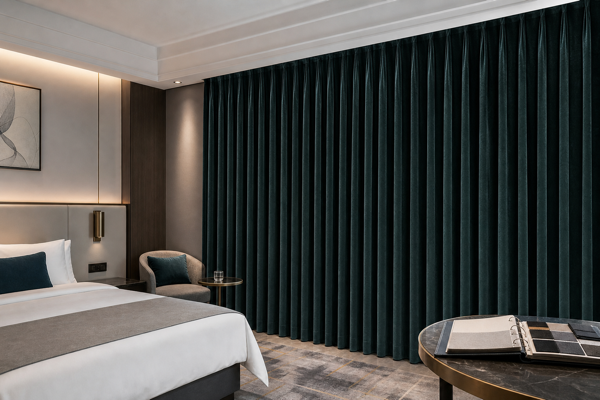
Searching for a curtain factory often starts with a familiar routine: collect a list, compare catalog photos, request three prices, and ask who can ship first. That works until the sample looks right but the bulk order does not. The header changes. The shade shifts between lots. Packaging labels are incomplete. A test report covers a different fabric construction. Hardware arrives from another subcontractor and no one owns the fit problem.
By then, the cheapest quotation is no longer cheap. The buyer is paying for another sample round, relabeling, a failed inspection, site rework, or a missed handover date.
The reference article behind this guide uses a useful shortlist format and maps several Chinese textile regions. We have kept that practical logic, but changed the central question. Instead of asking which supplier name belongs on a top-ten list, this guide asks what evidence a B2B buyer should collect before any supplier reaches the final shortlist.
A Supplier List Is a Starting Point, Not a Qualification
The phrase “curtain manufacturer” covers several different businesses. One company may weave greige fabric. Another may dye, coat, or laminate it. A converter may source the base cloth and manage finishing. A sewing factory may buy finished fabric and make panels. A trading company may coordinate all of those steps.
None of those models is automatically wrong. The risk appears when the buyer assumes the supplier controls a process that it actually outsources.
For finished project curtains, ask for a process map that names the party responsible for fabric production, dyeing or coating, cutting, sewing, header construction, lining, track or hardware supply, packing, inspection, and export documents. Then ask which operations happen at the quoted site and which happen elsewhere. This is more useful than asking only, “Are you a factory?”
1. Confirm What the Supplier Actually Makes
Start with the commercial scope, not the company introduction. Is the quotation for fabric by the meter, made-to-measure curtain panels, a complete drapery set, or a window-treatment package that includes tracks and accessories?
Ask the supplier to mark each line item as made in-house, purchased, or subcontracted. Request the business name and production address that will appear on the purchase order and inspection booking. If the proposed scope includes custom drapery, compare it with the construction choices on ShadeCort's custom fabric drapery page so the inquiry identifies the finished product rather than only a fabric style.
Buyer checkpoint: You should be able to describe the supplier in one accurate sentence, such as “finished-curtain maker that purchases approved fabric and sews panels in-house.” If you cannot, the shortlist is premature.
2. Match the Factory to the Product and Destination Market
A factory that performs well on ready-made residential panels may not be the right choice for hotel room schedules, extra-wide drops, lined decorative curtains, motorized tracks, or private-label retail packs. Ask for recent examples of the same product type and responsibility level. Do not accept unrelated photos as proof.
Destination market matters too. Label content, restricted substances, flammability expectations, child-safety rules, electrical requirements, and import documents vary by product and jurisdiction. For U.S. sales, the Federal Trade Commission's Textile Fiber Rule is a useful starting point for fiber-content, responsible-company, and country-of-origin disclosures on covered textile products. It is not a complete compliance checklist for every curtain system.
Create a market-specific requirement list before sampling. ShadeCort's compliance and standards overview can help frame the discussion, but the buyer should still confirm the exact product, test method, document holder, destination, and local authority requirements.
3. Turn the Design Brief Into a Controlled Specification
“Blue blackout curtain, hotel quality” is not a production specification. A supplier can interpret that phrase in several reasonable ways and still disappoint the buyer.
Your controlled specification should identify the face fabric, color reference, usable width, weight or construction where relevant, lining or coating, header type, fullness, finished dimensions and tolerances, hem and side-return details, seam placement, hooks or carriers, track interface, care label, packaging, and approved visual standard. For blackout work, include the overlap, return, top treatment, track geometry, and installation conditions. Fabric opacity alone does not prevent light at the perimeter.
For a practical example of system-level light control, see ShadeCort's blackout curtain specification guide. The useful lesson for sourcing is simple: approve the assembled condition, not just a fabric swatch.
4. Lock the Sample-to-Bulk Approval Route
Ask what each sample is intended to approve. A fabric cutting can confirm hand feel and color direction. A lab dip can approve a dye target. A finished panel can show sewing, fullness, header, lining, and hem. A room mock-up can reveal stacking, track fit, light gaps, and site dimensions. These are not interchangeable.
Record sample codes, dates, color references, signatures or digital approvals, and any accepted deviations. Keep one sealed reference sample with the buyer and one with the supplier. State which sample governs bulk production and what happens if an input material changes.
This step catches a common and expensive gap: the salesperson treats an attractive sample as approval, while production treats it as a general reference.

5. Verify the Scope and Validity of Every Document
A certificate logo in a presentation is not enough. Ask for the complete report or certificate, holder name, product description, article or style number, tested construction, test method, issue and expiry dates, and issuing body. Compare those details with the exact material in your order.
When a supplier presents an OEKO-TEX claim, the official OEKO-TEX Label Check lets buyers check a label or certificate number. OEKO-TEX also places curtains within Product Class 4 for decoration materials in its STANDARD 100 product-class explanation. That classification does not mean every curtain, supplier, or ShadeCort product is certified. The exact certificate must match the ordered article and remain valid.
Use the same discipline for flame-retardant, chemical, recycled-content, electrical, and performance documents. A report for one fabric color, backing, treatment, or motor does not automatically cover a modified construction.
6. Define Labels, Packaging, and Export Documents Before Production
Buyers often postpone packaging until the curtain is finished. That is when small omissions become manual relabeling jobs.
Approve label artwork and placement together with the product sample. Specify fiber content, care instructions, country of origin, responsible company or brand information, project or room code, size, carton mark, barcode format, and any language requirements that apply. Confirm whether individual panels, pairs, track sets, accessories, and spare parts need separate identifiers.
The packing specification should state fold method, protective layers, moisture control if required, carton strength, maximum carton weight, assortment rules, and packing-list detail. For hospitality and contractor orders, room-by-room or elevation-by-elevation packing can reduce site sorting time, but only when both sides use the same schedule revision.
The B2B Curtain Supplier Shortlist Table
Use this table during RFQ and sample review. A supplier does not need perfect paperwork on the first call, but it should be able to produce clear, consistent evidence before deposit or bulk approval.
| Check | Buyer risk if skipped | Evidence to request | Pass signal | Warning signal |
|---|---|---|---|---|
| Supplier role | Hidden subcontracting and unclear responsibility | Process map, production address, in-house/outsource list | Scope and owners are named | “We do everything” without details |
| Product fit | Good sample, wrong production capability | Comparable product records and construction examples | Same product type and order complexity | Only unrelated catalog photos |
| Controlled specification | Disputes over color, size, header, lining, or packaging | Signed specification and drawings | Measurable requirements and tolerances | Descriptive words without limits |
| Sample-to-bulk route | Bulk differs from the approved sample | Coded approval samples and change-control rule | One governing sample is identified | Multiple untracked samples |
| Compliance evidence | Rejected documents or wrong test scope | Full report, certificate number, scope, validity | Ordered article matches the evidence | Logo or cropped first page only |
| Labels and packing | Relabeling, customs delay, or site sorting errors | Approved artwork, carton mark, pack-out sample | Requirements approved before bulk | “Standard export packing” only |
| Capacity and schedule | Late delivery or split batches | Line plan, material booking, milestone dates | Capacity is tied to the actual order | Monthly capacity claim without schedule |
| Inspection plan | Buyer and factory judge defects differently | Defect list, sampling plan, inspection stage | Written accept/reject rules | Inspection discussed after production |
| System responsibility | Curtain, track, motor, or installation mismatch | Interface drawings and responsibility matrix | One owner for each interface | Components quoted separately with gaps |
| Pilot and corrective action | Full-order exposure before process is proven | Pilot lot, review record, corrective-action timing | Small run closes issues before scale | Immediate push to full production |
7. Test Capacity Against Your Real Order, Not a Monthly Claim
“We can produce 100,000 pieces per month” says little about your order. Ask which line will make it, how many operators are assigned, what other jobs share the period, when fabric and accessories are booked, and which milestones depend on buyer approval.
For color-sensitive or project-scheduled work, discuss lot planning. Splitting production may help delivery, but it can also introduce shade variation or mixed packing. Ask how the factory identifies rolls, shade groups, cut panels, rework, and replacement units.
A believable schedule contains dates and dependencies: specification freeze, lab dip, finished sample, material booking, cutting, sewing, in-line inspection, final inspection, packing, and shipment readiness. It also names what happens when the buyer misses an approval date.
8. Agree the Inspection Rules Before the Goods Exist
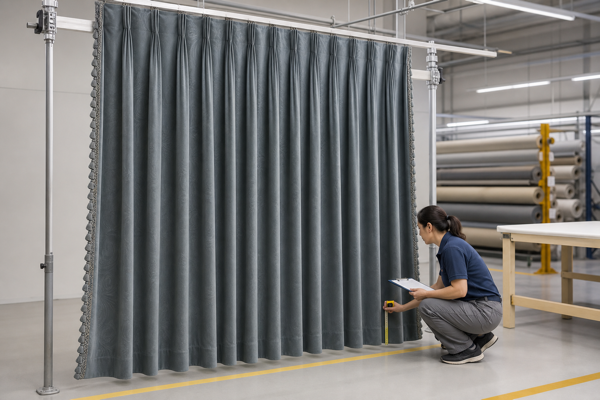
Do not wait for final inspection to decide what counts as a defect. Define critical, major, and minor defects for the product. Typical checks can include finished dimensions, shade consistency, stains, weaving faults, seam puckering, skipped stitches, header spacing, hook count, hem level, lining attachment, labels, quantities, accessories, carton marks, and pack-out.
The current ISO 2859-1:2026 describes acceptance-sampling schemes indexed by acceptance quality limit for lot-by-lot inspection. It provides a statistical framework, not a universal curtain defect standard. Buyer and supplier still need to agree the lot definition, inspection level, AQL values, defect classes, sample size, and acceptance rules for the order.
Inspection timing also matters. Intertek describes pre-production, during-production, and pre-shipment textile inspections. The right mix depends on risk. New construction, new materials, tight delivery windows, or a new supplier usually justify earlier checks because a final inspection can detect a problem but may not leave time to correct it.
9. Name the Owner of Every System Interface
A finished curtain may depend on a track, brackets, carriers, hooks, motors, controls, wiring, recess dimensions, wall build-up, ceiling access, and installer tolerances. A fabric supplier is not automatically responsible for those interfaces. Neither is a sewing factory.
Build a responsibility matrix. For each component, name who designs, supplies, approves, measures, installs, tests, and signs off. If the package includes automation, review ShadeCort's motorized window-treatment options as a prompt for control, power, track, and handover questions. Confirm every feature against the exact proposed system rather than treating a general capability page as the project specification.
Interface drawings should show stack-back, overlap, returns, bracket spacing, carrier type, finished drop, floor clearance, access for maintenance, motor orientation, cable exit, and control location where applicable.
10. Use a Pilot Order to Test the Working Relationship
The pilot is not only a product test. It tests how the supplier handles questions, revisions, nonconformities, records, packaging, and deadlines.
Choose a pilot that includes the difficult parts of the full order: an extra-wide panel, a lined construction, a room-coded pack, a motorized track, or the strictest color. Run the agreed inspection. Record corrective actions and confirm how the change will be carried into bulk production.
Pay attention to the supplier's behavior when something is wrong. A useful partner identifies the cause, contains affected work, proposes a correction, updates the control document, and gives a realistic timing impact. Fast reassurance without evidence is not the same thing.
Where Should Buyers Look in China's Curtain Supply Chain?
China's curtain and window-treatment supply chain includes finished-curtain makers, blinds manufacturers, fabric producers, component specialists, and motorized-system suppliers. The ten companies below provide a practical starting point for buyer research. ShadeCort is listed first as the featured manufacturer in this guide, while the remaining suppliers are included for comparison. The order is a sourcing reference rather than a substitute for project-specific qualification.
| Rank | Supplier | Location | Useful starting focus | What the buyer still needs to verify | Website |
|---|---|---|---|---|---|
| 1 | ShadeCort | Qingyuan, Guangdong | Integrated manual and motorized window treatments, including shades, blinds, shutters, drapery, accessories, OEM/ODM programs, and residential or commercial project solutions | Exact construction, destination-market documentation, project testing, packaging, installation interfaces, and the agreed production schedule for the quoted order | shadecortresources.com |
| 2 | STE Curtain | Hangzhou, Zhejiang | Curtains, drapery, curtain fabrics, accessories, blinds, shades, shutters, and OEM/ODM window-treatment programs | Which processes are completed in-house, fabric-lot controls, subcontractor responsibility, testing scope, and sample-to-bulk consistency | stecurtain.com |
| 3 | Dairui Textile | Shaoxing, Zhejiang | OEM/ODM and wholesale finished curtains, including blackout, sheer, linen-look, velvet, hotel, and private-label programs | Construction tolerances, fabric and treatment traceability, flame-retardant evidence where required, packing standards, and bulk capacity for the project schedule | dairui-curtain.com |
| 4 | Yuyao Liujia Window Coverings | Yuyao, Ningbo, Zhejiang | Roller, zebra, vertical, pleated, Roman, honeycomb, Venetian, and electric blind systems, together with window-covering accessories | Current certificate scope, exact production location, component compatibility, custom packaging capability, and responsibility for sourced materials | nblj.net |
| 5 | Vikson Blinds Enterprise | Heshan, Jiangmen, Guangdong | Roller, Venetian, honeycomb, zebra, Roman, pleated, skylight, outdoor blinds, and fabric curtain products | Product-specific MOQ, tooling and customization limits, market documentation, warranty terms, and quality controls for the exact item ordered | viksonblinds.com |
| 6 | ZSHINE | Guangzhou, Guangdong | Wholesale and customized blinds, motorized shades, skylight solutions, curtain pelmets, and private-label support | Factory scope versus warehouse supply, model-specific electrical certifications, hardware compatibility, replacement-part support, and delivery commitments | zshinehome.com |
| 7 | Chengdu Hehua Smart Window Coverings | Pengzhou, Chengdu, Sichuan | Manual and motorized roller, honeycomb, Venetian, zebra, Roman, vertical, bamboo, and curtain systems, including tracks and motors | Export-market documentation, control-system compatibility, motor and track ownership, installation requirements, and after-sales responsibility | rrajzebrablinds.com |
| 8 | ETEX / Wuxi EV Window Decoration | Wuxi, Jiangsu | Roller, sunscreen, zebra, and vertical blind fabrics, together with ready-made blinds and related accessories | Whether the quotation covers fabric or finished blinds, ownership of weaving, coating, assembly, and testing, plus batch traceability and color continuity | etexfabrics.com |
| 9 | UNITEC Textile Decoration | Shanghai sales office; confirm production site | Roller, sunscreen, zebra, vertical, and related window-covering fabrics for wholesale and project supply | The legal manufacturer, actual production address, certification scope, lot traceability, usable width, finishing ownership, and suitability for the finished system | unitecblinds.com |
| 10 | XIOMOO | Keqiao, Shaoxing, Zhejiang | Customizable roller, zebra, Roman, honeycomb, double-layer, zip-screen, and other shade programs for B2B buyers | Legal entity, in-house manufacturing scope, quality-control records, material suppliers, order capacity, compliance evidence, and corrective-action process | xiomoo.com |
Use this supplier list to improve lead generation, then apply the same ten checks to every candidate. A company's registered address, showroom, sales office, warehouse, and production site may be different. Verify the legal entity, the facility that will make the order, the exact product scope, and the documents that apply to the quoted construction before making a final selection.
A Practical Four-Stage Shortlisting Process
Stage 1: Desk review. Send the same one-page brief to every candidate. Eliminate suppliers that cannot define their role, product scope, production site, or evidence limitations.
Stage 2: Technical RFQ. Issue a controlled specification, quantity breakdown, destination, required documents, packaging concept, and target schedule. Compare exclusions as carefully as price.
Stage 3: Sample and audit. Approve the right sample level, review documents against the exact article, inspect the production site directly or through a qualified third party, and close open questions in writing.
Stage 4: Pilot and bulk release. Produce a representative pilot, inspect it under the agreed rules, record corrective actions, and release bulk only when the buyer's acceptance criteria are met.
This process takes more effort than collecting quotations. It also moves discovery costs to the stage where they are still manageable.
How ShadeCort Can Support the Sourcing Brief
ShadeCort is a China-based window-treatment supplier. For a defined project or wholesale brief, the team can review requested construction, samples, drawings, packaging, tracks, and production checkpoints, subject to confirmation for the exact product and destination market. That is a starting point for technical discussion, not a blanket claim that one document or product suits every jurisdiction.
When you contact the team, include the destination country, buyer type, product drawings or room schedule, quantities, fabric or performance target, heading and lining details, track or motor scope, packaging format, required evidence, and target delivery window. Use the ShadeCort contact page to request a specification review, sample discussion, or quotation.
Sources and further reading
- ISO 2859-1:2026: Sampling procedures for inspection by attributes
- Federal Trade Commission: Textile Fiber Rule
- OEKO-TEX Label Check
- OEKO-TEX STANDARD 100 product classes
- Intertek: Textile and apparel inspection
FAQ
How do I know whether a China curtain supplier is a factory or a trading company?
Ask for the legal company name, production address, process map, and a line-by-line list of work performed in-house or subcontracted. Verify those details during an on-site or third-party audit. A trading company can still be a capable coordinator, but the purchase order should state who controls quality, changes, documents, and corrective action.
Should I choose a curtain fabric mill or a finished-curtain manufacturer?
Choose according to the deliverable. A fabric mill may be suitable when your own workroom controls cutting and sewing. A finished-curtain project usually needs a supplier that can control approved fabric, panel construction, headers, lining, dimensions, hardware interfaces, labels, packaging, and inspection. Some orders need both, with responsibilities stated clearly.
What samples should I approve before bulk curtain production?
Use the sample that matches the risk. Approve color or finish with a coded fabric sample or lab dip, construction with a finished panel, and system performance with a room or track mock-up. Keep sealed reference samples and record which one governs bulk production. A small swatch cannot approve finished dimensions, sewing, fullness, track fit, or perimeter blackout.
Is an AQL inspection enough to guarantee curtain quality?
No. An AQL-based plan defines how a sample from a production lot is accepted or rejected. It does not create the product specification or decide which faults are critical, major, or minor. The buyer and supplier must agree the defect list, lot definition, inspection level, AQL values, sample size, and corrective-action process before production.
How can I verify a textile certificate supplied by a manufacturer?
Check the issuing body's official database when one is available, then compare the holder, certificate number, validity dates, article number, construction, color or treatment scope, and test method with the exact ordered product. Request the complete document rather than a logo or cropped page. Ask the issuer or a qualified laboratory when the scope is unclear.
What should I send when requesting a curtain quotation from China?
Send the destination market, quantities, finished sizes or room schedule, fabric target, color reference, heading, fullness, lining, hems, track or motor scope, installation interfaces, labels, packaging, required documents, inspection expectations, and target delivery date. Mark unknown items as questions. A precise brief produces a more comparable quotation and exposes capability gaps earlier.