
Quick Answer
For most U.S. and Canadian buyers, the practical difference between EXW and FOB is the point where the factory’s delivery work and risk end. Under EXW, the buyer takes responsibility when the goods are made available at the named factory or warehouse, normally before loading and export clearance. Under FOB, the seller clears the goods for export and delivers them on board the vessel at the named port. However, many custom-curtain shipments move in containers or through several transport modes. ICC guidance points buyers toward FCA for that type of handoff. Compare the named place, loading, export clearance, origin charges, carton data, and forwarder instructions before accepting any price.

Why can the lower quote cost more?
A buyer asks two factories for the same custom curtains. One sends an EXW price. The other sends an FOB price. The EXW total looks lower, so the buyer approves it and asks a freight forwarder to collect the order.
Then the missing work appears. The forwarder needs a truck that can protect long cartons. The driver needs a pickup appointment and loading instructions. Export documents must be prepared. Origin handling is added. A carton list changes after the finished drapery and tracks are packed. The forwarder revises the quote, and the order misses its planned consolidation date.
The mistake was not choosing EXW by itself. The mistake was treating an EXW product price as if it were comparable with an FOB origin-delivery price.
Incoterms help buyers and sellers allocate tasks, costs, and risks. They do not settle every part of the sale. The U.S. International Trade Administration notes that Incoterms do not decide payment timing, transfer of title, product conformity liability, or every document needed for destination customs clearance. Those points still need a contract, quotation, and shipping brief.
What does EXW mean for a custom-curtain order?
EXW means Ex Works at a named place, such as the seller’s factory or warehouse. Under the ICC rule, delivery occurs when the seller places the identified goods at the buyer’s disposal at that place. The seller does not have to load the collecting vehicle or clear the goods for export.
For a ShadeCort order, an EXW scope may cover the approved finished curtains, tracks, accessories, packaging, and agreed factory documents. The buyer then needs a capable party in China to arrange collection, loading responsibility, inland transport, export formalities, origin handling, and the next transport stage.
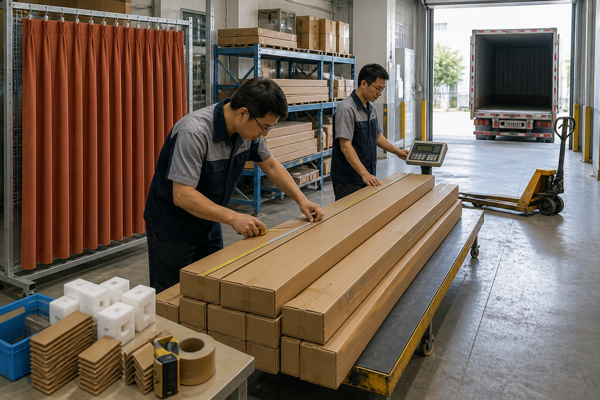
This is where the loading detail matters. A long carton may require more floor length than its weight suggests. A driver who arrives without the right vehicle, protective space, or pickup reference can cause delay or damage before the international trip begins. The ICC’s EXW explanatory notes also warn that the buyer may carry loading risk even when the seller physically operates the loading equipment, unless the parties agree otherwise.
EXW can work when the buyer has an experienced China-based logistics team, is consolidating several orders, or uses a courier service that collects from the factory. It is a poor shortcut when nobody has accepted the export-side work in writing.
What does FOB mean for a custom-curtain order?
FOB means Free On Board at a named port of loading. It is a sea or inland-waterway rule. Under FOB, the seller handles export clearance and delivers the goods on board the vessel at the named port. Risk transfers at that delivery point. The buyer normally arranges the main carriage from the port of loading and handles the destination side.
An FOB quotation should therefore name the port and the Incoterms version, for example, FOB Shenzhen, Incoterms 2020. Writing only FOB China leaves the delivery point unresolved.
For curtains, the supplier’s FOB scope may include factory-to-port transport, export clearance, and origin work required to reach the agreed on-board delivery point. The quote should still state what is included. A product unit price with a separate origin charge can be commercially workable, but the buyer needs the combined total and the same scope across every supplier.
FOB does not mean the supplier pays the ocean freight to Vancouver, Toronto, Los Angeles, New York, or the buyer’s home. It also does not decide import duties, destination terminal charges, brokerage, final delivery, installation, or damage-claim procedure.
EXW vs FOB vs FCA: what changes at the handoff?
| Question | EXW named factory or warehouse | FOB named port of loading | FCA named place |
|---|---|---|---|
| Where does delivery occur? | When the identified goods are made available at the named place, normally not loaded | When the goods are delivered on board the vessel at the named port | When the seller delivers to the buyer’s nominated carrier at the named place |
| Who handles export clearance? | Buyer, with seller assistance only as required by the rule | Seller | Seller |
| Who carries loading risk at the seller’s premises? | Buyer unless the parties write a different loading arrangement | Seller carries risk until on-board delivery | Seller loads when the named place is the seller’s premises |
| Which transport modes fit the rule? | Any mode | Sea or inland waterway | Any mode, including multimodal |
| Common custom-curtain use | Buyer-controlled China pickup or courier collection | Traditional on-board vessel delivery agreed with a forwarder | Container, LCL, air, rail, truck, or terminal handoff |
| Main buyer check | Can the nominated party load, clear export, and control origin work? | Is the port, vessel handoff, and full origin scope clear? | Is the exact carrier handoff point and loading responsibility clear? |
The table is a decision aid, not a substitute for the official rules or transaction-specific advice. The named place or port matters as much as the three-letter term.
Why may FCA fit containerized curtains better than FOB?
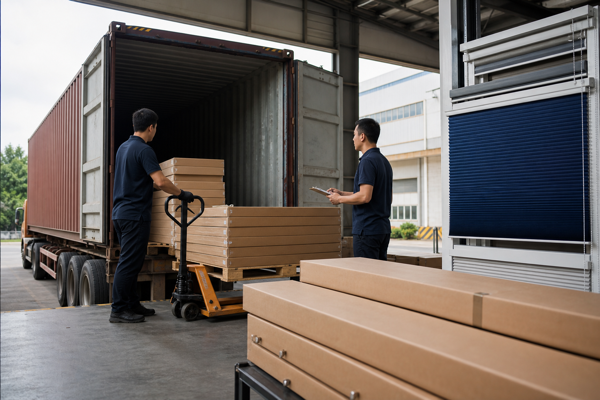
Custom curtains, tracks, roller shades, and motorized components commonly move in cartons that enter a container at a warehouse or terminal. The seller may hand the cargo to the buyer’s nominated carrier before anyone loads it on the ocean vessel.
The ICC Incoterms 2020 checklist says FCA should be considered when goods travel in containers, use multimodal transport, or are delivered to an inland or port terminal. FCA can place export clearance with the seller while matching the actual carrier handoff more closely. FOB remains available when the parties genuinely want delivery and risk transfer on board the vessel.
This does not mean every container shipment must use FCA. It means the buyer should ask a better question: where will the seller actually hand the packed window treatments to the carrier, and which rule describes that physical event?
What should an EXW or FOB price include?
Ask the supplier to separate the product scope from the delivery scope. For a made-to-measure order, the product side should identify the curtain or shade construction, dimensions, quantity, fabric, color, heading or system, hardware, controls, accessories, packaging, and approved sample reference.
The origin-delivery side should state:
- The exact named factory, warehouse, terminal, or port
Incoterms 2020or the agreed rule version- Loading responsibility and the equipment expected at pickup
- Factory-to-port or factory-to-terminal transport when included
- Export-clearance responsibility and the document contact
- Origin handling included in the supplier’s total
- The forwarder’s booking, cutoff, pickup, and shipping-mark instructions
- How final carton dimensions and weights may change the freight plan
A useful FOB comparison is not simply FOB price minus EXW price. Ask what creates the difference. If one factory includes export packing, long-carton protection, inland delivery, and origin work while another excludes part of that scope, the two totals are not equivalent.
ShadeCort’s guide to window-treatment quotations and trade terms provides a broader comparison of EXW, FOB, CIF, DAP, and DDP. For protective packing questions, review the custom window-treatment packaging guide.
What carton data does the forwarder need?
The first freight quote may use estimated cartons. The booking and pickup should use reconciled data once production and packing are complete.
For each carton type, provide length, width, height, gross weight, quantity, product description, room or window reference, shipping mark, and any non-stackable or fragile condition. Long tracks should not be hidden inside an average carton dimension. Motorized orders may also require the exact motor, battery, control, and power configuration for transport review.
The buyer’s forwarder should confirm the required format and deadline. ShadeCort can prepare factory-side packing data for the approved order and coordinate the agreed pickup or origin delivery. The forwarder remains responsible for its transport booking, route, carrier instructions, and quoted logistics services.
The related guide on choosing a freight forwarder for custom curtains explains how to compare route scope, customs support, long-carton handling, and final delivery.
Does EXW or FOB change U.S. or Canadian import responsibility?
No. The Incoterm allocates responsibilities between buyer and seller under the sale, but it does not replace destination customs law.
U.S. Customs and Border Protection says an importer may use a licensed customs broker, but the importer remains responsible for meeting CBP requirements. A direct buyer should confirm the importer of record, product description, classification review, value, origin, bond or entry needs, and any other agency requirements before shipment.
The Canada Border Services Agency similarly states that an importer who uses an agent remains responsible for accounting documents, duties and taxes, and later corrections involving classification, origin, or valuation. CBSA also explains that only a licensed customs broker may perform specified accounting and duty-payment work as an agent.
For a personal home order, ask the broker which personal-import process applies. For resale, project, or commercial use, confirm the business and importer setup before the cargo leaves China. ShadeCort can provide product and shipment inputs for the agreed order, but the buyer and qualified broker must confirm the destination filing.

How ShadeCort supports the origin handoff
ShadeCort is the window-treatment supplier, not the buyer’s customs broker or ocean carrier. Our role is to make the factory-side handoff match the approved product and quotation.
A practical order sequence can include:
- Confirm the finished custom drapery or window-treatment specification, quantity, packaging, destination, and requested delivery rule.
- Name the factory, terminal, or port and write the Incoterms version into the quotation.
- Share preliminary carton estimates so the buyer can compare logistics options.
- Receive the nominated forwarder’s booking, pickup, cutoff, and marking instructions.
- Measure and weigh final cartons, then reconcile the packing list before release.
- Coordinate collection or the agreed origin delivery and provide the relevant factory contact.
- Keep product, transport, export, and destination questions with the party that owns each task.
The exact scope remains subject to the approved quotation and shipment plan. If the forwarder requests a process that changes packing, timing, documents, or cost, the buyer and supplier should approve that change before pickup.
Watch: measure before the shipping handoff
A wrong finished size changes more than the curtain. It may change the package length, carton count, weight, remake schedule, and booked cargo space. Use ShadeCort’s measuring guide before approving a made-to-measure order, then compare the final order schedule with the factory packing list.
Open the ShadeCort Measuring Guide on YouTube if the player is unavailable.
Common EXW and FOB mistakes
Treating Incoterms as ownership terms
Incoterms address delivery, risk, cost, and defined tasks. They do not decide when legal title transfers. Put title, payment, inspection, and acceptance terms in the sales contract.
Writing only EXW China or FOB China
Each rule needs a named place or port. Use the precise pickup location, terminal, or port and identify the rule version.
Using FOB automatically for every ocean shipment
Ocean transport later in the route does not prove that on-board vessel delivery is the real supplier handoff. Ask whether FCA better matches a container or terminal delivery.
Booking freight from rough carton estimates
Early estimates help budgeting. Final pickup instructions should use actual carton count, dimensions, weights, long-piece details, and cargo-ready timing.
Assuming a broker removes importer responsibility
A broker can file and advise within its licensed scope. U.S. and Canadian authorities still place core accuracy and compliance responsibilities on the importer.

Buyer checklist before approving the trade term
- The order specification and approved sample are identified.
- The rule is written with the named place or port and
Incoterms 2020. - The planned transport mode matches the selected rule.
- Loading responsibility and loading risk are written down.
- Export clearance has a named responsible party.
- The EXW-to-FOB or EXW-to-FCA cost difference is itemized.
- The buyer’s forwarder has accepted the pickup or handoff point.
- Final carton data and long-piece restrictions have a deadline.
- The importer and customs broker roles are confirmed for the United States or Canada.
- Payment, title, inspection, defects, insurance, and claims are covered outside the Incoterm.
Request a comparable ShadeCort quotation
Send ShadeCort the product type, finished sizes, quantity, fabric or system, manual or motorized operation, packaging needs, destination city and postal code, preferred transport mode, and nominated forwarder details if available. Ask for the EXW scope and the relevant FOB or FCA alternative using the same product specification.
We can review the factory-side delivery assumptions, prepare preliminary packing data, and coordinate the agreed handoff. The buyer and qualified logistics providers should confirm the final route, export arrangement, importer setup, customs treatment, duties, taxes, and insurance.
Contact ShadeCort to request a custom-window-treatment quotation and origin-handoff review.
Sources and further reading
- U.S. International Trade Administration: Know Your Incoterms
- International Chamber of Commerce: EXW explanatory notes and obligations
- International Chamber of Commerce: Incoterms 2020 checklist and flowcharts
- U.S. Customs and Border Protection: Do I need a customs broker?
- Canada Border Services Agency: Licensed customs brokers
FAQ
Is EXW always cheaper than FOB?
The supplier’s EXW price is usually lower because it stops earlier, but that does not prove the shipment costs less. Add loading, China pickup, export clearance, origin handling, main freight, destination charges, brokerage, duties, taxes, and final delivery before comparing totals.
Does FOB include ocean freight to the United States or Canada?
No. FOB names the port of loading, not the destination. The seller delivers on board the vessel at that port. The buyer normally arranges and pays the main carriage and the destination side unless a separate agreement says otherwise.
Who loads the truck under EXW?
Under the ICC EXW rule, the seller does not have to load the collecting vehicle. If the factory will load, write down who provides the equipment and who carries risk during that operation. FCA at the seller’s premises may fit better when the seller should load and clear the goods for export.
Should containerized curtains use FOB or FCA?
ICC guidance points toward FCA when goods travel in containers, use multimodal transport, or are delivered to an inland or port terminal. Buyers should confirm the actual carrier handoff and obtain qualified advice rather than choosing FOB only because an ocean vessel appears later in the route.
Can ShadeCort quote both EXW and FOB?
ShadeCort can review an EXW scope and an appropriate origin-delivery alternative for the same approved product brief, subject to the shipment, named place or port, packaging, forwarder instructions, and current quotation. FCA may be the clearer alternative for some containerized or multimodal orders.
Does the Incoterm decide who pays import duties?
Each Incoterm allocates import-clearance duties in its own way, but the rule does not replace destination customs law or determine every importer obligation. Confirm the importer of record, broker, classification, valuation, taxes, and filing requirements for the exact U.S. or Canadian shipment.