Quick Answer
A window-treatment brand should not move from private label to ODM or OEM simply because deeper customization sounds more professional. Start with private label when you need to test a product, price point, or sales channel. Move to ODM when repeat orders reveal a clear need for different fabrics, finishes, controls, packaging, or hardware. Consider OEM when a proven product line needs buyer-led structure, performance, or motorization that an existing platform cannot provide. At every stage, define the bill of materials, approval sample, branding, documentation, MOQ drivers, and change-control rules in writing.
Who this guide is for
This guide is written for startup brands, e-commerce sellers, importers, wholesalers, and distributors buying finished curtains, blinds, or shades under their own name.
It is especially useful when the first supplier conversation starts with a vague request such as:
- "Can you put our logo on this product?"
- "Can we have an exclusive color?"
- "Can you make the motor work with our preferred control system?"
- "Can you develop a version that competitors cannot buy?"
Those questions sound like one customization project. They are not. A logo on a standard carton, a custom fabric program, a new bracket, and a changed radio-control system create very different approval work and commercial exposure.
The expensive mistake is upgrading too early
Many young brands assume that more custom work creates more differentiation. Sometimes it does. It can also tie cash to a product that has not earned its place in the range.
Suppose a seller has not yet proved which shade width, color family, control method, or price point customers will accept. If that seller commissions custom fabric, printed cartons, unique hardware, and a new motor configuration at the same time, several minimums arrive before useful sales data does. One component may sell slowly while another needs replenishment. Packaging becomes obsolete after a specification change. Samples pass visually but fail during installation or returns handling.
The practical question is not, "Are we an OEM brand?" It is, "What evidence justifies the next layer of development?"
Use each order to learn something specific:
- Which product family receives repeat orders?
- Which complaint or lost sale appears often enough to solve?
- Which option can be standardized across more than one SKU?
- Which custom feature has a measurable customer or channel benefit?
- Which parts, fabrics, packaging, and service items can the business support after launch?
When the answer is still uncertain, a narrower private-label program is often the more disciplined choice.
Private label, ODM, and OEM in practical terms
Suppliers use these labels differently, so the written scope matters more than the acronym. ShadeCort's separate guide to OEM vs. ODM window treatments explains the definitions in more detail. For a staged product plan, use the following working meanings.
Private label: prove the offer
Private label starts with an established product. The buyer chooses from available constructions, fabrics, colors, mechanisms, and sizes, then adds approved brand presentation such as labels, instructions, barcodes, inserts, or cartons.
This route is useful for testing a new category or channel because the product architecture remains stable. The buyer can spend more attention on assortment, pricing, product content, installation guidance, and customer service.
Private label is not automatically low risk. Printed packaging can have its own minimum. The selected fabric may not be stock supported forever. A product that looks standard may use different brackets or controls in later batches. The quotation should identify the exact construction and how repeat orders will be matched.
ODM: improve what customers already buy
ODM uses an existing manufacturer platform as the starting point, but the buyer changes selected layers. A growing brand might keep the roller-shade system and change the fabric collection, fascia finish, remote, mounting kit, instruction set, or packaging format.
This model makes sense when sales evidence points to a specific improvement. Perhaps customers want a warmer neutral range. Perhaps installers keep asking for a different bracket. Perhaps a distributor needs one motor and control family across several shade types. The buyer has a problem worth solving, but does not need to redesign the complete product.
OEM: build around a controlled specification
OEM is appropriate when the buyer owns or leads a detailed specification that goes beyond an existing platform. The work might involve a new cassette section, bracket geometry, track, control behavior, folding structure, side channel, fabric construction, or motorized assembly.
OEM requires more than a sketch and a target price. The buyer needs someone who can approve drawings, materials, tolerances, function, ownership terms, test scope, packaging, and service parts. If those decisions remain open, the project can spend months changing direction without reaching a production-ready sample.
A three-stage upgrade plan for window-treatment brands
The table is a planning tool, not a rule that every product must pass through all three stages. Some project products begin with a detailed OEM specification. Some standard items should remain private label for years.
| Decision point | Stage 1: Private label pilot | Stage 2: Focused ODM | Stage 3: Controlled OEM |
|---|---|---|---|
| Main goal | Prove the product, price, and channel | Fix a repeated customer or installer need | Create a defensible product platform or project-specific solution |
| Starting point | Established factory product | Proven factory platform with selected changes | Buyer-led specification or jointly engineered new configuration |
| Product changes | Standard construction; selected color, label, insert, barcode, or carton | Fabric, finish, hardware, controls, accessories, dimensions, or packaging | Structure, mechanism, motorized system, special fabric construction, or proprietary component |
| Evidence before upgrading | Initial demand and usable customer feedback | Repeat orders plus a clear reason for each change | Stable demand, technical ownership, development budget, and approval capacity |
| Typical MOQ pressure | Brand labels and printed packaging | Custom fabric, finish, hardware, controls, and packaging | New tooling, components, processes, testing, and supplier commitments |
| Sample plan | Representative product and artwork proof | Material approvals plus configured functional sample | Engineering prototype, corrections, validation sample, and golden sample |
| Main risk | Weak differentiation or poor repeat availability | Too many changes added to one launch | Under-scoped development, ownership disputes, and delayed commercialization |
| Best use | Category test, channel test, entry assortment | Growing line with a specific improvement target | Mature line, large distributor platform, or defined contract project |
What should trigger an upgrade?
An upgrade should answer a business problem that is already visible. The following signals are more useful than a general desire to be unique.
Move from private label to ODM when the base product is selling
Repeat orders show that the market accepts the basic product. At that point, targeted changes may improve margin, reduce returns, simplify installation, or make the assortment easier to sell.
Good ODM triggers include:
- Customers repeatedly ask for a fabric, color, or opacity that is missing.
- Installers report the same bracket, instruction, or accessory problem.
- Several products can share one finish, packaging system, motor, or remote.
- A retailer requires different labels, pack quantities, or shelf presentation.
- The current product performs well, but the brand needs a more coherent collection.
Do not turn every request into a custom feature. A useful change should apply to enough volume or solve a costly problem.
Move from ODM to OEM when the platform becomes the limit
OEM becomes reasonable when a proven opportunity cannot be met by configuring the existing system. A distributor may need a proprietary mounting method. A contract buyer may need a project-specific track and blackout detail. A motorized program may require a different control architecture or service approach.
Before that move, confirm:
- The requirement is measurable rather than aesthetic preference alone.
- Expected volume can support development and component commitments.
- The buyer can approve technical decisions without repeatedly reopening the concept.
- Ownership, exclusivity, tooling, and later revisions can be documented.
- Service parts and support can continue after launch.
Keep a mixed assortment when that is the better commercial answer
A brand does not need one model for every SKU. A core roller-shade family might justify ODM fabrics and packaging. A high-volume motorized hero product might justify OEM development. Slow-moving accessories can remain private label.
This mixed approach protects development resources. It also lets the brand place custom work where customers can notice it.
Customize in layers, not all at once
Separate the brief into layers and mark each one as standard, modified, or new.
Brand and packaging
List every place the brand appears: product label, bottom rail, remote, instruction sheet, hardware bag, retail carton, master carton, barcode, and digital content. Confirm dielines, editable artwork ownership, languages, revision control, and the minimum for each printed item.
For covered U.S. textile products, the FTC Textile Fiber Rule requires labels to disclose fiber content, the manufacturer or marketer identity, and the country where the product was processed or manufactured. Branding therefore needs to sit within a complete label plan.
Fabric and visible finish
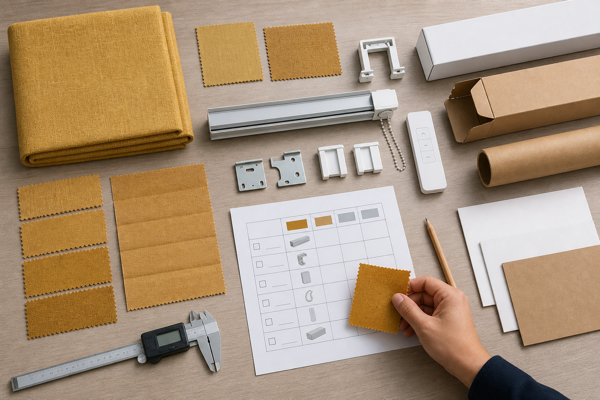
Define fiber content, usable width, weight, weave or coating, opacity, lining, color, care method, and whether the material is stock supported or made to order. Use physical swatches, lab dips, or finish samples for approval. Phone photos are useful for discussion, but not for final color control.
ShadeCort's public window-shade range includes several product families. That breadth can help a buyer build one fabric or color direction across roller, zebra, Roman, cellular, and other shade formats, subject to the actual material and construction available for each product.
Hardware and installation
Record the headrail, tube, cassette, bottom rail, track, bracket, chain or cordless mechanism, fasteners, accessory pack, and installation method. A bracket change can affect clearances, load, pack size, installation time, and spare-part planning.
Motor and controls
Specify torque, tube fit, voltage, power supply, charging method, remote protocol, channel count, limit setting, wall control, hub, app, platform integration, and manual operation where relevant.
ShadeCort publishes a broad motorization scope, which is useful when a buyer wants manual and motorized versions reviewed together. The exact motor, control method, radio module, product size, and destination documentation still need confirmation for the quoted configuration.
For radio-controlled products entering the United States, buyers should identify the applicable FCC equipment-authorization path for the exact device. In the EU, official product compliance guidance says a company that has a product made and sells it under its own name or trademark can be treated as the manufacturer, with duties that begin at the design stage.
How MOQ, sample cost, and timing really change
There is no reliable universal MOQ for private label, ODM, or OEM window treatments. One finished product can contain several minimums set by different suppliers and processes.
Fabric may be available from stock, allocated by roll, custom colored, printed, woven, or coated. Metal finishes may require a production batch. Molded parts, extrusions, motors, remotes, labels, cartons, and instruction sheets can each have their own setup quantity.
Ask for a cost map that separates:
- Standard finished-product price.
- Custom material or component commitments.
- Artwork and packaging proofs.
- Sample and courier charges.
- Engineering, drawing, fixture, tooling, or software work.
- Testing and documentation costs.
- Any development stock left after the first order.
The schedule should also show decisions, not only factory days. A useful timeline includes brief review, feasibility, quotation, material approval, prototype work, corrections, golden-sample approval, bulk material commitment, production, inspection, and pack-out review.
The more layers that change, the more important it becomes to freeze the bill of materials before bulk purchasing begins.
Common mistakes during a staged launch
Changing the product and the sales promise at the same time
If the mechanism, fabric, controls, packaging, and product claims all change together, a failed launch teaches very little. Keep enough of the product stable to understand what caused the result.
Treating a low finished-product quantity as a low component commitment
A small order may still require a full fabric roll, finish batch, motor quantity, or carton run. Ask which minimum belongs to which component and whether unused stock can be applied to later orders.
Approving a showroom sample instead of a production standard
A good-looking sample does not record the complete product. The golden sample should connect to the final bill of materials, dimensions, finish references, controls, accessories, labels, packaging, and inspection points.
Adding motorization after the manual product is approved
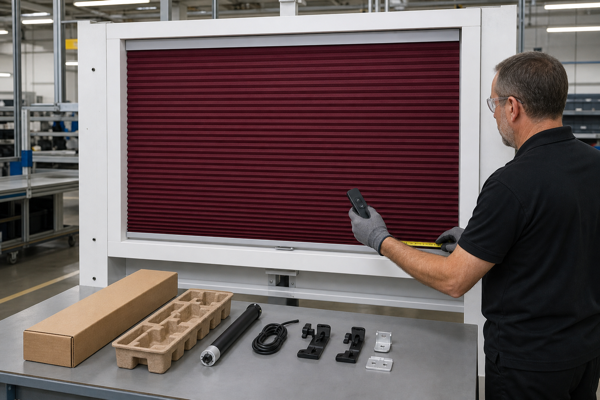
Motorization can change tube size, brackets, clearances, weight, power, control behavior, documentation, and service parts. Review the complete assembly rather than treating the motor as an accessory.
Assuming the supplier name is enough due diligence
The U.S. International Trade Administration recommends due diligence on foreign business partners because a poor choice can lead to financial, legal, liability, and reputational problems. Review the legal entity, manufacturing scope, sample responsibility, subcontracted processes, and change-control process before committing development funds.
Why ShadeCort fits a staged development model
ShadeCort Resources publicly presents itself as a China-based window-treatment manufacturer and OEM/ODM service provider. Its public range covers manual and motorized shades, blinds, shutters, drapery, tracks, controls, packaging customization, and project consultation.
The practical advantage is not that every idea should become OEM. It is that a buyer can discuss the next stage against a wider product platform. A private-label pilot can begin with an established product. A proven line can add selected fabrics, packaging, hardware, or controls. A mature requirement can then be assessed as OEM development without changing the basic product category or starting the supplier search from zero.
That continuity can be useful when:
- Manual and motorized versions need related fabrics, colors, packaging, and instructions.
- A brand wants several shade types to share a visual system.
- Packaging and accessory decisions should work across a collection.
- The team needs to separate standard options from custom development before quoting.
- Compliance documents must be checked against the exact product and destination.
Buyers can review ShadeCort's compliance information before sending a brief. Public certificates and claims should still be matched to the exact model, component, test scope, and destination. That is part of a proper specification review, not an awkward footnote.
A practical ShadeCort upgrade process
- Start with the commercial evidence. Share the product family, sales channel, destination, current sales or project status, customer feedback, expected quantity, and target launch date.
- Mark every layer. Identify which fabrics, finishes, hardware, controls, labels, packaging, and structural details remain standard, which are modified, and which are new.
- Choose the narrowest workable model. Use private label, ODM, OEM, or a mixed route by SKU and component.
- Map minimums and development work. Separate finished-product quantity from fabric, hardware, motor, packaging, tooling, testing, and documentation commitments.
- Plan approvals. Define swatches, finish samples, functional samples, artwork proofs, motor configuration, installation check, and golden sample.
- Freeze the production standard. Connect the final sample to the bill of materials, drawings, labels, accessories, packaging, inspection points, ownership, and change-control record.
- Review the next upgrade after real use. Use order history, installation feedback, returns, and customer requests before adding another custom layer.
Buyer checklist before requesting a proposal
- What product and sales channel are already proven?
- What customer, installer, or project problem should the change solve?
- Is the starting point an established ShadeCort product, a reference sample, or a buyer-owned specification?
- Which countries will receive the finished product?
- Which layers remain standard, modified, or new?
- Which physical samples and functional checks will be approved?
- Which component creates each MOQ?
- Who owns artwork, drawings, tooling, modified designs, and test reports?
- Which substitutions need written approval?
- What must be included in the golden sample?
- Which spare parts and service information will be needed after launch?
- What evidence will justify the following development stage?
Request a staged customization proposal
Use the ShadeCort contact form to send a short brief. Include the product type, destination market, sales or project stage, expected first order and annual volume, target price position, current customer feedback, requested changes, motor and control needs, packaging format, available drawings or samples, and target date.
Ask the response to separate:
- The recommended private-label, ODM, OEM, or mixed route.
- Standard and custom components.
- MOQ drivers by fabric, hardware, motor, label, and packaging.
- Sample, development, testing, and production costs.
- Approval stages and buyer decisions.
- Ownership and change-control points.
This gives both sides something more useful than an "OEM available" badge: a product plan that can grow with evidence.
Sources and further reading
- FTC Textile Fiber Rule
- European Commission guidance on general product compliance
- FCC Equipment Authorization Grantee Registrations
- U.S. International Trade Administration: Company and Partner Risk
FAQ
Is private label the same as ODM for blinds and curtains?
The terms can overlap in supplier quotations. For planning purposes, private label normally keeps the established product construction and changes brand presentation or selected standard options. ODM changes more of an existing manufacturer platform, such as fabric, finish, hardware, controls, or packaging. Write the requested changes into the quotation instead of relying on the label.
When should a startup choose private label window treatments?
Private label is usually sensible when the brand still needs to prove the product family, price point, sales channel, and core options. Keep the first assortment narrow enough to learn from. Confirm the exact construction, repeat availability, labels, packaging, and approval sample even when the product is based on a standard model.
What is a good reason to move from private label to ODM?
Move when repeat orders reveal a specific problem or opportunity that an existing option cannot address. Examples include a missing fabric range, repeated installation complaints, retailer packaging requirements, or the need to share one motor and control family across several products. Each change should have a commercial reason.
Does OEM always require a completely new product?
No. OEM can also mean buyer-led development of a major structure, mechanism, motorized system, or performance requirement within a familiar product category. What matters is the depth of buyer-owned specification, engineering, validation, and ownership terms, not whether every part starts from a blank page.
Can one brand use private label, ODM, and OEM at the same time?
Yes. A mixed assortment is often practical. Entry-price or slow-moving SKUs can remain private label, a proven core range can use ODM fabrics and packaging, and one high-volume product can justify OEM development. The model should fit the SKU rather than the brand's ego.
What should be approved before bulk production?
Approve the final bill of materials, dimensions, drawings, fabric and finish standards, functional sample, controls, accessories, labels, instructions, packaging, inspection points, and golden sample. Confirm ownership and substitution rules. Match any test or compliance document to the exact product, component, and destination.