Quick Answer
A B2B curtain supplier helps hotel owners, procurement teams, designers, contractors, and developers turn a room schedule into a repeatable window treatment order. The work may cover blackout curtains, sheers, decorative drapery, flame-retardant fabrics, or motorized tracks. Before production, the buyer should confirm dimensions, fabric construction, lining, heading, controls, test documents, packing labels, and delivery phases. The supplier should then produce approved samples and keep the bulk order consistent with them.
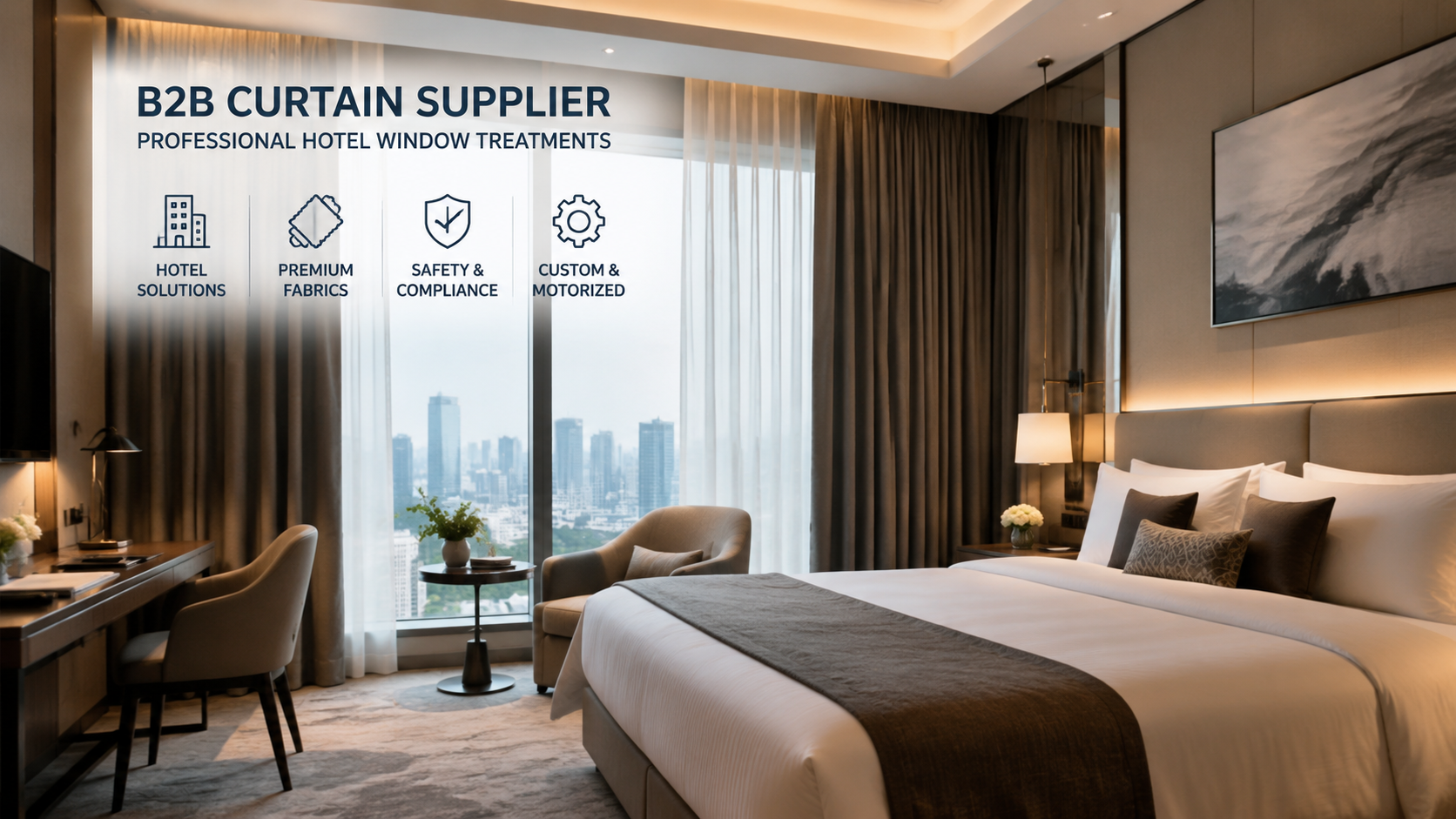
Why hotel projects need a specialist curtain supplier
Buying curtains for a hotel is different from ordering one pair for a home. A single project may cover hundreds of guest rooms, plus suites, corridors, restaurants, meeting rooms, and public areas. Each space can have a different window size or operating requirement, but the finished property still needs to look consistent.
The difficulty is keeping every repeated unit consistent. A small difference in color, drop, stitching, or hardware may be easy to miss on one window. Across 200 rooms, it becomes expensive rework. A hospitality supplier should be able to manage commercial quantities, room schedules, sample approval, fabric batches, phased deliveries, and packing by floor or room.
Destination requirements matter too. A specification accepted for one country, building type, or room use may not be suitable for another. Buyers should confirm the applicable code, test method, and approval process with the project consultant or local authority before placing the order.
How curtains affect a hotel room
Guests notice curtains when something goes wrong. A bright strip of light early in the morning, a track that sticks, or a sheer that provides too little privacy can quickly become a room complaint.
The system should give guests practical control over daylight and privacy, suit the interior, and tolerate regular use and cleaning. Curtain fullness, track position, overlap, stack-back space, and finished length all affect the result.
Window coverings can also influence heat gain and heat loss, but the outcome depends on climate, orientation, fit, product construction, and how the covering is operated. The U.S. Department of Energy review of window attachments notes that performance varies by product and operating conditions. Hotel buyers should treat energy performance as a project-specific calculation, not a blanket curtain claim.
Blackout curtains for hotels
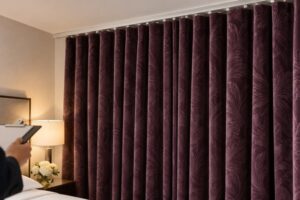
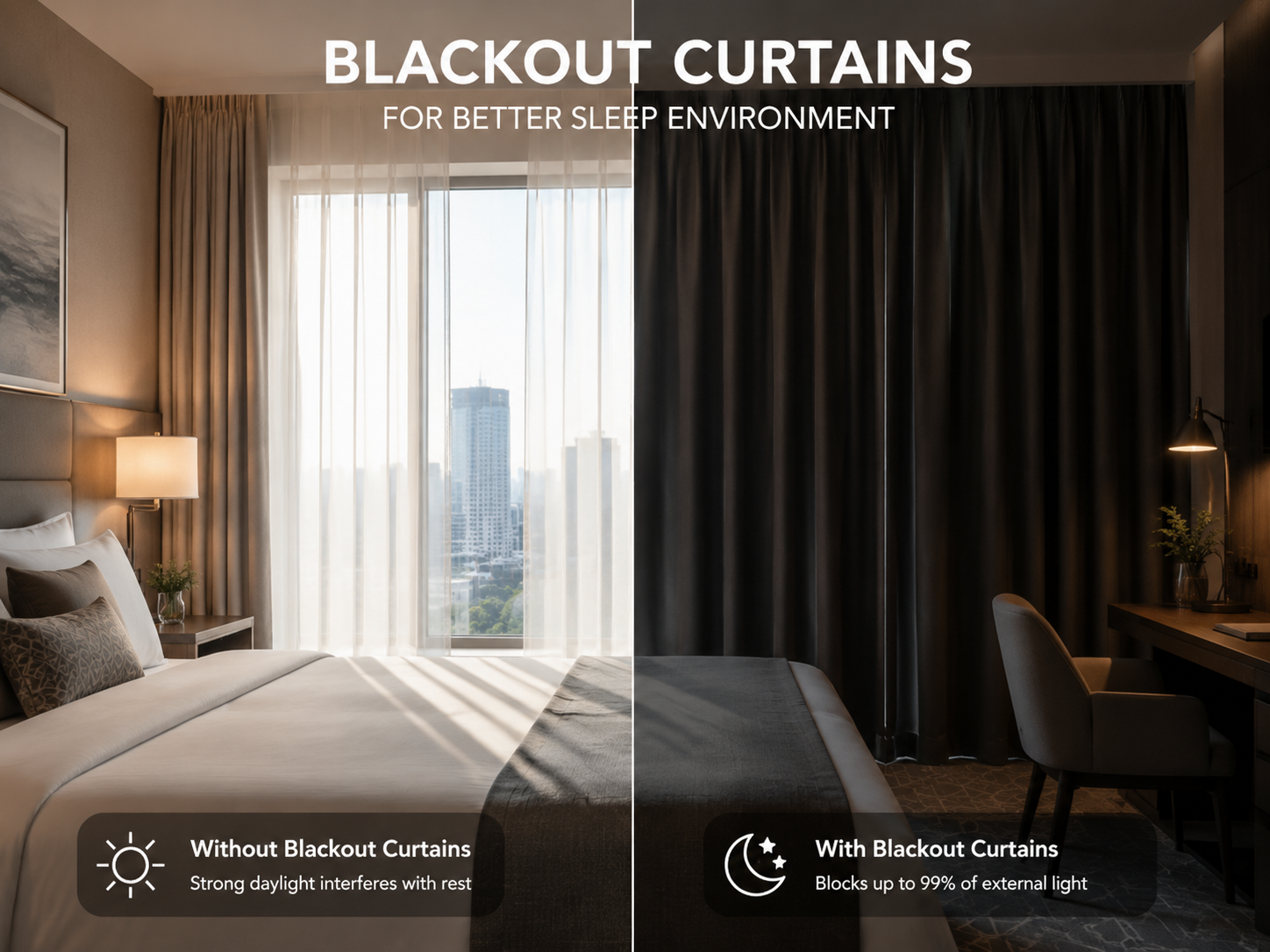
Blackout curtains reduce daylight and outside light in guest rooms. They are often specified for airport hotels, city rooms facing illuminated streets, resorts, crew accommodation, and properties in regions with long summer daylight hours.
Dark fabric is not enough. Light can enter at the sides, above the track, below the hem, or where two panels meet. The project team should review the complete assembly, including the track, overlap, return, pelmet, lining, and installation tolerances. ShadeCort’s guide to blackout curtains and hotel light leakage covers these details in more depth.
The CDC’s National Institute for Occupational Safety and Health advises using light-blocking window coverings to keep sleeping areas dark when daylight lasts longer. A U.S. Air Force temporary lodging design guide provides one useful project example: it specifies a separate blackout liner and commercial-quality traverse rods. That document applies to its own facilities, but it shows why the liner and hardware need to be specified together.
Hotel window treatment options
Hotel window treatments may use decorative drapery, sheers, blackout curtains, roller shades, motorized tracks, or a layered combination. The right arrangement depends on the room type, design brief, operating needs, maintenance plan, and budget.
| Hotel or room type | Common window treatment approach | What to confirm before approval |
|---|---|---|
| Luxury hotel or suite | Sheer plus decorative drapery and a blackout layer | Fullness, stack-back space, track layout, lining, and finished drop |
| Business hotel | Blackout curtains with simple manual controls | Light gaps, operating force, cleanability, and hardware durability |
| Resort | Decorative curtains paired with adjustable light control | Sun exposure, privacy, moisture conditions, and maintenance method |
| Extended-stay property | Durable curtains designed for frequent use | Care cycle, replacement process, room labeling, and spare components |
| Smart or accessible room | Motorized curtains linked to room controls | Motor capacity, control location, power, integration, and service access |
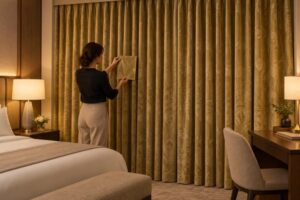
A fabric swatch cannot confirm the whole system. Buyers should approve a finished sample or room mock-up when the drape, blackout performance, heading, or motorized operation affects acceptance.
Flame-retardant curtains and project compliance
Hotels, dormitories, hospitals, and other commercial accommodation may require curtains with documented flame performance. The applicable requirement depends on the jurisdiction, occupancy, product construction, and written project specification.
For U.S. projects, NFPA 701 contains test methods for flame propagation of textiles and films. The 2024 International Fire Code, Chapter 8, refers to NFPA 701 test methods where improved flame performance is required for curtains, draperies, and similar decorative materials. The local code and authority having jurisdiction still determine what a particular hotel must submit.
Buyers should check the exact test method, fabric or assembled product covered by the report, laboratory details, report date, and any cleaning or conditioning limits. UK government fire safety guidance also warns that some treated materials can have a limited wash life for flame-retardant performance. ShadeCort’s article on flame-retardant hotel curtain documentation explains how certificate, fabric, and maintenance mismatches can occur.
“Flame retardant” is not a universal approval, and it does not mean “fireproof.” The supplier should provide documents for the proposed construction, while the project consultant or local authority confirms final acceptance.
Layered drapery for luxury hotels
Layered drapery gives guests more control than a single curtain. A sheer can filter daylight and add daytime privacy. Decorative drapery sets the room’s visual direction, while a separate blackout layer can darken the room for sleep.
Not every project needs three layers. Some hotels combine the decorative and blackout functions in one lined curtain. Others pair a sheer with a roller shade. The design team should choose the simplest arrangement that meets the brief and leaves enough space for tracks, overlaps, and curtain stack-back.
The design team should decide on the arrangement before finalizing ceilings, pelmets, wall blocking, and power points. Late changes can reduce the clear window area or force the installer to use a weaker fixing position.
Motorized curtains for smart and accessible rooms
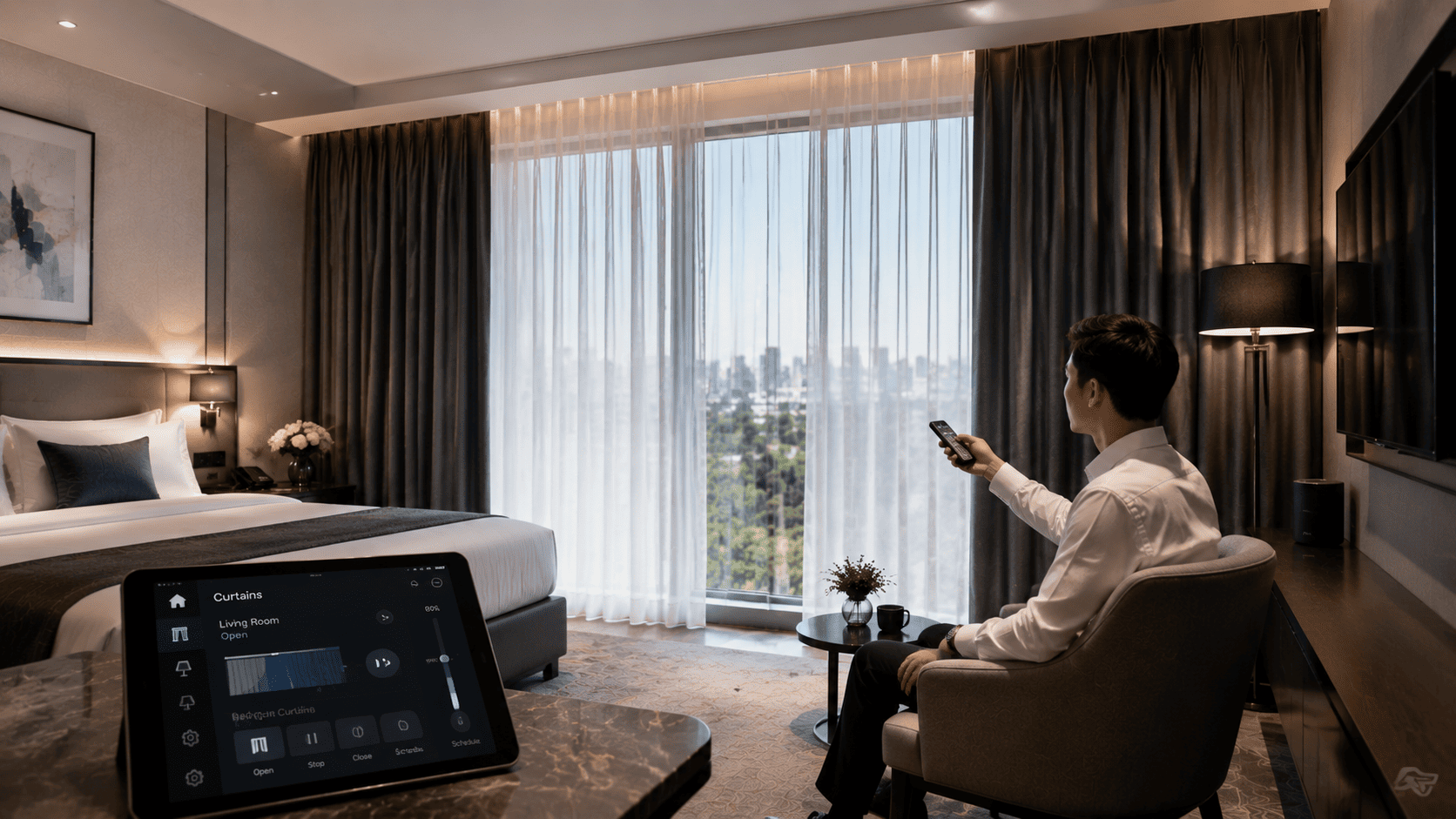
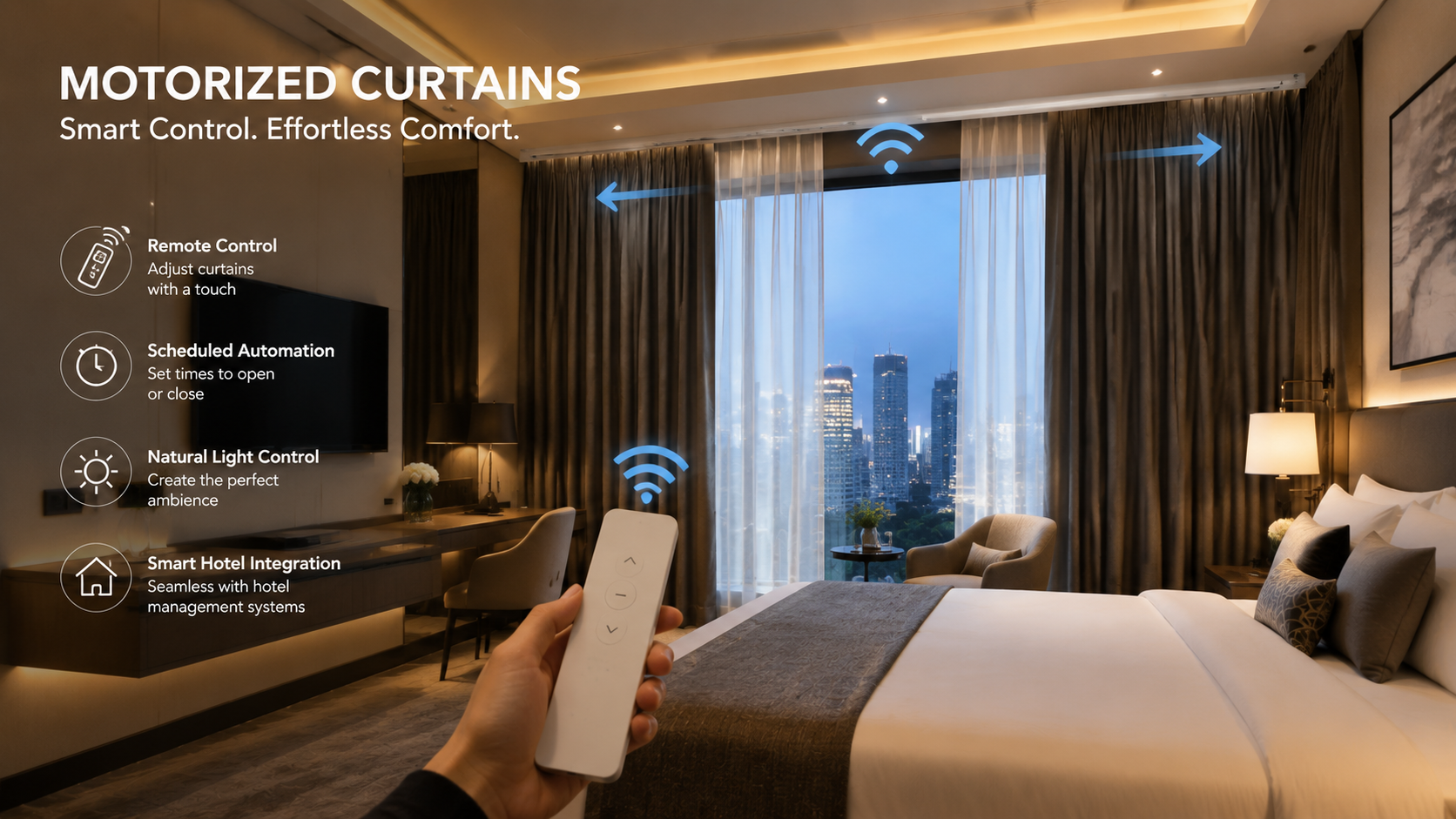
Motorized curtains can be operated by a wall switch, remote control, room management system, or programmed schedule. They are commonly considered for suites, smart rooms, high windows, and accessible accommodation. ShadeCort’s motorized window treatment overview shows the available control and power approaches.
The project team should confirm curtain weight, track length, motor capacity, power location, control protocol, manual operation, commissioning responsibility, and maintenance access. For U.S. accessible spaces, the design team should also review the U.S. Access Board guidance on operable parts when deciding where fixed controls belong and how they should operate.
Curtains for shift-worker accommodation
Airline crew hotels, healthcare staff housing, transport accommodation, industrial workforce housing, and other 24-hour facilities need rooms that support daytime sleep.
Light reduction comes first, but the curtain also needs to provide privacy, withstand frequent use, and allow routine cleaning. Side returns, overlapping panels, pelmets, or carefully positioned tracks can help reduce light gaps. The best detail depends on the window and wall construction.
For a room-by-room specification approach, see ShadeCort’s B2B guide to window treatments for shift-worker properties.
How to choose a B2B curtain supplier
- Ask whether the supplier can produce the full quantity while keeping dimensions, color, stitching, and hardware consistent.
- Review a finished sample or room mock-up when fullness, lining, heading, track layout, or motor operation matters.
- Check that test reports and care instructions refer to the fabric or assembly being proposed.
- Agree on tolerances for width, drop, seams, hems, panel matching, tracks, motors, labels, and packing.
- Decide whether packages need to be grouped by floor, room, phase, or installer sequence.
- Record changes to site dimensions and handover dates. The supplier should confirm anything that affects cost, production, or delivery.
Working with ShadeCort Resources
ShadeCort Resources develops window treatment orders for hotel and commercial project briefs. Options can include blackout curtains, layered drapery, documented flame-retardant fabrics, and motorized curtain systems, subject to confirmation for the proposed construction and destination.
Buyers can review ShadeCort’s available compliance and standards information before requesting project-specific documents. For a useful first review, prepare the room schedule, window dimensions, drawings or photos, fabric direction, required test method, control requirements, quantity, and delivery destination.
Contact ShadeCort Resources to discuss samples, specification details, or a quotation for a hotel or commercial curtain project.
Sources and further reading
- National Fire Protection Association: NFPA 701, Standard Methods of Fire Tests for Flame Propagation of Textiles and Films
- International Code Council: 2024 International Fire Code, Chapter 8
- UK Government: Fire safety risk assessment guidance for places of assembly
- CDC and NIOSH: Light-blocking window coverings and a dark sleep environment
- U.S. Department of Energy: Energy savings from window attachments
- U.S. Access Board: Guide to operable parts under the ADA Accessibility Standards
- Whole Building Design Guide: Temporary Lodging Facilities Design Guide
FAQ
What is a B2B curtain supplier?
A B2B curtain supplier provides window coverings and project support for hotels, offices, developers, contractors, and other commercial buyers. Orders are usually larger and require more coordination than residential purchases, including samples, room schedules, labeling, phased delivery, and product documents.
Why do hotels use blackout curtains?
Hotels use blackout curtains to reduce outside light and give guests more control over sleeping conditions. The complete installation matters. Even an opaque fabric may perform poorly if light enters around the track, panel edges, hem, or center opening.
Which curtains are commonly used in hotels?
Common options include blackout curtains, decorative drapery, sheers, layered systems, roller shades, and motorized curtains. The room design, privacy needs, light-control target, maintenance plan, and budget determine the final choice.
Do hotels need flame-retardant curtains?
Requirements vary by jurisdiction, building use, and project specification. Buyers should confirm the applicable rule with the project consultant or local authority, then request reports that match the proposed fabric or curtain assembly.
Are motorized curtains suitable for hotels?
Yes, when the track, motor, power, controls, curtain weight, commissioning, and maintenance access are planned together. They are often considered for suites, smart properties, high windows, and accessible rooms.
What should a hotel approve before bulk production?
The approval should cover the fabric, color, lining, heading, fullness, finished dimensions, track, controls, test documents, care method, labels, and packing plan. A finished sample or room mock-up is more useful than a fabric swatch when appearance or operation affects acceptance.
What information should a buyer send for a hotel curtain quotation?
Send the room schedule, window dimensions, drawings or photos, preferred fabric and color direction, lining or blackout requirement, track and control type, requested test method, quantity, delivery destination, and target schedule. Mark any information that is still provisional.