Quick Answer
If your curtains arrived damaged, keep the curtains, carton, packing materials and order records together. Photograph the package before changing its condition, then connect each affected panel to its room label or order item. Describe what you can see: a tear, a stain, a bent part, a missing panel or a size difference. Avoid guessing who caused it. Contact the seller promptly and ask which carrier steps, evidence and deadlines apply to that shipment. Get instructions before cleaning, altering, repairing or returning the goods. A useful record supports review; it does not guarantee a particular remedy.
First, Keep the Order and Packaging Together
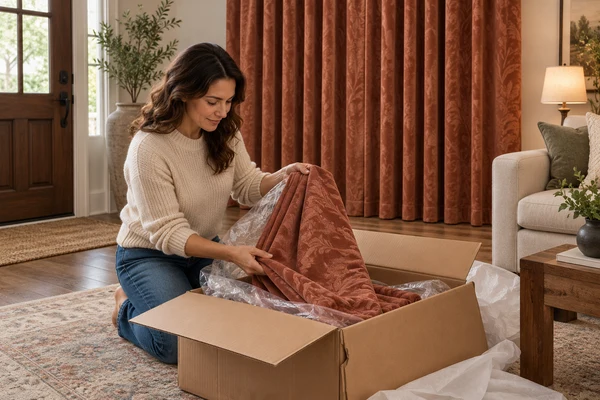
Preserve the delivered condition while you collect a clear record. Set the carton, inner wrapping, labels and affected curtains aside together, where you can identify them again. Before throwing anything away, photograph how the items were packed.
For UPS shipments, the carrier’s U.S. guidance says to retain damaged contents and packaging. It also directs recipients seeking claim updates to the shipper. See UPS’s damaged-package guidance. These are UPS instructions, not a rule for every delivery service.
Pull up the order confirmation and packing list too. Record which cartons arrived and whether the seller has identified another parcel still in transit. Treat an apparent shortage as a question to check, rather than an immediate conclusion that the seller forgot an item.
Payment records and dispute routes are a separate topic. Our safe online-order and payment guide covers that wider context. This guide stays with the physical delivery: what arrived, what it looks like and which item needs attention.
Photograph the Curtain Delivery Before Changing It
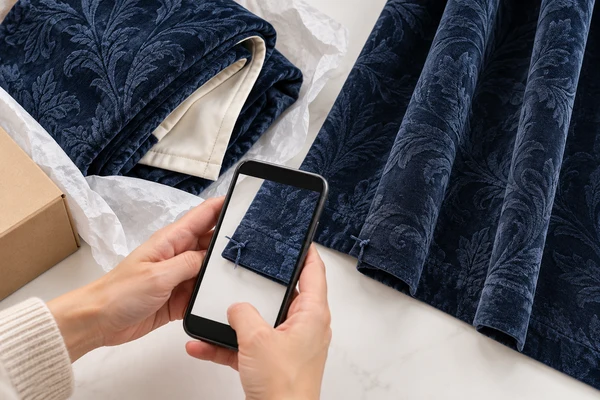
Take a sequence that lets someone connect the package to the affected curtain. A sharp close-up helps, but the reviewer also needs to know where that detail sits on the panel and which order item it belongs to.
Use this proposed photo checklist:
- Start with the carton exterior, including the area you want to report.
- Capture the shipping label and tracking reference for the private seller or carrier conversation.
- Show the contents in their original packing position before rearranging them.
- Add the room label, item label or other identifier beside the complete panel.
- Photograph the whole panel, then the specific mark, tear, seam or hardware concern.
- Keep the packing list and your received-item count with the same photo set.
UPS’s claims user guide gives a carrier-specific example: its damage documentation includes views of the outer package, the goods in their original cushioning and a readable shipping label. Confirm the current requirements for your own shipment.
Keep original photos as well as any marked-up copies. When sharing an example publicly, cover personal delivery details; send the necessary identifying records through the seller’s or carrier’s private channel.
When Curtains Arrived Damaged: Classify What You Can See
Separate the observation from the explanation. A crushed carton, a torn lining and a panel that appears too short raise different questions. This receiving table is a practical sorting tool, not a diagnosis of the cause or a decision about compensation.
| What you notice | What to record | What to ask next |
|---|---|---|
| A dented, torn or wet carton | Outer condition, label and the contents’ position | Does the seller or carrier need further inspection before anything moves? |
| A mark, tear or open seam on a panel | Complete panel, affected detail and item identity | How should this specific condition be reviewed before care or repair? |
| Fewer panels or accessories than expected | Received contents beside the packing list | Is the order split across parcels, or does the count need investigation? |
| A different size, heading, color or lining | Product label and the approved order description | Is this the specified item, and which measurement or construction needs comparison? |
| A fold or surface change you cannot identify | Untreated condition in context and close-up | What care or inspection instructions apply to this exact construction? |
For a multi-room order, label your notes by room and item. Do not mix the photograph of one carton with the close-up of a curtain from another. If the cause is unclear, say so. An accurate observation is more useful than an unsupported accusation.

Send an Item-Level Message, Not a Guess About the Cause
Your first message should identify the order, the affected item and the condition you want checked. Keep the requested next step specific. You can ask for instructions without deciding in advance whether the answer must be a repair, replacement, return or carrier investigation.
Adapt this proposed message to your order:
Subject: Delivery review for order [order reference], item [room or panel label]
The shipment arrived on [date]. I received [carton references and item count]. On item [identifier], I can see [plain description of the condition].
I have attached the carton, label, packing-position, whole-panel and detail photos. The affected item and packing materials are retained. I have not cleaned, altered or repaired it.
Please confirm whether you need another view or inspection, who should handle any carrier contact, and what I should do with the item while you review it. If another parcel is expected, please identify it.
Change any sentence that does not match what actually happened. For example, if you already unpacked everything, say that and send the records you do have. Do not recreate a packing scene and present it as an arrival photograph.
Seller or Carrier? Confirm the Next Step in Writing
Contact the seller with your item-level record, then confirm the carrier route for that particular shipment. Ask who booked the service, who will submit any claim, who receives updates and what further evidence is needed. Keep the seller inquiry and carrier reference together so the conversations remain traceable.
Canada Post tells recipients of damaged packages or missing contents to contact the sender, retain the original packaging and take photos. Its guidance says only the sender can request its investigation. Read Canada Post’s damaged-package instructions for its eligibility conditions and process. Do not apply that sender-only rule to every courier.
Check the current seller terms and the actual carrier’s instructions promptly. Ask for the relevant reporting deadline instead of relying on a general number from an online article. A delivery concern, a carrier claim and a request to correct an order are not interchangeable labels.
For a future order, our pre-shipment curtain quality-control guide covers inspection before dispatch. That review has a different purpose from documenting the condition of the parcel you have just received.
Wrong Fit Needs a Separate Measurement Check
A fit concern needs a comparison with the approved size and measurement basis. Record the product identifier, the dimension you checked, how you measured it and the corresponding order entry. Ask the seller to confirm the comparison before trimming fabric or changing the heading.
For measurement context, watch ShadeCort’s Measuring Guide below. It is not a transit-damage assessment or a curtain-size tolerance specification. Use the written instructions for the exact product and mounting method in your order, rather than assuming one video’s dimensions apply to every curtain or shade.

Open the ShadeCort measuring guide on YouTube if the player is unavailable.
If both a physical mark and a size question exist, list them separately. This lets the seller answer each observation without treating an uncertain measurement as proof of shipping damage.
What to Send ShadeCort
If your curtains arrived damaged, send ShadeCort the order reference, affected item identity and your concise delivery record. Ask for a comparison with the confirmed product construction and for written instructions about the next step.
ShadeCort Resources describes itself as a manufacturer and retail supplier serving commercial buyers and individual consumers. Its manufacturing and consumer overview explains those channels. The custom fabric drapery page lists double-turned hems, sewn-in liners and bottom weights. Those details give you useful names for identifying the part of the curtain that needs review; check them against the construction actually ordered.
A factory conversation is most useful when it concerns a named panel, lining, heading or accessory. Ask which further photo or order detail is needed, then confirm any proposed care, collection, repair or replacement arrangements before authorizing them. This guide does not introduce a new refund, warranty or replacement policy.
Discuss your curtain order on WhatsApp: +86 18926693786
You can use the ShadeCort contact form for the same inquiry. Include the item reference in either channel so your question stays connected to the correct order.
Sources and further reading
- UPS: File a Claim, for packaging retention and recipient update guidance.
- UPS: How to submit a claim on UPS.com, for its damage-photo documentation example.
- Canada Post: Damaged packages, for sender and recipient instructions.
ShadeCort’s official company and drapery information is linked in the contact section. The receiving table, photo sequence and message template are proposed reader tools, not a carrier’s complete claim requirements. Carrier rules apply only within their stated service and eligibility conditions.
FAQ
Do I need an unboxing video to report a problem?
Check the seller’s and carrier’s instructions for your actual order. The UPS documentation cited here asks for specific photographs; it does not establish an unboxing-video requirement for every curtain delivery. A video can supplement your record, but keep item labels, still photos and order references too. If no video exists, say that and ask what evidence the reviewer needs.
Can I wash or steam a marked curtain before reporting it?
Photograph the untreated condition first and ask for instructions for that exact curtain construction. Keep the order and care information with your inquiry. Do not assume a general cleaning tip is suitable for the face fabric, lining or finish you ordered. If you have already tried a treatment, describe it accurately rather than leaving the reviewer to assume the item is unchanged.
Can I send only a close-up of the fabric?
A close-up is a useful part of the record, but add a wider view and the item identifier. Your proposed photo sequence should let the reviewer connect the detail to the complete curtain and the relevant parcel. For several similar panels, put the room or item reference in the message beside each photo so the reviewer can tell them apart.
Should I send the curtains back before receiving instructions?
Ask for the return or inspection instructions before arranging shipment. Confirm the address, reference, packaging method, carrier arrangement and any charges with the responsible party. Keep the conversation in writing and retain your original photos. This is a practical coordination step, not a statement about your legal rights or a promise that a return will be approved.