
Quick Answer
Hotel curtain fullness compares the curtain’s finished flat width with the width it must cover, using a clearly stated calculation basis. Before comparing suppliers, agree on covered width, heading construction and finished dimensions. A named ripplefold system also needs its own fabrication chart, rather than an assumed generic multiplier. Approve a hung room mock-up with the curtains both closed and open, then request quotes against that same specification. Keep raw cutting allowances separate from finished flat width. This gives hotel procurement teams a common quantity basis without treating a ratio as a finished-room guarantee. Helser Brothers’ measuring instructions explain system-specific fullness and coverage.

Why Two Quotes for the Same Window Can Differ
Two quotes may describe different quantities even when both suppliers receive the same window width. Treat that as a scope question before treating it as a price difference.
For example, ask whether each quote describes the width across the track, the combined flat width of the finished panels, or raw fabric before sewing. Ask whether the price includes the same lining and heading construction. These are questions for the supplier, not assumptions to fill in yourself.
This guide is for hotel procurement managers, hospitality designers and fit-out contractors preparing a curtain RFQ. An RFQ is a request for quotation. For broader supplier qualification, use our hotel and commercial curtain procurement guide. Here, the decision is narrower: which curtain construction should every supplier price?
Hotel Curtain Fullness: Define the Width Before the Ratio
Define hotel curtain fullness against the agreed covered width, not an unexplained dimension on a drawing. For the comparison in this guide, fullness equals combined finished flat curtain width divided by covered width.
Covered width means the span your specification requires the closed curtain to cover. Finished flat width means the combined width of the sewn panels when laid flat, before their fullness is gathered into the heading. Label both measurements in the room schedule, and state whether a width refers to one panel or the complete pair.
Do not label the glass width, track length and covered width as interchangeable. Put the intended coverage on the drawing and ask the supplier to confirm its interpretation. Then record the calculation basis beside the ratio.
Helser Brothers’ ripplefold instructions use system-specific fullness, carrier spacing and coverage charts. Those charts are the appropriate reference for that system; the simple comparison below is a separate buyer tool.
Compare Fabric Allowances on One Room Opening
Compare proposed finished flat widths against one covered width before comparing prices. The following hypothetical example uses a 300 cm opening and three illustrative multipliers. These are not recommended ratios or cutting instructions.
| Agreed covered width | Illustrative multiplier | Combined finished flat width | What the supplier should confirm |
|---|---|---|---|
| 300 cm | 1.5x | 450 cm | Heading construction and any separately defined extras |
| 300 cm | 2x | 600 cm | Heading construction and any separately defined extras |
| 300 cm | 2.5x | 750 cm | Heading construction and any separately defined extras |
The arithmetic is 300 x 1.5 = 450, 300 x 2 = 600 and 300 x 2.5 = 750. Each result describes the combined finished flat width on the stated basis, before separately defined extras. It does not describe raw fabric consumption or price.
If one supplier proposes 450 cm and another proposes 750 cm, ask both to quote the same approved construction before selecting the lower total. Also request a separate explanation of any change they recommend. You can then compare the common specification and the alternative without mixing them into one price column.
Match the Heading System and Confirm Cutting Allowances
A named heading system needs its own documented calculation method. Do not translate a ripplefold percentage into a generic multiplier without confirming the manufacturer’s chart and the supplier’s construction.
For example, Silent Gliss Wave uses a glider-cord to control fabric extension and create its closed wave and open stack. This describes that named system, not every curtain sold as wave or S-fold. Ask the supplier to identify the proposed hardware and heading details.
Keep the finished flat-width comparison separate from the cutting plan. Ask for raw cutting allowances, pattern matching, usable fabric width, hems and seams separately from the finished flat width. Have the supplier show how those items appear in the quotation rather than estimating missing allowances yourself.
Use the curtain fabric selection guide for the material decision. In this RFQ, record the selected fabric reference and ask the workroom to confirm its suitability for the proposed heading. This article does not calculate raw fabric yield.
Approve the Closed Curtain and the Open Stack
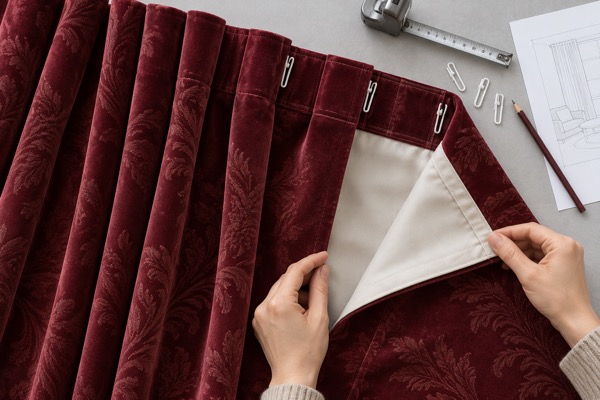
Approve a full-size room mock-up in both positions before releasing the specification. Review the closed appearance and the space occupied by the open curtain against the actual room drawing.
Stack-back is the space the curtain occupies when drawn open. Silent Gliss’ curtain planning guidance explains that heading choice and fitting space affect stacking, and advises checking fabric suitability for Wave. Avoid applying a single stack-back allowance to every construction.
Use this approval checklist with the sample and its specification revision:
- Confirm the covered width and finished panel dimensions against the drawing.
- Close the curtain fully and review the heading, lining and intended coverage.
- Open the curtain fully and record the stack location and available clearance.
- Operate the sample through its intended travel and record any adjustment required.
- Identify the approved fabric, hardware, heading and sample revision in writing.
- Separate accepted details from changes that still need another review.
Ask the designer, installer and procurement team to sign off on the same sample record. Our custom curtain quality-control checklist covers the wider inspection process. The approval here is specifically about the construction you want suppliers to reproduce.
Put Every Supplier on the Same RFQ Basis
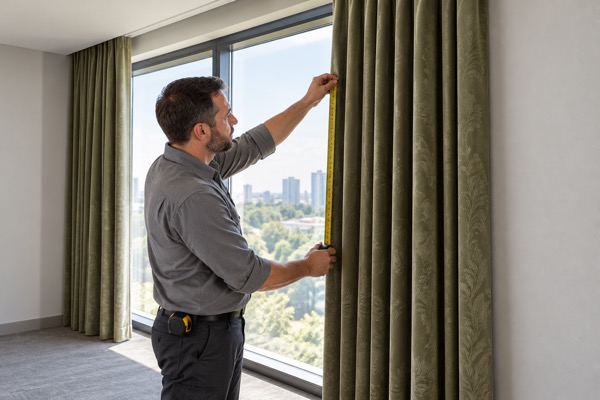
Send one room schedule and ask suppliers to return their assumptions against it. Keep finished curtain dimensions and raw cutting allowances in separate fields so you can compare like-for-like responses.
Include these fields in the RFQ:
- Room or opening ID, quantity and drawing revision.
- Agreed covered width, finished drop and measurement units.
- Combined finished flat width, or the named system’s documented calculation basis.
- Heading construction, hardware reference and one-way or split-draw arrangement.
- Fabric and lining references, with the approved sample revision.
- Supplier confirmation of usable fabric width, pattern matching, hems and seams.
- Open-stack location and room mock-up approval status.
- Included scope, exclusions and any proposed alternative, shown separately.
Ask for raw cutting allowances, pattern matching, usable width, hems and seams separately from the finished flat-width comparison. If a response omits a field, return that field for clarification before comparing totals.
Keep the approved baseline unchanged while reviewing alternatives. When the team accepts a change, issue a new revision to every supplier still quoting. Record which response matches that revision. This gives the purchase order a specific construction to refer to instead of relying on a description such as “full hotel curtains.”
Send ShadeCort a Room Schedule, Not Just a Window Width
Send ShadeCort Resources the room schedule, drawing and sample requirements so the discussion starts with a defined construction. Include your hotel curtain fullness basis and list any details that remain undecided.
ShadeCort’s custom fabric drapery page describes sewn-in liners, hems and bottom weights. These are useful construction details to address in a project specification. Confirm the proposed combination in the quotation and sample record rather than assuming every option applies to every order.
Send your curtain specifications to ShadeCort with the covered width, heading preference and required sample review. Ask for a response against the common RFQ basis and keep any alternative construction separate.
Sources and further reading
- Helser Brothers: Fabric/Fullness Measuring Instructions for Ripplefold. System-specific coverage and fabrication reference.
- Silent Gliss: Wave curtains. Explanation of the named heading mechanism.
- Silent Gliss: Planning your curtains. Heading, fabric suitability and fitting considerations.
ShadeCort’s product construction information is linked beside the relevant statement above. The comparison table and RFQ checklists are illustrative buyer tools, not manufacturer fabrication instructions.
FAQ
Should every room in a hotel use the same fullness?
Set the specification by approved room type rather than automatically applying one ratio to the whole hotel. Group openings with the same coverage and construction requirements, then identify any exceptions in the room schedule. Ask the project team to approve the baseline and each exception before you request comparable quotes.
Can a small swatch replace a hung curtain sample?
Use a swatch for the material review and request a hung sample for construction approval. Keep those approvals separate. A small piece of fabric does not provide the full-size closed and open configurations required by this checklist. Record the hung sample’s dimensions and revision so the purchase order refers to the reviewed construction.
Does a higher ratio guarantee full blackout?
Do not accept a fullness ratio as evidence of full blackout. Specify the required light-control outcome separately, then ask to review it on the complete closed room mock-up. Record the agreed construction and acceptance criteria in the sample approval. This guide’s width comparison is not a blackout performance test or guarantee.
What happens if the supplier changes fabric after approval?
Treat a proposed fabric substitution as a specification change. Ask the supplier to identify the replacement and show which approved details it changes. Hold acceptance of the revised construction until the project team reviews the affected sample and quotation. Update the revision record before giving production approval; do not rely on a verbal substitution.