Quick Answer
Railroaded curtain fabric can be useful for a wide hotel window, but approve the cutting direction and finished drop before ordering. A railroaded pattern label does not, by itself, approve a seam-free curtain. Ask the supplier to show the usable fabric width, heading and hem allowances, pattern orientation, proposed joins, and separate lining layout. Then approve a hung sample in the intended construction. Use that record for each room type. The purchasing decision is whether the proposed material and layout meet the finished specification, not whether the word “railroaded” appears on a swatch.
Settle the fabric direction before comparing prices
Agree on the curtain’s visible pattern direction and cutting layout before asking suppliers to price it. Otherwise, two quotations can describe the same fabric while allowing different joins or producing a different pattern at the window.
This guide is for hotel procurement managers, hospitality designers, and dealers buying made-to-order drapery. It addresses a specific step after material selection. For the wider choice of face fabric, lining, care method, and light control, use ShadeCort’s curtain fabric selection guide.
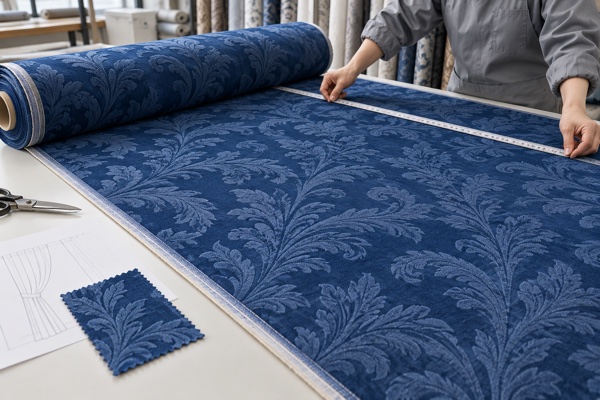
Railroaded describes a pattern running across the fabric roll; up-the-roll patterns run along its length. Sailrite’s explanation of railroaded fabric illustrates this terminology. A catalog label describes how the design relates to the roll. The workroom still needs to confirm how that material should be cut and hung for your curtain.
Ask for a sketch with the roll edges, fabric face, intended top, and finished curtain direction marked. Do not rely on a square swatch that has lost its original orientation. A stripe that looks right when held in one direction may face another way in the proposed panel layout.
Have the designer approve the appearance and the supplier confirm the making direction in the same record. Treat an unconfirmed direction as an open specification item, rather than letting the lowest-priced quotation settle it by default.
Check railroaded curtain fabric against the finished drop
For a crosswise layout, check whether the usable fabric width can accommodate the finished drop and the actual making allowances. This is the feasibility check to complete before approving a no-join face panel.
In a crosswise drapery layout, the usable roll width becomes the dimension available for the curtain drop. Knoll Textiles’ drapery specification guide explains this geometry for its wide-width Creative Wall drapery. Its documented construction is an example, not permission to rotate every fabric or reuse its yardage schedule for a different project.
Ask the supplier to separate the nominal roll width from the width it can actually use. Then request a height budget showing the proposed heading, bottom hem, excluded edges, and any other construction allowance. Ask whether the quoted drop is measured from the hook, the top of the heading, or another agreed reference point.
Planning example, using assumed inputs: suppose the usable width is 300 cm and the proposed heading and hem together consume 20 cm in the drop direction. That leaves 280 cm for the finished drop. A 270 cm drop leaves 10 cm within this assumed budget; a 290 cm drop does not fit it. These values illustrate subtraction only. They are not standard allowances or a ShadeCort product specification.
The height budget and comparison checklist are planning tools; the workroom must confirm the actual construction. If the budget does not fit, ask for a wider approved material, an up-the-roll layout with agreed seams, or a specifically approved alternative join. A different heading or hem is another design option only if the project team accepts the change.
Check the tallest room type early. Do not assume that a layout approved for a standard guest room also works for a suite with a higher ceiling. Ask the supplier to flag exceptions on the room schedule before it calculates the material order.
Compare the seam layout in every quotation
Request quotations against the same finished appearance and construction. “Seamless,” “wide-width,” and “railroaded” need a drawing and an agreed scope to be useful purchasing terms.
Use the following matrix to frame the supplier discussion. It is a buyer checklist, not a recommendation that every fabric can use every layout.
| Proposed layout | What the supplier should confirm | What the buyer should approve | Detail the quote must state |
|---|---|---|---|
| Approved crosswise face fabric | Making direction, usable width, and feasible drop | Pattern direction and the no-join face-panel proposal | Whether the lining and finished assembly contain joins |
| Up-the-roll face fabric with joined widths | Number and position of joins, and pattern-matching plan | Seam appearance in a hung sample | Joining and matching included in the price |
| Alternative wider fabric | Available construction and intended end use | New color, texture, pattern, and sample | Exact replacement fabric reference |
| Proposed horizontal or decorative join | Join location and making method | Visible design change before production | Written acceptance of the revised layout |
A quote for a face panel without vertical seams is not automatically a quote for a finished curtain without any joins. Ask the supplier to identify the face, lining, and any additional layer separately. Specify what “seam-free” means in the purchase documents.
Also ask for the measurement basis, unit of sale, curtain quantity, heading, finished width, and drop. Compare total finished scope before comparing price per metre or yard. A lower material price does not resolve an omitted sewing operation or an unapproved substitute.
Where the supplier offers two feasible layouts, request both against the same room schedule. Let the team compare their hung samples and complete quotations. Avoid assigning a universal savings percentage to railroading; the project needs an actual material and making calculation.
Approve the face fabric and lining as a finished sample
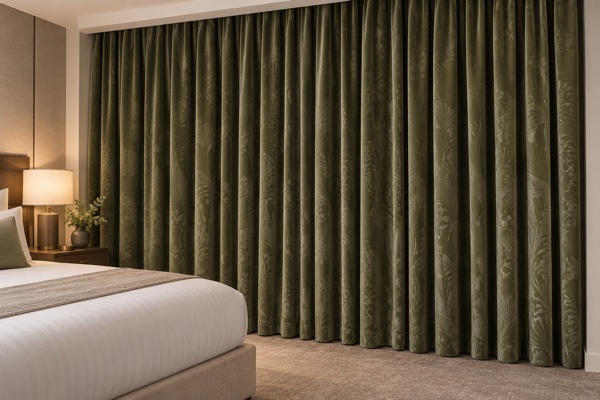
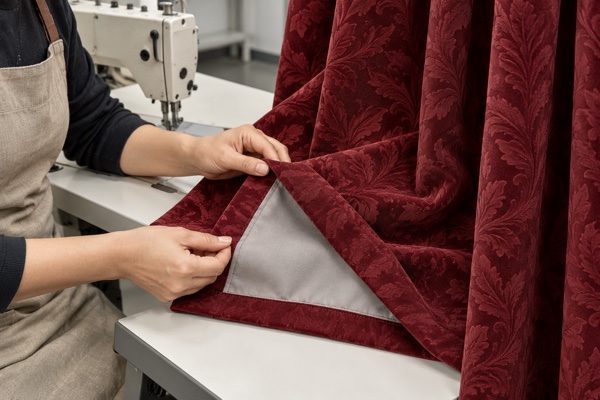
Approve a hung sample that demonstrates the proposed face fabric, lining, heading, seams, and finished dimensions together. A small fabric memo cannot show the complete panel layout.
Use an opening and lighting condition representative of the room type. Ask the designer and supplier to agree on what will be evaluated before the sample is made. The approval should cover both the intended appearance and the construction the workroom will repeat.
Record these items:
- Fabric reference, color, face side, and approved cutting direction.
- Finished width and drop, measurement reference points, and agreed tolerances.
- Heading, hems, and the position of each accepted join.
- Pattern direction and matching across adjacent panels.
- Lining reference, its own cutting layout, and how it is attached.
- Appearance when the curtain is open, partly drawn, and closed.
- Sample identification, drawing revision, approver, and unresolved items.
For a joined layout, request the applicable seam information for the selected material. ACT lists seam-slippage guidance for applicable woven drapery, with scope conditions rather than a universal rule for every curtain. The ACT woven-fabric physical-properties guideline is useful context for that discussion; it is not proof that a particular curtain has passed a test.
Judge seam placement on the actual hung sample. A seam hidden in one fold during a photograph may be visible when the curtain is drawn. Ask the reviewer to move the curtain through its normal positions and record the accepted appearance.
When a room requires blackout, keep the specified light-control construction as a separate approval item. A favorable seam layout does not establish opacity or the performance of an installed window treatment. Do not trade away a required layer just to obtain a simpler face-panel layout.
Carry the approved layout into every room type
Release the order against a room schedule and an approved layout revision. The sample is useful only if the production documents identify the construction it represents.
For each room type, record the opening reference, finished dimensions, fabric direction, allowed joins, lining layout, and sample approval. Flag taller drops, different headings, or different materials for their own review. Ask the supplier to identify which exceptions need another sample or drawing approval.
Keep the accepted sample or its documented reference available during the order. Include clear photographs of the face direction and approved seams. Photographs support the record, but they should not replace dimensions and a written construction description.
If a fabric reference, usable width, lining, or layout changes, request a revised record before cutting. State who is authorized to accept the change. A supplier should not need to infer approval from an informal discussion about a possible alternative.
At bulk inspection, compare the actual panels with the approved direction and seam plan. ShadeCort’s custom curtain quality-control guide covers the broader inspection sequence. Keep this orientation check within that process rather than replacing the whole inspection with a visual review of seams.
Send ShadeCort a construction brief
Send a project brief that makes the orientation decision reviewable: destination, room schedule, finished dimensions, fabric reference or design target, approved pattern direction, heading, lining, and acceptable joins. Include photographs or drawings of the intended result, and mark any layout that remains unconfirmed.
ShadeCort’s custom drapery page lists sewn-in liners and double-turned hems among its construction details. The custom fabric drapery range gives buyers a relevant product starting point. Ask the project team to confirm which materials, dimensions, and making options apply to the specific order.
For a railroaded curtain fabric proposal, request the usable-height budget, face and lining layout, and proposed sample approval in the response. That gives the project team concrete decisions to review before it compares a complete quotation.
Send your curtain construction brief to ShadeCort, with the approved information and open questions clearly separated.
Sources and further reading
- Sailrite: What Is Railroaded Fabric? for pattern-direction terminology.
- Knoll Textiles: How to Specify Drapery for crosswise construction geometry within its documented product system.
- Association for Contract Textiles: Woven-Fabric Physical Properties for the scope of voluntary seam-slippage guidance.
- ShadeCort Resources: Custom Fabric Drapery, linked in the construction-brief section, for the stated product-category details.
FAQ
What should a supplier’s sample label show?
Ask for the fabric and color references, face side, intended top, cutting direction, and sample revision. Keep the label tied to the approved drawing or sample record. A label is most useful when another reviewer can understand the intended construction without relying on the person who first presented it.
Should the face fabric and lining use an identical cutting layout?
Ask the supplier to propose and document each layer separately. The buyer should approve how they work together in the finished curtain, including accepted joins and attachments. Avoid requiring identical layouts merely for consistency on paper; review the actual assembly and the project requirements before accepting a proposal.
What should I do if one room is taller than the approved mock-up?
Treat that room as an exception. Request a fresh height budget and layout review for its finished drop, heading, and hem. Ask whether the existing material and orientation still fit or whether another construction needs approval. Keep the exception visible in the room schedule before production is released.
Can I reuse the approved layout for a later order?
Use it as a reference, then ask the supplier to reconfirm the material, usable width, lining, making direction, and finished dimensions. Record any change in a new revision. Keep the original approval available for comparison, but do not treat it as automatic approval of a different fabric or construction.