How to Choose a Reliable B2B Curtain Supplier for Hotel Projects
Choosing the right B2B curtain supplier is a critical decision for hotel owners, developers, interior designers, contractors, and procurement teams.
Hotel curtains are not simply decorative products. They directly influence guest comfort, privacy, sleep quality, safety requirements, and the overall appearance of hospitality spaces.
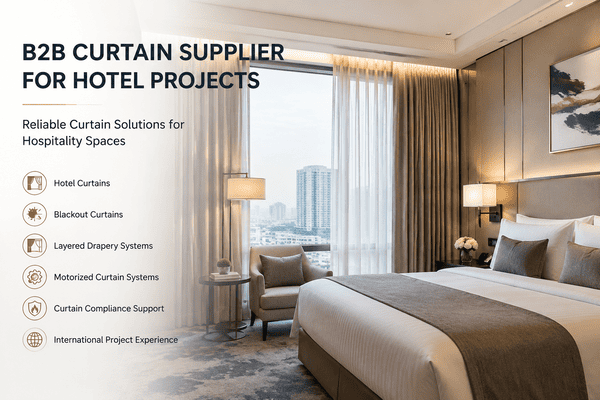
A reliable supplier should provide more than fabrics. Professional hotel curtain partners offer complete solutions including
hotel curtains, blackout curtains, hotel window treatments, curtain compliance support, layered drapery systems, and motorized curtains.
For international hospitality projects in the United States, Canada, Australia, and other English-speaking markets, selecting the right supplier can help ensure consistent quality, smooth project execution, and long-term performance.
Why Choosing the Right Curtain Supplier Matters for Hotels
Hotel projects have unique requirements compared with residential curtain purchases.
A single hospitality project may require hundreds or thousands of curtain panels with identical specifications.
Any inconsistency in fabric color, stitching, dimensions, or installation can affect the final appearance of guest rooms and public areas.
A professional B2B curtain supplier helps hotels manage:
- Large-volume production
- Custom curtain sizes
- Fabric selection
- Blackout performance
- Fire safety requirements
- Motorized curtain systems
- Installation coordination
- Replacement orders
The right supplier becomes a project partner rather than only a product manufacturer.
What Should Hotels Look for in a B2B Curtain Supplier?
Choosing a supplier requires evaluating more than price.
The lowest quotation may not always provide the best long-term value for a hospitality project.
Hotel buyers should review:
- Manufacturing capability
- Customization options
- Quality control systems
- Technical support
- International project experience
1. Manufacturing Capability and Production Capacity
A reliable hotel curtain supplier should have the ability to handle commercial-scale production while maintaining consistent quality.
Hospitality buyers should evaluate:
- Production capacity
- Fabric sourcing ability
- Sewing quality
- Quality inspection procedures
- Packaging standards
- Delivery reliability
Large hotel projects require suppliers that can reproduce approved designs consistently across many rooms and locations.
For example, a 300-room hotel renovation may require thousands of curtain panels produced according to one approved specification.
The supplier must ensure every finished product matches the approved sample.
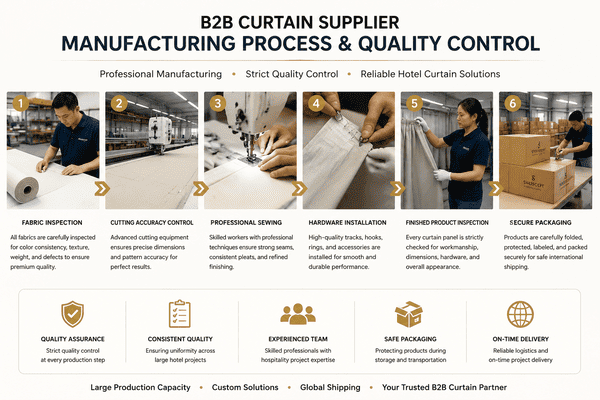
A strong manufacturing process normally includes:
- Fabric inspection
- Cutting accuracy control
- Professional sewing
- Hardware installation
- Finished product inspection
- Secure packaging
2. Customization Ability for Hospitality Projects
Hotels rarely use standard residential curtains.
Each project may have different requirements based on:
- Window dimensions
- Interior design concept
- Brand guidelines
- Room category
- Lighting requirements
- Control systems
A professional supplier should provide customization options such as:
- Custom curtain sizes
- Fabric selection
- Color matching
- Different lining options
- Custom headings
- Decorative designs
- Motorized curtain integration
For hotels, customization is not only about appearance.
The right construction affects durability, maintenance, guest experience, and long-term operating costs.
When selecting materials, hotel buyers can also review our guide:
12 Best Curtain Fabrics for Hotels: A B2B Buyer’s Guide
3. Quality Control and Sample Approval Process
Before placing a large order, hotel buyers should establish a clear sample approval process.
A professional supplier should provide samples that allow buyers to evaluate:
Fabric Performance
Important factors include:
- Texture
- Weight
- Opacity
- Color consistency
- Durability
Finished Curtain Construction
Buyers should review:
- Stitching quality
- Pleat structure
- Curtain fullness
- Hem finishing
- Lining attachment
Functional Testing
For operational projects, testing should include:
- Curtain movement
- Track operation
- Motor compatibility
- Opening and closing performance
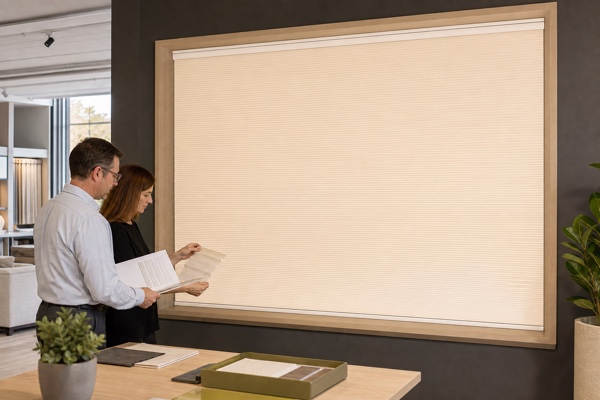
A full-size room mock-up is recommended for major hotel projects because small fabric samples cannot always show the final installed appearance.
4. International Shipping and Project Experience
Hotels in the United States, Canada, Australia, and other international markets often require suppliers who understand export procedures and project coordination.
Important supplier capabilities include:
- Export documentation
- International packaging
- Production scheduling
- Communication across time zones
- Technical drawings
- Installation guidance
A supplier experienced with international hospitality projects can reduce communication problems and prevent costly delays.
Hotel Curtain Solutions a Professional Supplier Should Provide
A complete hospitality curtain supplier should support different applications throughout a hotel property.
- Guest room curtains
- Suite window treatments
- Restaurant curtains
- Conference room solutions
- Public area drapery
- Smart curtain systems
The right solution depends on the purpose of each space.
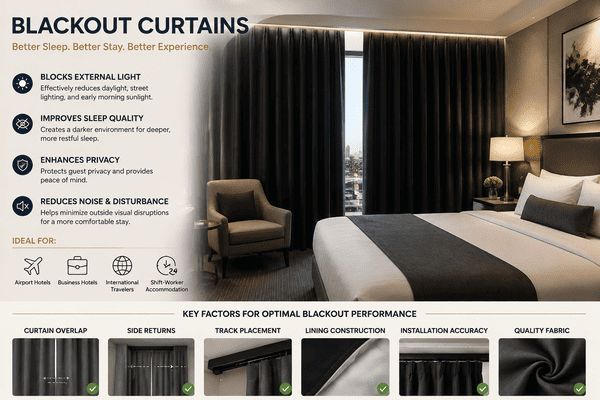
Blackout Curtains for Hotel Guest Rooms
Blackout curtains are one of the most important products in modern hospitality.
Guests expect hotel rooms to provide a comfortable sleeping environment regardless of outside conditions.
Blackout curtains help reduce:
- External daylight
- Street lighting
- Early morning sunlight
- Visual disturbance
They are especially useful for:
- Airport hotels
- Business hotels
- International traveler accommodation
- Shift-worker accommodation
A well-designed blackout curtain system requires more than selecting a dark fabric.
Performance also depends on:
- Curtain overlap
- Side returns
- Track placement
- Lining construction
- Installation accuracy
For a deeper understanding of curtain materials and blackout performance, read:
Hotel Curtain Fabrics Guide: Materials, Benefits, and B2B Buying Considerations
Hotel Window Treatments for Modern Hospitality Design
Hotel window treatments include more than traditional curtains.
Modern hospitality projects often combine:
- Drapery
- Sheer curtains
- Blackout curtains
- Roller shades
- Motorized systems
- Layered window treatments
A complete window treatment strategy should consider:
- Guest comfort
- Interior design
- Privacy
- Maintenance requirements
- Operational efficiency
Luxury hotels often use layered solutions because they provide greater flexibility throughout the day.
Example:
- Morning: Sheer curtains allow natural daylight
- Afternoon: Decorative drapery controls privacy
- Night: Blackout curtains create a darker sleep environment
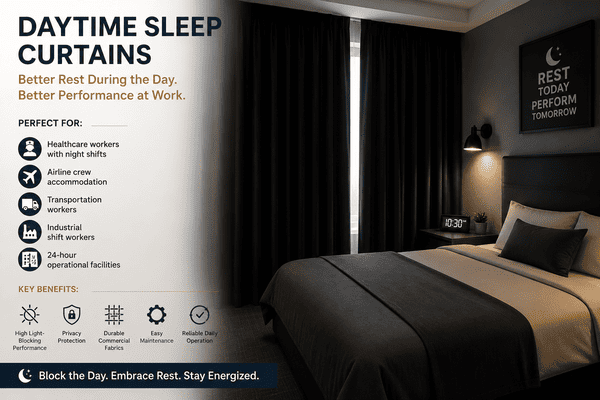
Daytime Sleep Curtains for Shift-Worker Accommodation
Modern accommodation needs are becoming more diverse.
Hotels, workforce housing providers, healthcare facilities, and transportation-related accommodation increasingly require solutions designed for people who sleep during daytime hours.
Daytime sleep curtains are designed to create a darker and more comfortable sleeping environment when natural daylight is unavoidable.
These solutions are especially valuable for:
- Healthcare workers with night shifts
- Airline crew accommodation
- Transportation workers
- Industrial shift workers
- 24-hour operational facilities
A professional B2B curtain supplier should understand that daytime sleep requirements are different from standard decorative curtain applications.
Important considerations include:
- High light-blocking performance
- Privacy protection
- Durable commercial fabrics
- Easy maintenance
- Reliable daily operation
Creating a better sleep environment helps improve accommodation quality and supports guests with non-traditional schedules.
Layered Drapery Systems for Premium Hotel Interiors
Layered drapery is one of the most popular solutions for luxury hotels because it combines design flexibility with practical performance.
A typical layered hotel curtain system includes three components:
- Sheer curtain layer: Provides daytime privacy while allowing natural light.
- Decorative drapery layer: Adds texture, color, and interior design value.
- Blackout curtain layer: Provides stronger light control for sleeping comfort.
This combination allows guests to adjust their environment according to different times of day.
Benefits of layered drapery include:
- Improved guest comfort
- Flexible privacy control
- Luxury visual appearance
- Better room functionality
- Compatibility with premium hotel designs
Layered systems are commonly used in:
- Luxury hotels
- Resorts
- Executive suites
- Boutique accommodations
- High-end serviced apartments
For hotel buyers comparing different fabric and curtain system options, our guide:
12 Best Curtain Fabrics for Hotels: A B2B Buyer’s Guide

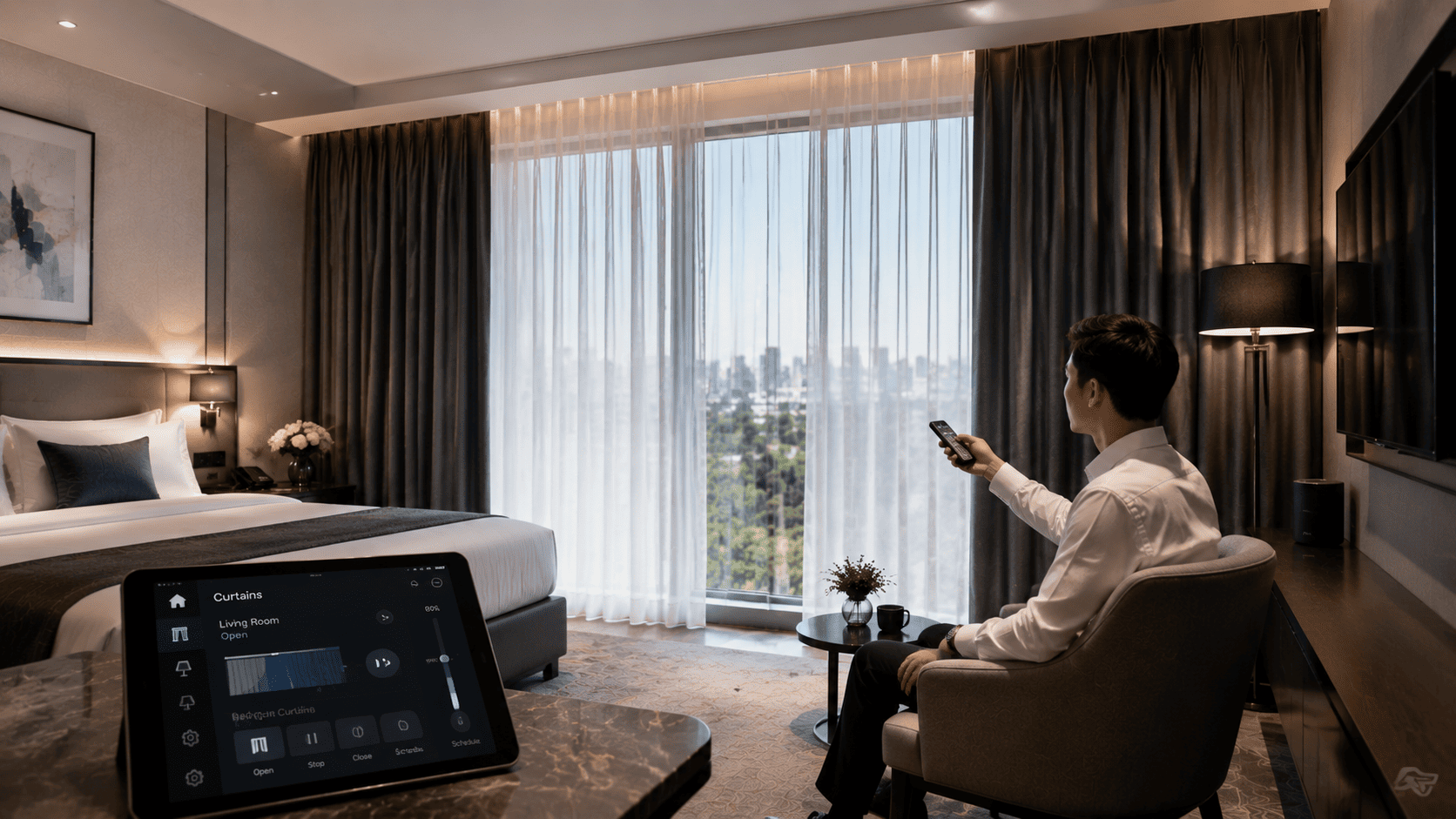
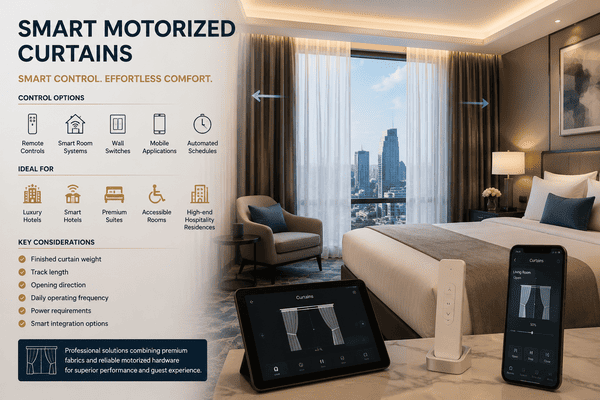
Motorized Curtains for Smart Hotel Projects
Technology is becoming an important part of modern hospitality design.
Motorized curtains allow hotels to provide a more convenient and premium guest experience.
Motorized curtain systems can be integrated with:
- Remote controls
- Smart room systems
- Wall switches
- Mobile applications
- Automated schedules
They are especially suitable for:
- Luxury hotels
- Smart hotels
- Premium suites
- Accessible hotel rooms
- High-end hospitality residences
When selecting motorized curtains, suppliers should evaluate:
- Finished curtain weight
- Track length
- Opening direction
- Daily operating frequency
- Power requirements
- Smart integration options
A professional supplier should provide both the curtain fabric solution and the correct motorized hardware system.
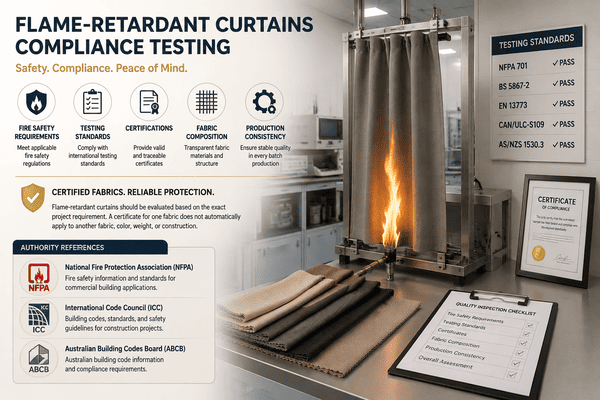
Curtain Compliance and Flame-Retardant Requirements
For hospitality projects, curtain compliance is an important part of the purchasing process.
Hotels and commercial accommodation facilities may have specific requirements regarding flame-retardant materials and textile performance.
Before ordering, buyers should confirm:
- Applicable fire safety requirements
- Required testing standards
- Available certificates
- Fabric composition
- Production consistency
Flame-retardant curtains should always be evaluated based on the exact project requirement.
A certificate for one fabric does not automatically apply to another fabric, color, weight, or construction.
For projects in the United States, buyers can review fire safety information from:
National Fire Protection Association (NFPA)
The NFPA provides widely recognized fire safety resources used across many commercial building applications.
For building code information, buyers may also review:
International Code Council (ICC)
For projects in Australia, local requirements should be confirmed through relevant building authorities, including:
Australian Building Codes Board (ABCB)
How to Evaluate a B2B Curtain Supplier Before Ordering
Before selecting a supplier, hotel buyers should use a structured evaluation process.
B2B Curtain Supplier Evaluation Checklist
- Does the supplier have hospitality project experience?
- Can they provide custom hotel curtains?
- Can they support large-volume production?
- Can they provide fabric samples?
- Can they meet blackout curtain requirements?
- Can they provide curtain compliance documentation?
- Can they support motorized curtain systems?
- Can they manage international shipping?
The right supplier should combine manufacturing capability, technical knowledge, quality control, and project communication.
Choosing a supplier only based on price may create problems later, including inconsistent quality, delayed delivery, unsuitable materials, and additional project costs.
Why Choose ShadeCort Resources as Your B2B Curtain Supplier?
ShadeCort Resources provides professional window treatment solutions for commercial and hospitality projects.
The company focuses on helping businesses, designers, contractors, wholesalers, and hospitality buyers create customized curtain solutions based on project requirements.
Solutions include:
- Hotel curtains
- Blackout curtains
- Custom drapery
- Layered window treatments
- Motorized curtain systems
- Commercial window solutions
For more information about selecting a professional hospitality curtain partner, visit:
B2B Curtain Supplier for Hotels and Commercial Projects
Working with an experienced supplier helps simplify procurement, improve quality consistency, and create better guest environments.
Frequently Asked Questions
What is a B2B curtain supplier?
A B2B curtain supplier provides curtain products and solutions for businesses such as hotels, contractors, designers, developers, wholesalers, and commercial property owners.
Unlike residential suppliers, B2B suppliers usually support customization, bulk production, and project requirements.
How do hotels choose the right curtain supplier?
Hotels should evaluate supplier experience, manufacturing capability, customization options, quality control, compliance support, delivery ability, and technical service before placing orders.
What curtains are best for hotel rooms?
The best hotel curtains depend on project requirements.
Many hotels use blackout curtains, layered drapery systems, sheer curtains, and durable commercial fabrics to balance comfort, privacy, and interior design.
Why are blackout curtains important for hotels?
Blackout curtains help create a better sleep environment by reducing external light.
They are especially useful for international travelers, airport hotels, business hotels, and daytime sleepers.
What are daytime sleep curtains?
Daytime sleep curtains are designed to provide stronger light control for people who need to sleep during daylight hours, including shift workers, healthcare professionals, and transportation workers.
Do hotel curtains need flame-retardant materials?
Requirements depend on location, building regulations, and project specifications.
Hotels should confirm required curtain compliance standards before selecting materials.
Are motorized curtains suitable for hotels?
Yes.
Motorized curtains are commonly used in luxury hotels and smart hospitality projects because they provide convenient operation and support modern room automation.
What are layered drapery systems?
Layered drapery systems combine sheer curtains, decorative curtains, and blackout layers to provide flexible privacy, light control, and premium interior appearance.
Conclusion
Choosing the right B2B curtain supplier is an important decision for any hotel project.
The ideal supplier should provide reliable manufacturing, customization capability, quality control, compliance support, and complete window treatment solutions.
From blackout curtains and daytime sleep curtains to layered drapery and motorized curtain systems, professional suppliers help hospitality businesses create comfortable, functional, and visually appealing spaces.
By selecting a supplier with commercial experience and technical expertise, hotels can improve guest satisfaction while ensuring long-term project value.