Quick Answer
The best curtain fabrics for hotels depend on the room and the finished construction. Polyester is a practical choice for many guest rooms. Velvet and jacquard add visual weight, linen and cotton blends create a softer look, voile manages filtered daylight, and woven or coated blackout fabrics suit sleep-focused spaces. The buyer still has to match the face fabric with the lining, heading, track, controls, cleaning method, and project documents.
A fabric that looks right in a sample book can still fail after installation. B2B buyers should approve the complete custom fabric drapery system, not the swatch alone.
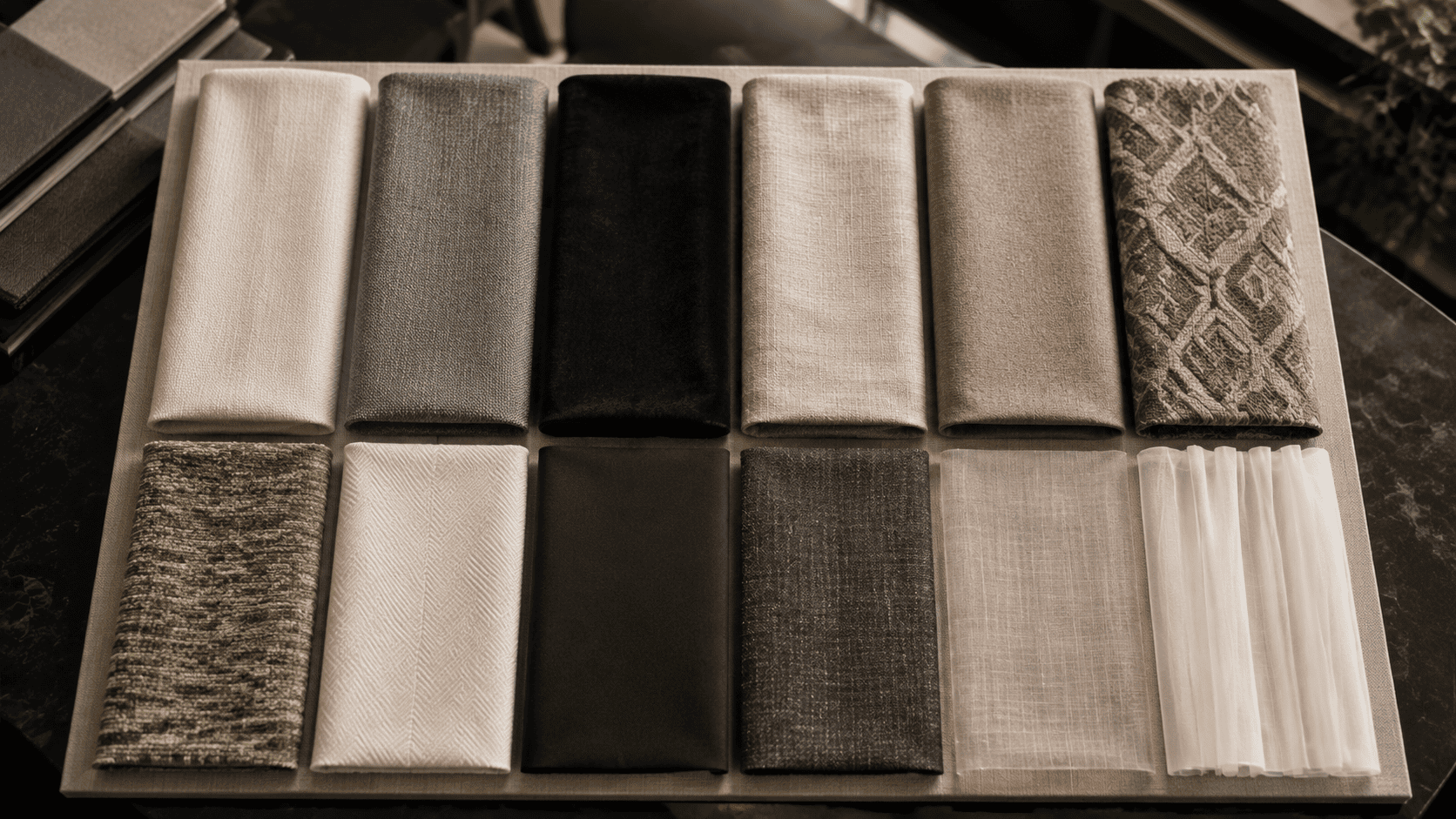
How to choose hotel curtain fabric
Start with the room schedule. Identify which spaces need blackout, softer daylight control, a decorative layer, easy cleaning, or motorized operation. Then compare the proposed fabrics against those requirements.
Check the required light control
A guest room intended for daytime sleep needs a different curtain from a restaurant or meeting room. Define the target first, then review:
- How much light the room should admit when the curtain is closed
- Daytime and nighttime privacy
- Window orientation and room use
- Possible gaps at the track, sides, center, and hem
Words such as “dimout” and “blackout” are not enough on their own. Test the proposed construction, preferably in a finished mock-up.
Plan for use and cleaning
Hotel curtains are handled every day. Sunlight, repeated operation, vacuuming, spot cleaning, washing, or dry cleaning can change how the material looks and hangs.
Ask for the care method before approval. Check fabric strength, wrinkle recovery, color stability, dimensional change, and whether the maintenance team can follow the required process. Contract-textile guidance separates performance requirements by fabric construction, intended application, and indoor or outdoor use. If light exposure matters, ask which colorfastness method and result apply to the proposed fabric rather than accepting a general claim.
Match the weight to the track
Weight changes the drape, the stack-back space, and the load on the hardware. A heavy velvet curtain may suit a suite, but it needs stronger tracks and fixings. A light voile puts much less load on the track, although it is normally used as a sheer layer rather than the main room-darkening curtain.
For motorized curtains, calculate with the finished curtain weight. The fabric sample does not include the lining, heading, seams, or added fullness.
Confirm compliance before production
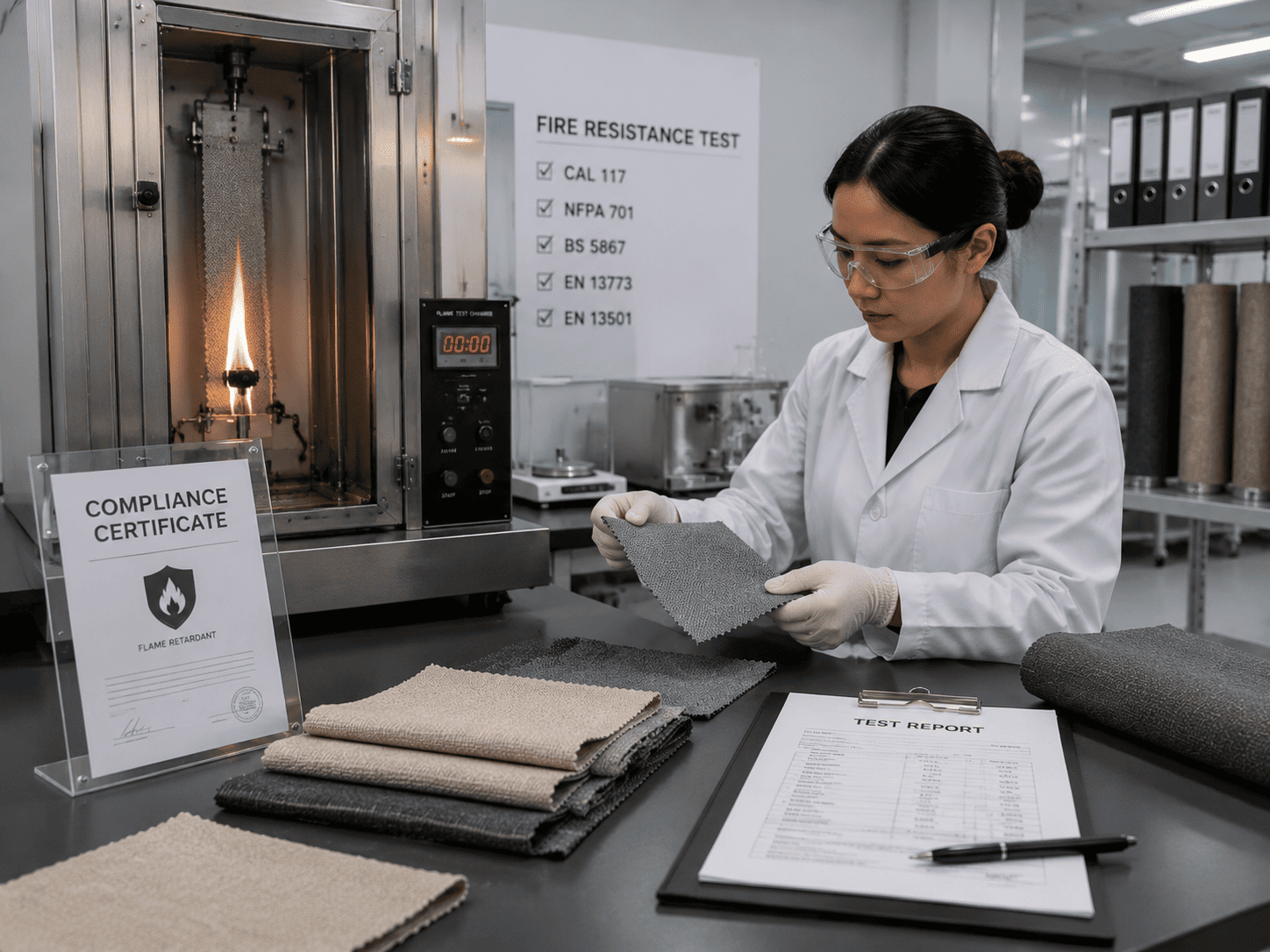
Hotels and other commercial accommodation may require documented flame performance. The applicable test depends on the destination, building use, and written specification.
Confirm the requested test method and check that the report covers the exact fabric or curtain construction being supplied. NFPA 701 addresses flame propagation tests for textiles and films, while the UK Home Office sleeping-accommodation guide lists BS 5867-2 for curtain and drape fabrics, including nets and linings. These references are not interchangeable approvals for every market.
Review cleaning or conditioning limits as well. A report for a similar-looking fabric is not evidence for the proposed material. The detailed flame-retardant hotel curtain specification guide explains how to match the report, material, lining, care cycle, and production batch.

Hotel curtain fabric comparison
This table is a starting point. Lining, construction, installation, and maintenance can change the result.
| Fabric | Typical application | Blackout potential | Maintenance | Why buyers specify it |
|---|---|---|---|---|
| Polyester | Standard guest rooms | High with suitable lining or construction | Usually straightforward | Stable, practical, and widely available |
| Polyester-cotton blend | Guest rooms and suites | Medium to high with lining | Moderate | Softer look with added stability |
| Velvet | Luxury rooms and public areas | Can be high with suitable construction | Moderate | Dense texture and formal appearance |
| Linen blend | Resorts and boutique hotels | Usually medium unless lined | Moderate | Relaxed, natural-looking texture |
| Jacquard | Decorative interiors | Usually medium unless lined | Moderate | Woven pattern and visual depth |
| Blackout fabric | Bedrooms and sleep-focused rooms | Very high when correctly specified and installed | Often straightforward | Strong light reduction |
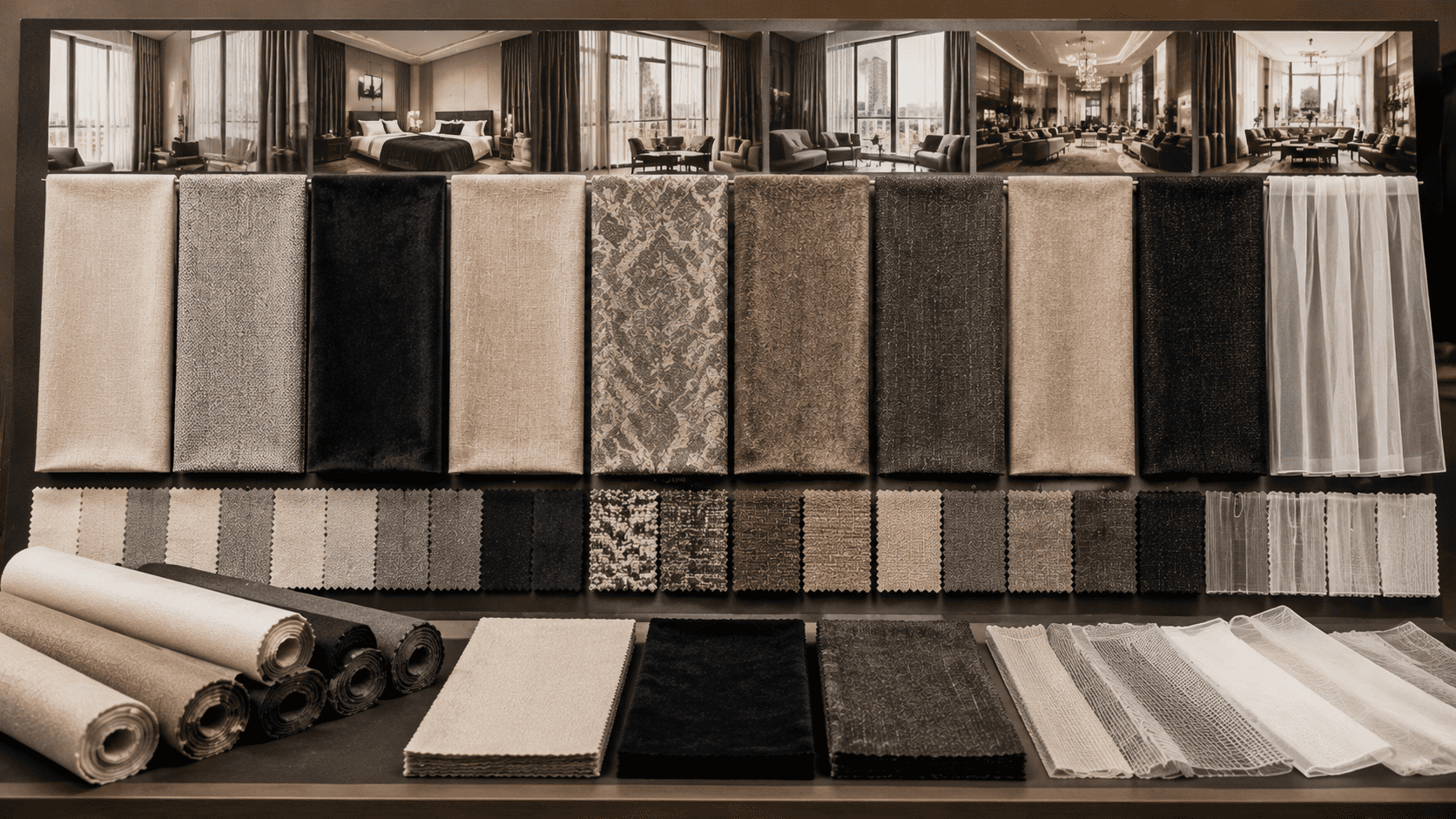
12 best curtain fabrics for hotels and commercial projects
1. Polyester
Polyester is common in hotel projects for a practical reason: buyers can source it in many weights, textures, colors, and blackout constructions. It generally offers good dimensional stability and manageable care.
Do not assume that two polyester fabrics will perform the same way. Approve the actual weight, weave, color, drape, and finished construction. Polyester is a familiar choice for business hotels, standard guest rooms, extended-stay properties, and other large orders.
2. Polyester-cotton blend
A polyester-cotton blend can soften the look of a curtain while retaining some of polyester’s stability. The fiber ratio and weave determine how the material feels, hangs, cleans, and responds to moisture.
It is useful in guest rooms, serviced apartments, boutique hotels, and decorative drapery where pure cotton would require more care than the project can support.
3. Velvet
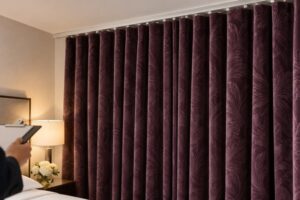
Velvet suits rooms where the curtain needs visual weight. Its dense pile works well in luxury rooms, executive suites, lounges, and restaurants. With the right construction and lining, it can also provide strong light reduction.
Its weight is the catch. Check the track, brackets, wall fixing, motor capacity, seam direction, and available stack-back space. The cleaning plan matters too because pile can show pressure, shading, and handling marks.
4. Linen blend
Linen blends give resorts, villas, and boutique hotels a relaxed texture without all the movement and maintenance associated with pure linen. The added fiber can improve stability, but the result depends on the blend.
Review wrinkles, dimensional change, shade variation, and care instructions on the exact material. These details are more important than the generic “linen look” description in a catalog.
5. Cotton blend
Cotton blends can make a room feel closer to a residential interior, which suits some boutique hotels and serviced apartments. They also work for decorative panels where the curtain is not expected to provide blackout on its own.
Check the fiber ratio, shrinkage, color stability, and cleaning method. A soft hand is useful only if the fabric still looks consistent after maintenance.
6. Jacquard
Jacquard has a pattern woven into the fabric. It can carry more of the decorative work in a suite, restaurant, lobby, or meeting room without relying on a printed surface.
Pattern repeat affects cutting and fabric consumption. Seam matching, usable width, and lining should all be resolved before the buyer approves quantities.
7. Chenille
Chenille has a soft pile and visible texture, so it is often used in lounges, club areas, restaurants, and higher-end rooms. It can make a large window feel warmer, but the surface is more sensitive than a flat weave.
Test how it responds to abrasion and cleaning. Also view the sample from several angles because pile direction and room lighting can change its appearance.
8. Inherently flame-resistant polyester
Inherently flame-resistant polyester has its flame-resistant properties within the fiber rather than only in a surface treatment. Projects may consider it when the specification requires documented flame performance and maintenance durability.
The product name does not prove compliance. Match the report to the fabric reference, construction, test method, cleaning conditions, and intended use. Confirm the acceptance criteria with the project consultant or local authority.
9. Woven blackout fabric
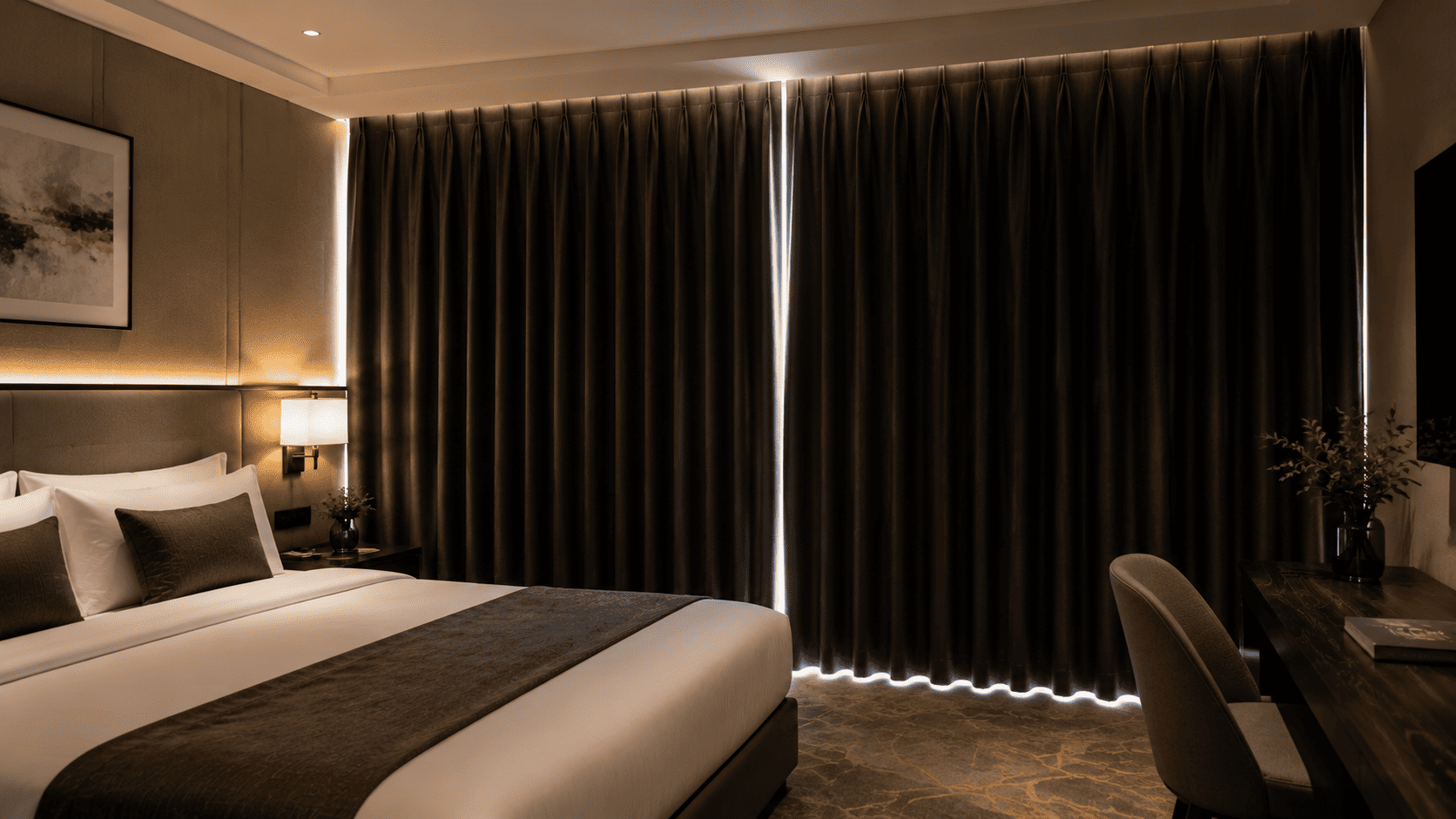
Woven blackout fabric reduces light through a dense or multilayer textile construction. It avoids a separate coated backing in products designed this way and is widely considered for hotel bedrooms, airport hotels, crew accommodation, and rooms used for daytime sleep.
The installation can still let light in. Check the center overlap, side returns, track position, top treatment, hem, and tolerances at the wall.
10. Coated blackout fabric
Coated blackout fabric uses a backing layer to limit light transmission. It can be a practical choice for high-volume hotel projects, especially when the brief calls for strong light reduction within a controlled budget.
Inspect the coating rather than relying on the face fabric. Look at odor, flexibility, cleaning limits, fold marks, seam appearance, and how well the backing is expected to hold up in use.
11. Dimout fabric
Dimout fabric is for spaces that need less daylight without sleep-focused darkness. Restaurants, conference rooms, lounges, and public areas often need this softer balance.
Ask for measured or sampled performance on the proposed material. “Dimout” covers a broad range, and a dark color does not automatically provide the same result as a purpose-built construction.
12. Polyester voile
Polyester voile filters daylight and adds daytime privacy while keeping the window visually light. Hotels use it in guest rooms, suites, restaurants, and spaces with large windows.
Voile is usually one layer in the system. Pair it with decorative drapery, a lined curtain, or a blackout layer when the room also needs privacy at night or strong light reduction.
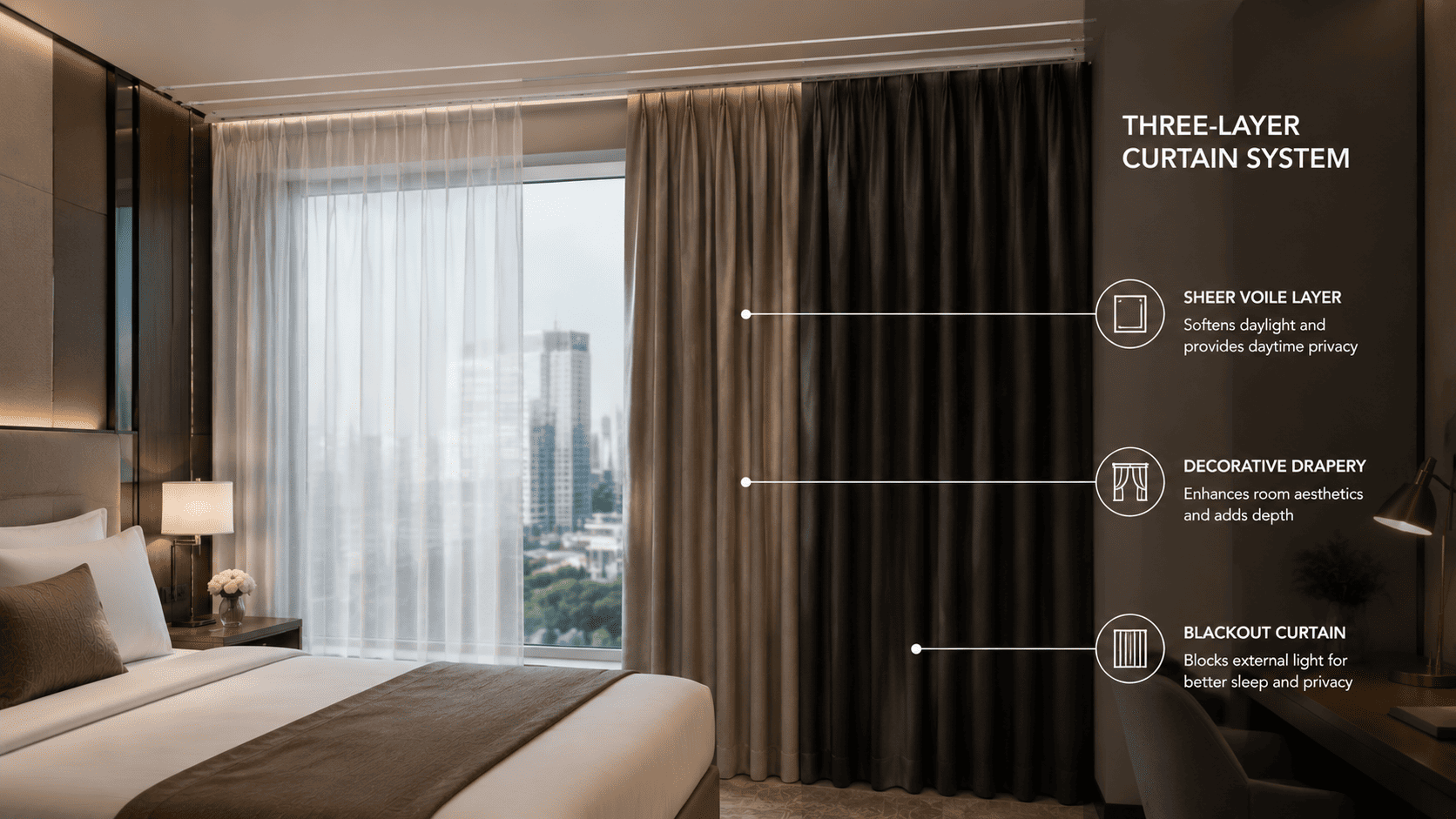
Which fabric works best for blackout hotel curtains?
Woven blackout fabric is one option. A decorative face fabric with a suitable blackout lining is another. The better choice depends on the design, care method, budget, and required construction.
Do not approve blackout from an uninstalled swatch. The fabric may be opaque while the room still has light at the center opening, sides, top, or hem. Include overlap, returns, track position, top coverage, and installation tolerances in the specification. The ShadeCort guide to blackout curtains, light leakage, and hotel sleep environments covers the mock-up and installation checks in more detail.
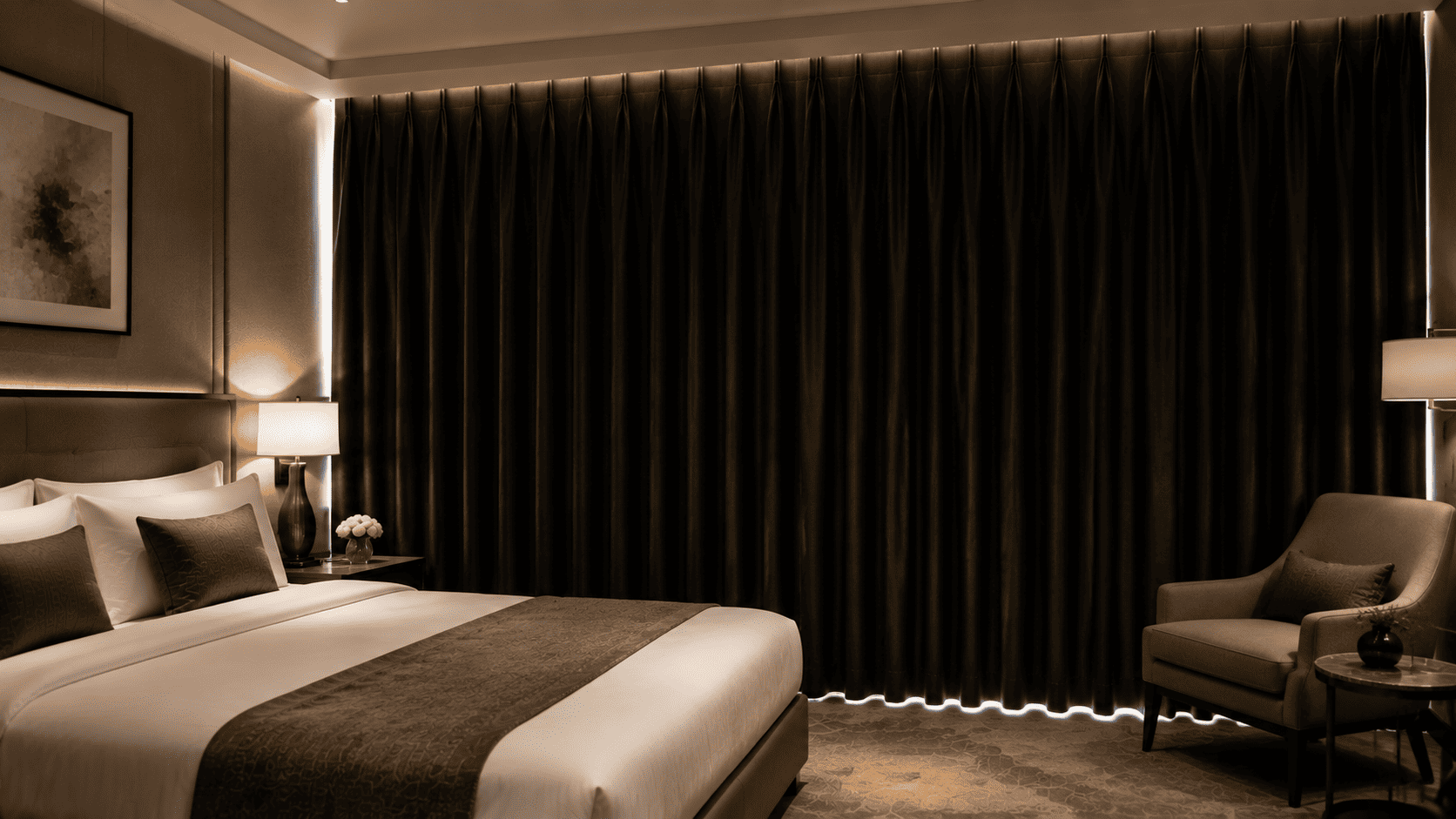
How layered drapery works in a hotel room
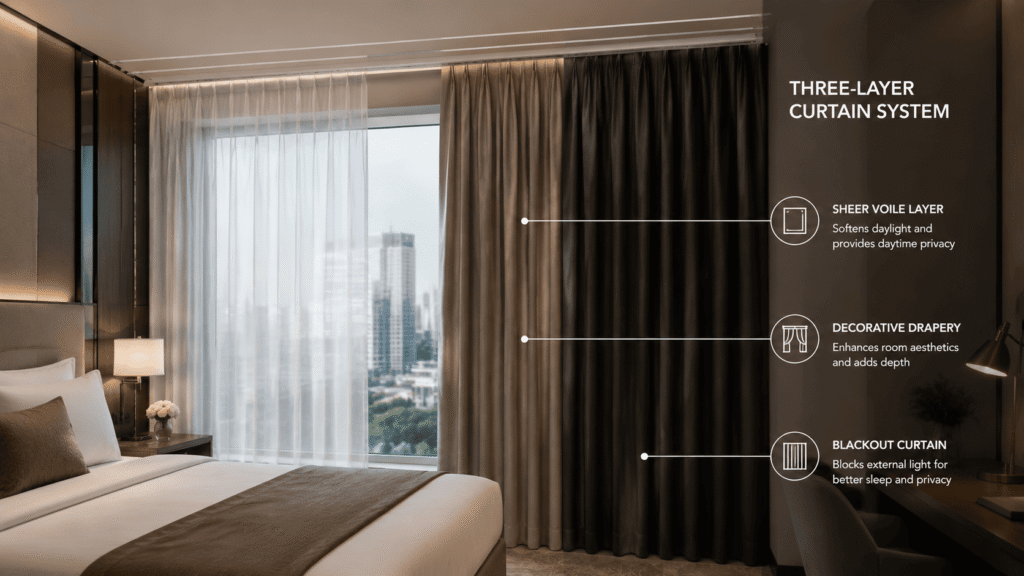
A layered window treatment often combines voile for filtered daylight, decorative drapery for the room design, and a blackout curtain or lining for sleep. Guests can adjust the layers without giving up privacy.
Three layers are not always necessary. A lined decorative curtain may handle appearance and blackout in one panel, while another project may pair a sheer with a roller shade. Leave enough space for every track and for the curtains when they are open.
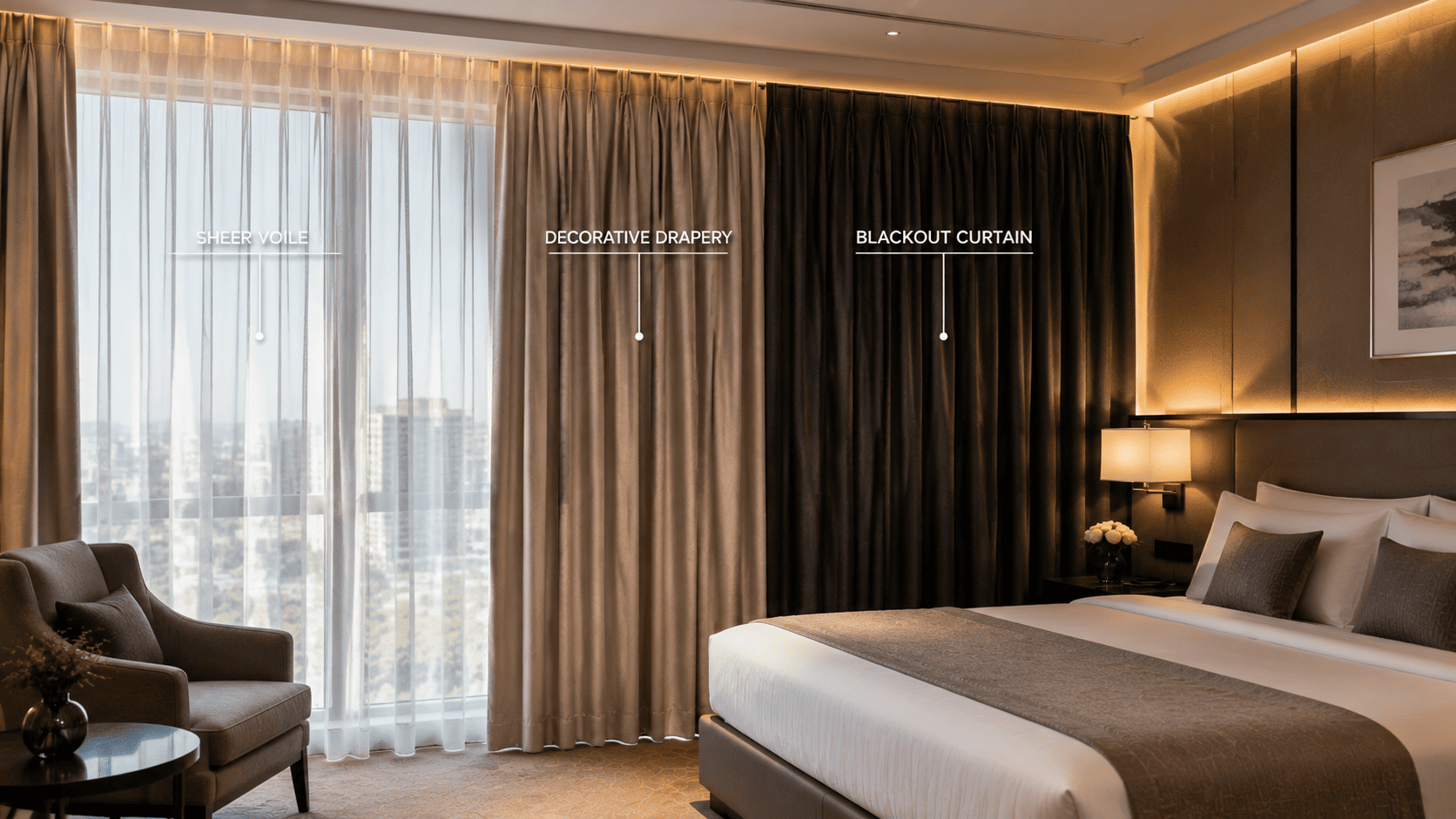
Choosing fabric for motorized curtains
Polyester, velvet, linen blends, blackout constructions, and layered curtains can all run on motorized tracks. Suitability depends on the finished curtain, not the fiber name.
Provide the total curtain weight, track length, opening direction, daily operating frequency, control requirements, and access for servicing. The motor and track should be selected after the lining, heading, fullness, and dimensions are known. Review ShadeCort’s motorized window-treatment systems when the project brief includes curtain tracks, controls, or smart integration.
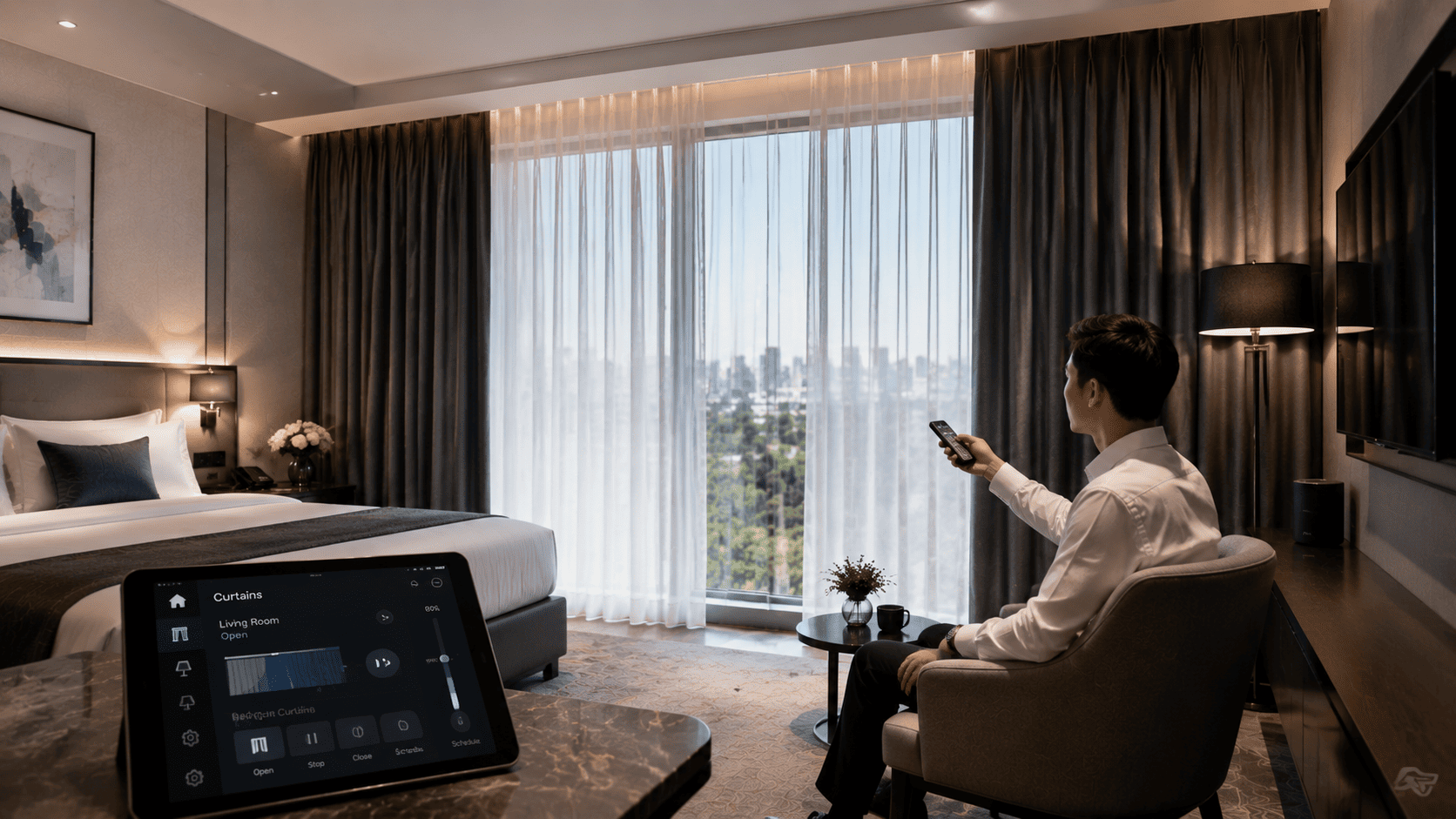
What to check in a curtain sample
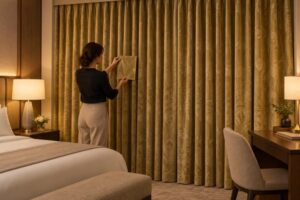
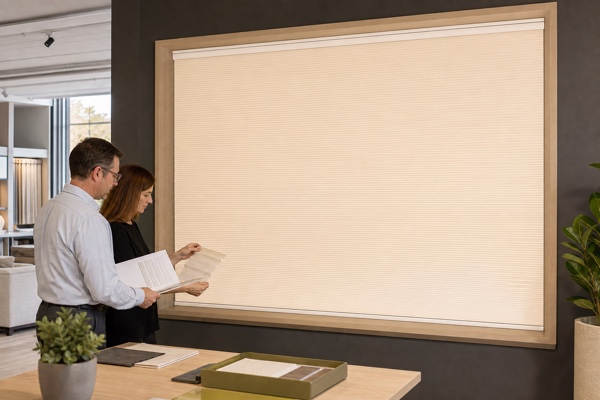
View the sample in daylight and artificial light. Test the proposed blackout construction against a strong light source, then hang enough fabric to judge the drape rather than holding up a small square.
Check seams, fullness, heading, lining, hardware, and finished length. For woven drapery, the Association for Contract Textiles includes seam slippage among the physical properties that may need review. Confirm the cleaning method and match every compliance document to the fabric reference. For a large or technically sensitive order, approve a finished room mock-up before bulk production.
Choosing a B2B curtain supplier
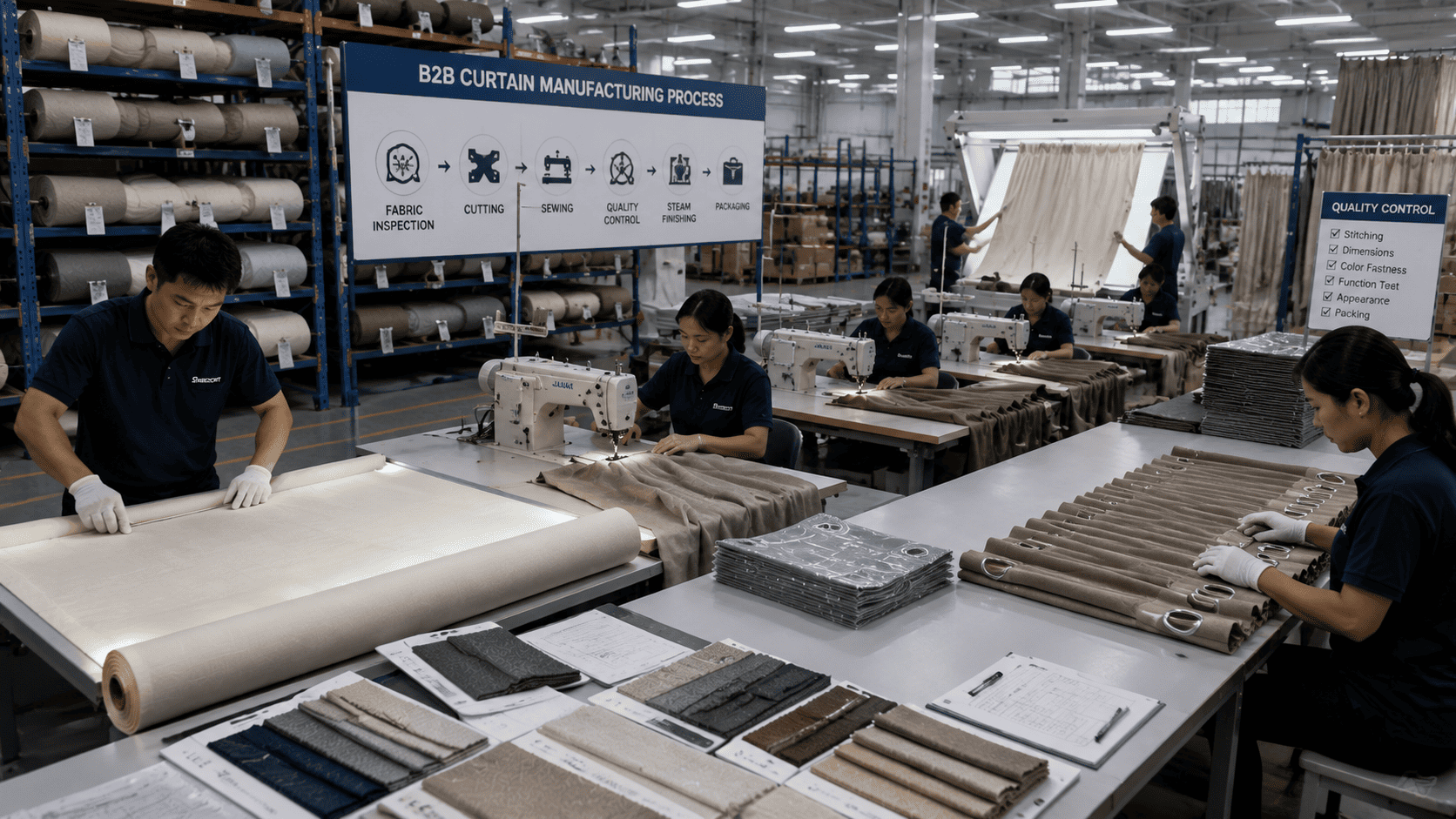
A fabric catalog tells you very little about how a supplier will handle a hotel project. A useful B2B curtain supplier for hotels and commercial projects should be able to explain how its team works from a room schedule, controls fabric batches, labels packages, records approvals, and checks finished dimensions.
Review its custom manufacturing capability and experience with the products in your brief, including blackout construction, flame-performance documents, layered drapery, or motorized tracks. For an imported order, also ask about export packing, shipping documents, and the installation information provided to the site team.
The supplier should turn the approved sample into clear production and inspection requirements, then keep the bulk order consistent with them.
Specify the curtain, not just the fabric
The fabric choice should be tied to the room, lining, heading, track, controls, cleaning method, and installation details. If any of those remain undecided, the buyer has not finished the curtain specification.
Each material in this guide has a useful role. The room schedule should make that role clear before samples are approved and bulk production begins.
Request a hotel curtain fabric review
For a useful first review, send the project location, room schedule, window sizes and quantities, required light control, preferred face fabric and lining, cleaning method, track or motor details, and any written flame-performance requirement. ShadeCort can review possible constructions and prepare samples subject to confirmation for the selected materials and destination.
Contact the ShadeCort project team with the brief, drawings, or reference images. A complete inquiry makes it easier to compare realistic options and identify missing decisions before pricing.
Sources and further reading
- NFPA 701: Standard Methods of Fire Tests for Flame Propagation of Textiles and Films
- UK Home Office: Fire safety risk assessment for sleeping accommodation
- Association for Contract Textiles: Voluntary performance guidelines
- Association for Contract Textiles: Physical properties guideline for woven fabrics
- ISO 105-B02: Colour fastness to artificial light
FAQ
What is the best fabric for hotel curtains?
There is no universal best choice. Polyester, blackout fabric, velvet, linen blends, and flame-resistant materials suit different rooms. Select according to appearance, maintenance, light control, track capacity, and the project’s compliance requirements.
Are blackout curtains important for hotels?
They are important where guests need strong control over outside light, especially in bedrooms and daytime sleep accommodation. The result depends on the full installation, including overlaps, returns, track position, and top coverage.
What curtains do luxury hotels commonly use?
Many luxury hotels use layered systems with voile, decorative drapery, and a blackout curtain or lining. Velvet and jacquard are also used when the design calls for a dense texture or woven pattern.
What fabric suits shift-worker accommodation?
Woven or coated blackout fabric can work when the installation also controls light gaps. Assess the finished room rather than approving performance from the fabric sample alone.
Do hotel curtains need to meet fire safety standards?
The requirement depends on the jurisdiction, building type, room use, and written specification. Confirm the test method and required documents before selecting the material.
Can blackout curtains use motorized tracks?
Yes. Select the motor and track for the finished curtain weight, dimensions, opening direction, and expected operating frequency.
What should a hotel ask a curtain supplier before ordering?
Ask about the exact fabric and construction, customization, test documents, sample approval, quality checks, track and lining compatibility, production capacity, packing, and delivery.
Are layered curtains better than a single curtain?
They offer more control over daylight, privacy, and darkness, but require more space and hardware. A single lined curtain may be simpler when separate layers would add little value.
What is the difference between dimout and blackout curtains?
Dimout curtains reduce daylight and glare. Blackout curtains are intended for stronger light reduction, although the installed system still determines how dark the room becomes.