Quick Answer
Local vs global sourcing for custom window treatments is a choice about responsibility, not simply distance or unit price. A local supplier may suit one-room orders, urgent replacements, difficult site measurements, or buyers who want measuring and installation in one contract. A global factory may make more sense for multi-room projects, repeatable specifications, deeper customization, or dealer programs. Compare the same scope: product, sample, freight, duties, taxes, safety documentation, installation, spares, and remake terms. Many U.S. and Canadian buyers get the clearest result from a hybrid model that combines factory production with local measurement and installation.

Who this guide is for
This guide is for U.S. and Canadian homeowners, interior designers, small dealers, e-commerce brands, and project buyers comparing a nearby window-treatment seller with a factory outside North America. It is most useful before requesting final quotations, when there is still time to define what each quote must include.
The decision changes with order size. A homeowner replacing one damaged shade has a different risk from a designer specifying 40 windows or a dealer launching a repeatable product line. The right answer may also differ by task. Production can be global while measurement, import clearance, installation, and service remain local.
The buyer problem: two quotes rarely cover the same job
A local quote may include an in-home visit, finished measurement, delivery, installation, and a person who can return if a bracket does not fit. A factory quote may cover a made-to-measure product packed for export. Both can be reasonable offers, but the numbers are not comparable until every responsibility is visible.
The gap often appears after the deposit. A buyer discovers that international freight was estimated without final carton dimensions. The installer expects fasteners that were not specified. A motorized shade arrives with a control method that was never mapped to the room. A replacement is possible, but its delivery window misses the move-in date.
Start with a scope sheet. ShadeCort’s window shade specification sheet shows the type of measurement, mount, fabric, control, safety, and installation information that should be settled before comparing sources.
What local and global sourcing mean
Local sourcing
Local sourcing means buying from a supplier in your country or region. The local company may manufacture the product, assemble imported components, buy from another factory, or act as a retailer and installer. Proximity does not prove that production is local, so ask who makes the finished unit and who owns the service obligation.
Local sourcing can reduce coordination work when the seller measures and installs the order. It may also make a site visit or remake easier. The tradeoff can be a smaller selection, less control over component origin, or a price that includes local sales and service overhead.
Global sourcing
Global sourcing means buying from a supplier in another country. For custom window treatments, that can provide direct access to a factory, a broader material or component base, private-label packaging, coordinated multi-product programs, or factory-level customization.
It also adds distance. The buyer must define the product more carefully, confirm who imports the goods, allow for international transport, and arrange local installation or service. Global sourcing works best when the order is specific enough to manufacture and inspect without relying on assumptions.

Local vs global sourcing for custom window treatments
The table below compares typical patterns, not guarantees. A strong local fabricator may offer deep customization. A well-prepared global order may move faster than a congested local shop. Ask each supplier to price the same written scope.
| Decision area | Local supplier | Global factory | What the buyer should verify |
|---|---|---|---|
| Small or urgent order | Often easier when materials and labor are available nearby | Sampling and international delivery may outweigh a small factory-price advantage | Earliest confirmed installed date, not only production time |
| Multi-room or repeat program | Convenient for site service, but product range and capacity vary | May suit repeatable sizes, coordinated finishes, custom packaging, or larger schedules | MOQ by product, color, motor, and packaging version |
| Measurement | May include an in-home measure | Usually relies on buyer-approved dimensions and mount details | Who owns finished-size deductions and remake risk |
| Product choice | May focus on a selected local assortment | Can offer broader factory-level fabric, hardware, and control options | Which options are confirmed for the exact order |
| Price comparison | May include local tax, delivery, measure, and installation | May exclude freight, duties, taxes, brokerage, storage, and installation | Total landed and installed cost |
| Safety and labeling | Seller may coordinate destination requirements | Buyer and supplier must map the exact product to the destination rules | Product-specific records, labels, instructions, and responsible importer |
| Service | Easier access to local visits and repair labor | Requires an agreed spare-parts and replacement route | Response owner, replacement method, and delivery timing |
When local sourcing usually fits better
Local sourcing is often practical for a single window, an urgent remake, or a home with uneven openings that need an experienced person on site. It can also help when installation requires wall assessment, electrical work, unusual access, or coordination with a renovation contractor.
The value is not merely a shorter shipping distance. It is the ability to bundle service with the product. Ask whether the seller’s price includes measuring, removal of old treatments, installation, disposal, follow-up adjustment, and sales tax. Also ask whether the seller fabricates locally or imports the finished product, since that affects replacement timing and parts availability.

When global sourcing can be the better fit
A global factory becomes more relevant when the buyer has enough volume or repetition to justify careful specification. Examples include a whole-home package, a multi-unit residential project, a dealer assortment, private-label cartons, a repeated color program, or a combination of manual and motorized products.
Factory access can make material, hardware, color, packaging, and component discussions more direct. ShadeCort’s shade collection covers several product types, and its motorization overview helps buyers define control and power questions before quotation. Availability, MOQ, documentation, and timing still need confirmation for the final configuration.
Global sourcing is less suitable when the buyer cannot provide final dimensions, has no import plan, needs a technician tomorrow, or expects the factory to infer local installation conditions from a photograph.
Compare total cost, not the factory price
The U.S. National Institute of Standards and Technology describes total cost of ownership as a broader view than purchase price. Its sourcing guidance includes freight, tariffs, longer lead times, inventory cost, and the overhead of managing distant suppliers.
For custom window treatments, calculate at least these items:
- Product price for the exact fabric, hardware, control, and packaging.
- Sample, color approval, tooling, and bank or payment charges.
- International freight, insurance, destination delivery, duties, taxes, brokerage, and possible storage.
- Local measuring, installation, electrical work, removal, and service labor.
- Spare parts, inspection, remake probability, and the cost of waiting for a replacement.
U.S. Customs and Border Protection explains that imported goods may be subject to duty and user fees. The Canada Border Services Agency likewise notes that courier purchases may carry duties, GST or HST, and separate courier or broker administration fees. Rates and treatment depend on the shipment, product, value, origin, and entry method, so obtain a shipment-specific estimate instead of copying a percentage from a forum.
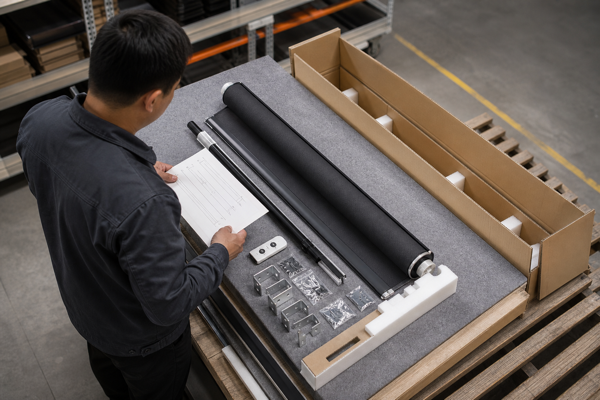
Safety duties do not move with the factory
Product safety is part of the sourcing decision. It is not solved by choosing a nearby seller or a well-known factory name.
For the United States, the Consumer Product Safety Commission’s window-covering guidance describes inner-cord requirements for stock and custom products and permanent marking information for finished window coverings. Ask who will map the exact operating system, inner-cord construction, labels, and order identification to the applicable requirement.
For Canada, Health Canada’s guidance states that corded window coverings manufactured, imported, advertised, or sold in Canada are subject to the Canada Consumer Product Safety Act and the Corded Window Coverings Regulations. The guidance also states that industry is responsible for compliance. A foreign factory can provide product and technical information, but the Canadian importer or seller should not assume that factory location transfers that responsibility.
Rules can change, and different products may trigger other electrical, radio, labeling, or building requirements. Confirm the current obligations for the final product and destination with a qualified professional when needed.
A hybrid model often gives buyers more control
Local and global sourcing do not have to be exclusive. A practical hybrid model can divide the work according to who is best placed to control it:
- A local designer or installer surveys the openings and records site conditions.
- The buyer and factory approve a written product schedule and finished dimensions.
- The factory develops samples, produces the approved construction, inspects it, and prepares packing and shipment information.
- A freight provider or courier handles the agreed transport and border handoff.
- A local installer receives the cartons, checks the parts, installs the treatments, and reports any issue against the approved records.
This model adds coordination, but it keeps site-dependent work close to the window and production-dependent work close to the factory. It is often more realistic than asking one distant company to control a wall it has never seen or asking a local installer to recreate an undocumented factory specification.
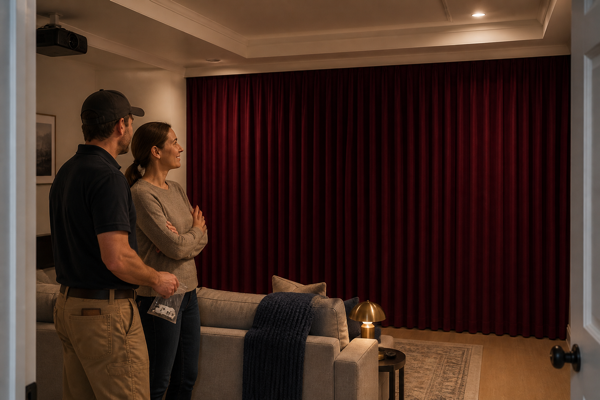
MOQ, lead time, and service questions to ask
MOQ and lead time are configuration questions. One number rarely applies to every product, color, size, motor, carton, and label version. Ask for MOQ by SKU and identify which materials can share a minimum.
Separate the schedule into measurement, quotation, sample approval, material readiness, production, inspection, international transit, customs handoff, and local installation. ShadeCort’s custom window treatment lead time guide explains why a production estimate is not the same as an installed date.
Service also needs a route. Confirm which spare brackets, controls, remotes, motors, or fabric can ship with the first order. Write down who diagnoses an issue, who authorizes a replacement, who pays freight, and whether a local technician can complete the repair.
Watch: measure before comparing quotes
Measurement errors can erase the advantage of either sourcing model. Watch ShadeCort’s measuring guide before requesting the final quote, then confirm the instructions for the exact product and inside- or outside-mount condition.
Watch the ShadeCort measuring guide on YouTube.
Open the ShadeCort measuring guide on YouTube if the player is unavailable.
A practical ShadeCort sourcing process
- Send the room type, product type, rough dimensions, quantity, destination, target date, and photographs of the openings.
- State what must remain local, such as final measurement, electrical work, import clearance, installation, or service calls.
- Define the factory scope: finished product, fabric, rails, brackets, controls, labels, instructions, spare parts, and packaging.
- Approve material samples and one representative finished sample before production when the order risk justifies it.
- Compare the total landed and installed cost with the local alternative using the same assumptions.
- Freeze dimensions, components, color references, packaging, inspection points, and change control in writing.
- Confirm carton data, shipment terms, receiving checks, and the local installation handoff before dispatch.
ShadeCort can review the factory-side brief and discuss custom shades, curtains, manual or motorized options, samples, packaging, and shipment information subject to the exact quotation. The buyer should appoint the people responsible for destination compliance, customs, site measurement, and installation.
Buyer checklist before choosing local, global, or hybrid sourcing
- Both quotes cover the same product construction and finished dimensions.
- Measurement responsibility and deduction rules are written.
- Fabric, color, hardware, control method, and component finishes are identified.
- MOQ is stated by product, color, motor, label, and packaging version.
- The schedule includes approval, production, transit, border, and installation stages.
- Freight, duties, taxes, brokerage, local delivery, and installation are included or clearly excluded.
- U.S. or Canadian safety, marking, instruction, and documentation responsibilities are assigned.
- Samples, inspection criteria, change control, spares, remakes, and service routes are agreed.
- The local installer has drawings, hardware details, and receiving instructions before the cartons arrive.
Request a factory-side sourcing review
Send ShadeCort your window schedule, photographs, destination, preferred product, control method, quantity, target date, and the services already covered locally. Contact ShadeCort to request a factory-side scope, sample plan, and quotation that you can compare with the local option on the same basis.
Sources and further reading
- NIST Manufacturing Extension Partnership: Supply Chain Management
- U.S. Consumer Product Safety Commission: Window Coverings 15(j) Rule Business Guidance
- Health Canada: Corded Window Coverings Regulations guidance
- U.S. Customs and Border Protection: Duty, taxes, and other fees
- Canada Border Services Agency: Importing casual goods by courier
FAQ
Is local sourcing always faster for custom window treatments?
No. A local supplier can be faster when material, labor, and installation capacity are available, especially for one-off replacements. A busy local shop or a product assembled from imported parts may take longer. Compare the confirmed installed date, including measurement and installation, rather than assuming that geography determines the schedule.
Is global sourcing always cheaper?
No. A factory price can be lower while the installed cost is higher after samples, freight, duties, taxes, brokerage, local labor, and replacement risk. Global sourcing is easier to justify when the order has enough repetition, customization, or volume to absorb the added coordination.
When should a homeowner buy from a local supplier?
Local service is often useful for one or two windows, urgent replacements, unusual openings, difficult access, or buyers who want one company to measure, supply, and install. Request a written scope so you know whether the seller also covers removal, adjustment, and follow-up visits.
Can a U.S. or Canadian buyer order custom shades directly from China?
Yes, subject to the supplier’s order terms and the buyer’s ability to manage measurement, payment, transport, import, destination requirements, and installation. A direct order is not automatically suitable for every home. Start with a controlled specification and a total-cost comparison.
Who pays customs duties, taxes, and brokerage fees?
The agreed shipping term and sales contract should identify the responsible party, but border authorities apply their own rules. Ask for the Incoterm or delivery basis, importer of record, estimated duties and taxes, courier or broker fees, and final-delivery scope before paying a deposit.
What should I send ShadeCort for a useful comparison quote?
Send the product type, rough and final dimensions, inside or outside mount, quantity, fabric or light-control goal, manual or motorized operation, destination, packaging needs, target date, and the local services already arranged. Photographs and a room-by-room schedule help expose missing scope before sampling.