Quick Answer
Single sourcing means choosing one window-treatment supplier even though qualified alternatives exist. Sole sourcing means only one supplier can meet the requirement, perhaps because it controls a unique fabric, compatible component, tooling, design, or approved construction. One source can simplify sampling, color control, hardware coordination, and communication. It also creates a concentration risk. Before committing, buyers should measure how long a replacement source would take to qualify, keep ownership of specifications and approvals, and decide whether a tested backup is worth the extra sampling, MOQ, and management cost.

Who is this guide for?
This guide is for U.S. and Canadian homeowners managing a large custom order, interior designers, small window-covering dealers, e-commerce brands, contractors, and project buyers. The order may cover one home, several rental units, a small hospitality project, or a repeat product line.
The question is the same: should one factory control the entire window-treatment package, or should the buyer qualify a second source?
For a one-time set of custom shades, two factories can create more work than protection. For a dealer planning repeat orders, however, a second qualified source may be useful. The correct answer depends on switching time, product complexity, volume, and the cost of a missed delivery.
Why can one supplier become a costly failure point?
A buyer may approve a fabric and hardware set, place every size with one supplier, and plan installation around one delivery. Then a component changes, the selected cloth runs out, or production capacity tightens. A second factory found at that moment is not yet a backup.
The new factory may need fresh samples, new color approval, revised brackets, another motor integration, new packaging tests, and a separate production slot. Even if it can make a similar product, “similar” may not match an existing room or previous batch.
NIST warns manufacturers to watch key materials obtained from a single source. Its supply-chain guidance also treats poor quality, raw-material delay, limited capacity, and transport constraints as possible bottlenecks. For window treatments, those risks appear as mismatched dye lots, incompatible rails, unavailable motors, delayed long cartons, or replacement shades that do not match the first installation.
What is single sourcing?
Single sourcing is a deliberate buyer choice. Several suppliers could make the product, but the buyer places the requirement with one of them.
The Chartered Institute of Procurement and Supply defines single sourcing in the same way: an organization chooses one supplier even when others are available. A buyer might choose this model after comparing quotations, samples, factory evidence, product fit, communication, and total cost.
For custom window treatments, the reason is often consistency. One factory can work from one measurement schedule, one approved sample, one fabric reference, one component list, and one packaging plan. The buyer also has one place to resolve a problem.
However, the choice should remain reviewable. A single-source relationship is stronger when the buyer retains complete specifications and periodically checks market alternatives.
What is sole sourcing?
Sole sourcing is different because the buyer has no equivalent qualified alternative for that exact requirement. CanadaBuys describes a sole source as a good or service available from only one supplier. In U.S. federal procurement, Acquisition.gov uses the phrase for buying after soliciting and negotiating with one source. These public-procurement definitions are not rules for a private curtain order, but they show the core distinction: availability, not preference.
In window treatments, a true sole-source situation may arise when:
- An existing building must use a proprietary control system or compatible replacement motor.
- A repeat order must match a discontinued fabric, finish, or approved component that only one supplier still holds.
- A designer specifies a protected pattern, unique weave, or exclusive material.
- A project approval names one exact tested construction and changing it would trigger new review.
- Only one factory has the tooling or engineering needed for an unusual window shape or system.
Do not call a favorite supplier a sole source merely because switching feels inconvenient. First, describe the requirement clearly and test whether another qualified supplier can meet it.
Single vs sole sourcing: what changes for a window-treatment buyer?
| Decision point | Single sourcing | Sole sourcing | Dual or backup sourcing |
|---|---|---|---|
| Supplier choice | Buyer selects one from several capable options | Only one qualified source meets the exact need | Two suppliers are qualified, or one primary source and one approved backup are maintained |
| Main benefit | Consistent execution and simpler coordination | Access to a unique or compatible product | Better continuity if one source is disrupted |
| Main risk | Buyer may become dependent and stop benchmarking | Weak leverage and no immediate substitute | More sampling, smaller split volumes, and more management work |
| Color and component control | One source can manage one approved standard | Match depends on the unique source | Both sources must be tested against the same controlled standard |
| MOQ effect | Volume is concentrated, which may help meet factory minimums | Supplier terms may be difficult to change | Each supplier may require its own MOQ or setup quantity |
| Switching time | Alternatives exist, but still need qualification | Replacement may require redesign or reapproval | Faster only if the second source was qualified before the disruption |
| Best fit | Custom packages where consistency matters and recovery time is acceptable | Proprietary, exclusive, or technically unique requirements | Repeat programs where a missed supply would cost more than maintaining a backup |

When does single sourcing make sense?
Single sourcing can be sensible when the order is custom, moderate in volume, and difficult to split cleanly. It is often the practical choice for a homeowner, designer, or small dealer ordering one coordinated package.
The products must match across rooms
One source can control the approved fabric, header, fullness, bottom finish, track, control side, and packaging references. This matters when a living room, bedroom, and adjoining space should look like one project.
The buyer has limited volume
Splitting a small order may push both suppliers below practical MOQs. It can also double sample, freight, and administration costs. Concentrating the volume may be more efficient, provided the buyer understands the recovery risk.
The package combines several coordinated items
A project may include drapery, roller shades, cellular shades, tracks, brackets, motors, remotes, and spare parts. One capable factory can coordinate interfaces more easily than several independent suppliers, especially when one measurement schedule controls the package.
The buyer can tolerate a planned recovery period
A one-time residential order usually does not need the same redundancy as a national retail program. Instead, the buyer may protect the order with approved samples, spare components, production updates, and a clear remedy process.
When should a buyer qualify a second source?
A second source is worth considering when one disruption could stop sales, delay several installations, or leave customers without replacements.
NIST’s recent resilience guidance identifies limited supplier diversification as a risk, particularly for important materials or components. Still, “use two suppliers” is not a complete plan. The second source must be capable of making the same usable product.
Consider a qualified backup when:
- The program repeats monthly or seasonally.
- A dealer promises replacement parts or matching follow-on orders.
- One fabric, motor, or rail is critical to many SKUs.
- A missed delivery would stop a project or create substantial customer refunds.
- Demand may exceed one supplier’s confirmed capacity.
- The product can be divided without creating visible inconsistency.
For example, a buyer might keep decorative drapery with one source to protect color continuity but qualify a second supplier for a standard roller-shade line. Another buyer may keep one primary source for production and approve only critical spare components from a backup.

What does a real backup supplier cost?
A backup source is not free insurance. It needs commercial and technical work before it can help.
Sampling and approval
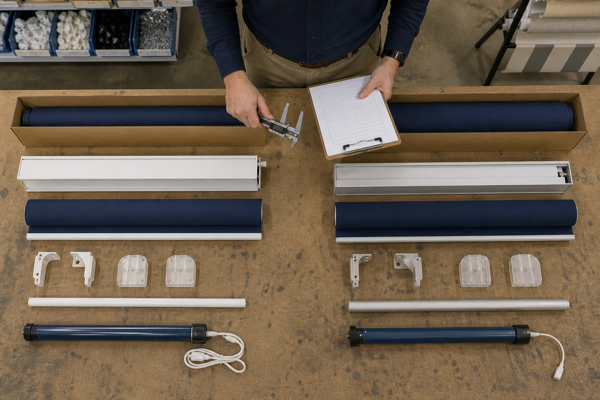
The second supplier needs the same drawing, measurement rules, bill of materials, fabric reference, control specification, labels, and packaging brief. The buyer then pays for samples and reviews the result. Our window shade specification sheet explains the details that must stay controlled before production.
MOQ and price
Two small orders may cost more than one larger order. Each supplier may apply its own MOQ, setup charge, packaging minimum, component price, or color minimum. Therefore, compare total landed and management cost, not only unit price.
Time and attention
The backup must remain current. If the primary source changes a bracket, motor, fabric, or carton design, the controlled specification must show that change. Otherwise, the second source is qualifying an old product.
Unequal product performance
Even when dimensions match, the two sources may use different rollers, tracks, tapes, linings, control speeds, or sewing tolerances. Run a focused functional and visual comparison. The custom curtain quality-control checklist gives buyers a stage-by-stage inspection framework.
How can buyers reduce risk while keeping one primary supplier?
Most buyers do not need to split every order. They do need a recovery plan. Start with the following controls.
Keep a buyer-owned specification pack
Store the final dimensions, drawings, fabric and color references, approved sample photos, bill of materials, hardware, control logic, labels, packaging, and revision history. Do not leave the only complete record inside a messaging thread or one supplier’s system.
Approve a physical master sample
The master sample becomes the reference for color, construction, operation, finish, and packing. Record who holds it and how long it remains valid. For a repeat program, keep a sealed duplicate when practical.
Define change control
Require written approval before the supplier changes a fabric, lining, rail, motor, bracket, remote, battery, label, or carton construction. A small component substitution can affect fit, appearance, safety review, or replacement compatibility.
Buy proportionate spares
Critical brackets, carriers, end caps, remotes, and motors may be cheaper to hold than to reproduce quickly. Select spares from the actual product and expected service need. Avoid buying random components that do not match the installed system.
Review capacity and lead time before peak demand
Ask the supplier which materials are stocked, which are made to order, and which parts come from sub-suppliers. Then compare the production plan with your installation or sales calendar. The custom window-treatment lead-time guide explains where approvals, materials, production, inspection, freight, and installation can add time.
Set a trigger for backup qualification
Do not wait for a missed shipment. Define a trigger such as repeated quality failures, missed milestones, a major price change, loss of a critical component, rising volume, or an unacceptable recovery-time estimate.
How can ShadeCort support a single-source or backup-source plan?
ShadeCort can be evaluated as a primary window-treatment factory, a source for a defined product family, or a candidate in a buyer’s backup plan. The correct role depends on the product and order scope.
Subject to the confirmed project brief, our team can review:
- Custom shade categories and coordinated drapery requirements.
- Drawings, finished sizes, mount details, operating method, fabrics, components, motors, and packaging.
- Approved-sample requirements and the records needed to compare sample with production.
- Spares, replacements, component continuity, and change-control questions.
- Factory-side production, inspection, packing, and shipment information within the agreed order scope.
We do not ask a buyer to treat ShadeCort as a sole source without evidence. Instead, send the product schedule and risk concerns. We can identify what we can make, what needs sampling, which inputs require confirmation, and where a second source may create compatibility or batch-matching work.
Watch: lock measurements before selecting the sourcing model
An incorrect measurement creates problems no supplier strategy can solve. Watch ShadeCort’s measuring guide before finalizing the specification pack. Then make sure every approved source uses the same mount method, deduction rule, control side, and finished-size convention.
Open the ShadeCort Measuring Guide on YouTube if the player is unavailable.
A buyer checklist before committing volume
- Is this truly a sole-source requirement, or are we choosing a single source?
- Which approved fabric, component, motor, tooling, or design creates dependency?
- How many weeks would a new supplier need to sample, revise, approve, and produce?
- Which rooms, SKUs, or projects must match the existing batch exactly?
- Can the order be divided without visible or functional differences?
- What drawings, samples, BOMs, and revisions does the buyer own?
- Which spares would shorten recovery?
- What event will trigger backup qualification or market benchmarking?
- Who approves component or material changes?
- What is the cost of a missed delivery compared with the cost of maintaining a second source?
Common sourcing mistakes
Calling a preferred supplier a sole source
Preference is not exclusivity. Define the technical requirement and test the market before accepting that only one source exists.
Splitting an order before the specification is stable
Two factories cannot match a moving target. Freeze the product definition first, then qualify both sources against the same revision.
Treating an untested quotation as a backup
A price and a sample photo do not prove interchangeability. Approve the actual construction, operation, packaging, and production evidence.
Chasing a lower unit price while doubling hidden cost
Extra sampling, separate MOQs, small freight lots, inspection, stock segregation, and customer-service complexity can erase the price difference.
Letting the supplier own the only complete specification
Without buyer-owned records, switching becomes slower and more expensive. Keep the current specification pack, approvals, and revision history accessible.
Request a sourcing-risk review
Send ShadeCort your product type, approximate quantities, destination, repeat-order plan, current specification, and the failure you most need to avoid. We can review whether the package suits one coordinated factory, where a backup may make sense, and what should be sampled before you commit.
Contact ShadeCort to request a specification and sourcing-risk review.
Sources and further reading
- CIPS: Single sourcing vs. sole sourcing
- CanadaBuys Supply Manual glossary: Sole source
- Acquisition.gov FAR Part 2 definitions
- NIST: Supply-chain risk management strategies for smaller manufacturers
- NIST: Building resilient supply chains
FAQ
Is single sourcing the same as sole sourcing?
No. With single sourcing, other qualified suppliers exist, but the buyer chooses one. With sole sourcing, only one supplier can meet the exact requirement. The difference matters because a single-source buyer can prepare alternatives, while a sole-source buyer may need to redesign, reapprove, or change the requirement to create another option.
Is one supplier always risky for custom curtains and shades?
No. One supplier can simplify communication and improve control over matching fabrics, dimensions, hardware, and packaging. The risk depends on the cost of failure and the time needed to recover. A one-time home project may use one source with clear specifications and spares. A repeat dealer program may justify a qualified backup.
Does dual sourcing mean splitting every order 50/50?
No. A buyer can use one primary supplier and place a small validation order with a backup. The split may also apply only to a standard product family or critical component. The goal is usable continuity, not an arbitrary equal share.
Can two factories make exactly the same curtain color?
They can work to one approved standard, but exact visual matching is not automatic. Fabric mill, dye lot, texture, lining, sewing, fullness, and lighting all affect appearance. Buyers should approve physical samples and keep batch references. For highly visible adjoining rooms, one production source is usually easier to control.
What should a buyer give a backup supplier?
Provide the current drawing, dimensions, measurement rules, approved sample, bill of materials, fabric and color references, hardware, controls, labels, packaging, test or compliance requirements, and revision history. Then inspect the backup sample against the same acceptance criteria used for the primary source.
How often should a single-source supplier be reviewed?
Review the relationship when volume, product design, materials, destination requirements, lead time, quality performance, or switching cost changes. Repeat programs can also set a scheduled commercial and technical review. The frequency should match the consequence of a disruption rather than a fixed calendar rule.